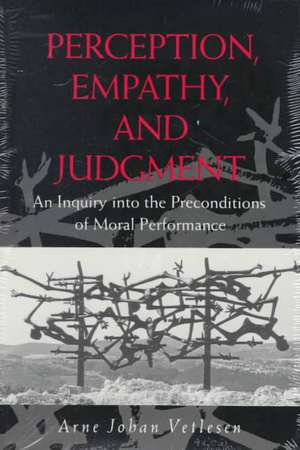
Perception, Empathy, and Judgment
Autor Arne Johan Vetlesenen Limba Engleză Paperback – 1994
In the powerful tradition from Kant to present-day theorists such as Kohlberg, Rawls, and Habermas, reason is privileged over feeling and judgment over perception, in such a way that basic philosophical questions remain unasked. Vetlesen focuses our attention on these questions and challenges the long-standing assertion that emotions are damaging to moral response. In the final chapter he relates his argument to recent feminist critiques that have also castigated moral theorists in the Kantian tradition for their refusal to recognize a role for emotion in morality.
While the book's argument is philosophical, its method and scope are interdisciplinary. In addition to critiques of such philosophers as Arendt, MacIntyre, and Habermas, it contains discussions of specific historical, ideological, and sociological factors that may cause "numbing" selective or broad-ranging, pathological insensitivity in humans. The Nazis' mass killing of Jews is studied to illuminate these and other relevant empirical aspects of large-scale immoral action."
Preț: 340.25 lei
Puncte Express: 510
Carte tipărită la comandă
Livrare economică 23 noiembrie-07 decembrie
Livrare prin curier în România Termenul estimat este afișat lângă disponibilitate.
Transport gratuit de la 400.00 lei Plată online sau ramburs, în funcție de opțiunile comenzii.
Retur gratuit în 14 zile Comandă securizată și suport în română.
Specificații
ISBN-13: 9780271010120
ISBN-10: 0271010126
Pagini: 408
Dimensiuni: 152 x 229 x 25 mm
Greutate: 0.66 kg
Ediția:New.
Editura: Pennsylvania State University Press
ISBN-10: 0271010126
Pagini: 408
Dimensiuni: 152 x 229 x 25 mm
Greutate: 0.66 kg
Ediția:New.
Editura: Pennsylvania State University Press
V-ar putea interesa
-
 -27%Preț: 385.15 lei530.97 lei
 -
 The Limits of MoralityShelly Kagan-28%Preț: 375.37 lei521.29 lei
 -
 Meaning and NormativityAllan Gibbard-20%Preț: 304.40 lei382.87 lei
 -
 -14%Preț: 298.16 lei346.58 lei
 -
 Oxford Studies Normative Ethics, Volume 4Mark Timmons-11%Preț: 322.32 lei363.46 lei
 -
 Tainted: How Philosophy of Science Can Expose Bad ScienceKristin Shrader-Frechette-31%Preț: 634.19 lei919.42 lei
 -
 -31%Preț: 629.54 lei911.18 lei
 -
 After VirtueAlasdair MacintyrePreț: 238.15 lei
 -
 Moral Relativism, Moral Diversity, and Human RelationshipsJames KellenbergerPreț: 376.17 lei
 -
 A Civil TongueMark KingwellPreț: 276.35 lei
 -
 Freedom's EmbraceJ. Melvin WoodyPreț: 279.03 lei
 -
 The Roots of MoralityMaxine Sheets-JohnstonePreț: 337.32 lei
 -
 Reconstructing RawlsRobert S. TaylorPreț: 382.94 lei
 -
 Preț: 308.50 lei
 -
 The Denial of Nature: Environmental philosophy in the era of global capitalismArne Johan Vetlesen-18%Preț: 1303.58 lei1589.74 lei
 -
 Evil and Human AgencyArne Johan VetlesenPreț: 415.93 lei
 -
 Well-BeingBen BradleyPreț: 145.15 lei
 -
 Moral PsychologyMark AlfanoPreț: 147.77 lei
 -
 The Denial of Nature: Environmental philosophy in the era of global capitalismArne Johan VetlesenPreț: 439.28 lei
 -
 Love and LiesClancy MartinPreț: 49.31 lei
 -
 LyingSam HarrisPreț: 91.32 lei
Textul de pe ultima copertă
This book is a study in moral theory. Its subject is the relation between morality and emotions. The account of moral performance advanced here has epistemological implications because in speaking of moral perceptions and judgment we need to know how the moral agent gains access to that over which perception and judgment are exercised.
Notă biografică
Arne Johan Vetlesen, whose dissertation was supervised by Jürgen Habermas, is Research Fellow in Philosophy at the University of Oslo.