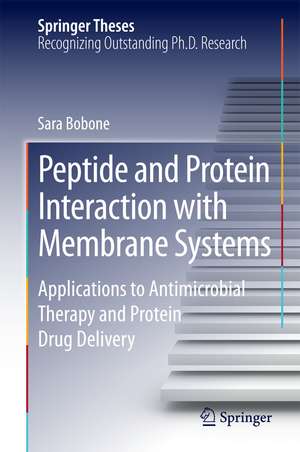
Peptide and Protein Interaction with Membrane Systems: Springer Theses
Autor Sara Boboneen Limba Engleză Hardback – 24 iun 2014
Din seria Springer Theses
- 18%
 Preț: 906.80 lei
 - 15%
 Preț: 617.28 lei
 - 15%
 Preț: 638.81 lei
 - 18%
 Preț: 1015.11 lei
 -
 Preț: 391.04 lei
 - 18%
 Preț: 1072.78 lei
 - 18%
 Preț: 972.22 lei
 - 18%
 Preț: 1182.27 lei
 -
 Preț: 393.91 lei
 -
 Preț: 375.86 lei
 - 18%
 Preț: 1076.54 lei
 -
 Preț: 384.20 lei
 - 18%
 Preț: 1352.59 lei
 - 18%
 Preț: 1348.61 lei
 - 18%
 Preț: 1068.71 lei
 - 18%
 Preț: 972.16 lei
 - 15%
 Preț: 650.72 lei
 - 15%
 Preț: 642.59 lei
 - 18%
 Preț: 1078.31 lei
 -
 Preț: 373.40 lei
 - 15%
 Preț: 623.27 lei
 -
 Preț: 374.23 lei
 - 15%
 Preț: 614.78 lei
 - 15%
 Preț: 619.58 lei
 - 15%
 Preț: 620.03 lei
 - 18%
 Preț: 964.49 lei
 - 15%
 Preț: 619.14 lei
 - 18%
 Preț: 1172.17 lei
 - 18%
 Preț: 973.50 lei
 - 18%
 Preț: 1080.53 lei
 - 18%
 Preț: 1186.50 lei
 - 18%
 Preț: 960.54 lei
 - 15%
 Preț: 617.77 lei
 - 18%
 Preț: 1345.25 lei
 - 18%
 Preț: 918.64 lei
 - 15%
 Preț: 618.91 lei
 - 18%
 Preț: 999.32 lei
 - 18%
 Preț: 1172.94 lei
 - 15%
 Preț: 621.42 lei
 - 15%
 Preț: 624.65 lei
 - 15%
 Preț: 644.88 lei
 - 18%
 Preț: 749.08 lei
 -
 Preț: 390.55 lei
 -
 Preț: 373.68 lei
 - 18%
 Preț: 1067.54 lei
 - 18%
 Preț: 759.82 lei
 - 15%
 Preț: 614.32 lei
 - 15%
 Preț: 618.21 lei
 - 15%
 Preț: 615.02 lei
 - 15%
 Preț: 639.92 lei
Preț: 631.06 lei
Preț vechi: 769.59 lei
-18%
Puncte Express: 947
Carte disponibilă
Livrare economică 28 octombrie-11 noiembrie
Livrare express 14-20 octombrie pentru 30.94 lei
Livrare prin curier în România Termenul estimat este afișat lângă disponibilitate.
Transport gratuit pentru acest produs Plată online sau ramburs, în funcție de opțiunile comenzii.
Retur gratuit în 14 zile Comandă securizată și suport în română.
Specificații
ISBN-13: 9783319064338
ISBN-10: 3319064339
Pagini: 156
Ilustrații: XIII, 140 p. 94 illus., 18 illus. in color.
Dimensiuni: 160 x 241 x 15 mm
Greutate: 0.41 kg
Ediția:2014
Editura: Springer
Colecția Springer Theses
Seria Springer Theses
Locul publicării:Cham, Switzerland
ISBN-10: 3319064339
Pagini: 156
Ilustrații: XIII, 140 p. 94 illus., 18 illus. in color.
Dimensiuni: 160 x 241 x 15 mm
Greutate: 0.41 kg
Ediția:2014
Editura: Springer
Colecția Springer Theses
Seria Springer Theses
Locul publicării:Cham, Switzerland
V-ar putea interesa
-
 A Tale of Seven ElementsEric Scerri-24%Preț: 215.57 lei283.85 lei
 -
 Electroplating and Related ProcessesJ. B. Mohler-9%Preț: 703.30 lei772.85 lei
 -
 -9%Preț: 806.83 lei886.62 lei
 -
 The Chemical Analysis of WaterD. T. E. Hunt-11%Preț: 603.65 lei678.27 lei
 -
 Analytical Chemistry Refresher ManualJohn Kenkel-18%Preț: 799.03 lei974.44 lei
 -
 Essential Forensic Biology 3eAlan Gunn-23%Preț: 449.91 lei584.29 lei
 -
 Validation of Tablet Coating PanMS Azra SameemPreț: 116.12 lei
 -
 The Toxicity of CaffeinMR John Benjamin RiegerPreț: 90.64 lei
 -
 Practical Instrumental AnalysisThimmaraju, Dr Manish KumarPreț: 35.41 lei
 -
 Atom-Emissions-SpektrometrieHeinz-Gerd Joosten-9%Preț: 758.11 lei833.09 lei
 -
 -44%Preț: 545.42 lei971.72 lei
 -
 -15%Preț: 618.30 lei727.42 lei
 -
 Handbook of Trace AnalysisIrena Baranowska-15%Preț: 699.01 lei822.37 lei
 -
 Polarographie und VoltammetrieGünter Henze-18%Preț: 753.55 lei918.96 lei
 -
 Quality in Chemical MeasurementsBernd NeidhartPreț: 370.30 lei
 -
 -15%Preț: 425.09 lei500.10 lei
 -
 -15%Preț: 612.05 lei720.07 lei
 -
 Analysis with Supercritical Fluids: Extraction and ChromatographyBernd WenclawiakPreț: 372.46 lei
 -
 Analytical Supercritical Fluid ExtractionMaria D. Luque de CastroPreț: 378.69 lei
 -
 Preț: 399.39 lei
 -
 Preț: 395.32 lei
 -
 Electroanalytical MethodsS. RaniPreț: 102.77 lei
Public țintă
ResearchCuprins
Overview.- Antimicrobial Peptides: Mechanism of Action, Selectivity and Biological Activity.- Introduction.- Techniques.- Materials and Methods.- Results and Discussion.- Hydrogel Nanoparticles for Enzyme-Based Therapies.- Introduction.- Materials and Methods.- Results and Discussion.- Concluding Remarks.
Notă biografică
I received my M.Sc. Degree in Chemistry magna cum laude from the University of Rome "Sapienza". After the degree, I moved to Tor Vergata, where I won a fellowship for PhD students in Chemical Sciences, under the supervision of Prof. L. Stella. I defended my thesis in 2013 and then continued my work as a postdoctoral fellow. The thesis was awarded the 2012-2013 "Premio Semerano" by the Italian Chemical Society, as the best Italian PhD Physical Chemistry Thesis. The thesis work led to the publication of 7 papers on international journals and to the participation to 13 international and national conferences.
Textul de pe ultima copertă
In her thesis, Sara Bobone outlines spectroscopic studies of antimicrobial peptides (AMPs) which are promising lead compounds for drugs used to fight multidrug resistant bacteria. Bobone shows that AMPs interact with liposomes and she clarifies the structure of pores formed by one of these molecules. These results help us to understand how AMPs are selective for bacterial membranes and how their activity can be finely tuned by modifying their sequence. Findings which solve several conundrums debated in the literature for years. In addition, Bobone uses liposomes as nanotemplates for the photopolymerization of hydrogels - exploiting the self-
assembly properties of phospholipids. Bobone was able to trap an enzyme using nanometeric particles, while still allowing its activity by the diffusion of substrates and products through the network of the polymer. The innovative nanodevices described in this thesis could solve many of the hurdles still hampering the therapeutic application of protein-based drugs.
assembly properties of phospholipids. Bobone was able to trap an enzyme using nanometeric particles, while still allowing its activity by the diffusion of substrates and products through the network of the polymer. The innovative nanodevices described in this thesis could solve many of the hurdles still hampering the therapeutic application of protein-based drugs.
Caracteristici
Nominated as an outstanding Ph.D. thesis by the University of Rome Tor Vergata, Italy Selected as the as the best Italian Ph.D. Physical Chemistry Thesis 2012-2013 by the Italian Chemical Society Provides a comprehensive but accessible introduction to both antimicrobial peptides and protein-based drugs: two hot areas in biomolecular pharmaceutics Presents numerous examples of the use of fluorescence spectroscopy to characterize peptide and protein interaction with lipid membranes, which provide a good starting point for the novice in this field Includes supplementary material: sn.pub/extras