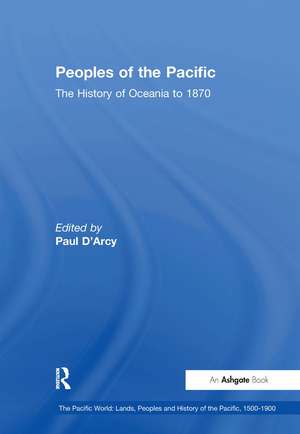
Peoples of the Pacific: The History of Oceania to 1870: The Pacific World: Lands, Peoples and History of the Pacific, 1500-1900
Editat de Paul D'Arcyen Limba Engleză Hardback – 17 iun 2008
Din seria The Pacific World: Lands, Peoples and History of the Pacific, 1500-1900
- 14%
 Preț: 1251.78 lei
 - 39%
 Preț: 1081.30 lei
 - 31%
 Preț: 1080.85 lei
 - 32%
 Preț: 1397.53 lei
 - 41%
 Preț: 707.74 lei
 - 32%
 Preț: 1397.12 lei
 - 33%
 Preț: 1051.29 lei
 - 31%
 Preț: 1081.37 lei
 - 32%
 Preț: 1285.01 lei
 - 36%
 Preț: 372.75 lei
 - 33%
 Preț: 1109.76 lei
 - 31%
 Preț: 1254.52 lei
 - 33%
 Preț: 1053.39 lei
 - 31%
 Preț: 1081.54 lei
 - 31%
 Preț: 1081.37 lei
 - 32%
 Preț: 1227.82 lei
Preț: 1632.82 lei
Preț vechi: 2385.65 lei
-32% Nou
Puncte Express: 2449
Preț estimativ în valută:
288.94€ • 338.81$ • 253.74£
288.94€ • 338.81$ • 253.74£
Comandă specială
Livrare economică 14-28 ianuarie 26
Doresc să fiu notificat când acest titlu va fi disponibil:
Se trimite...
Preluare comenzi: 021 569.72.76
Specificații
ISBN-13: 9780754662211
ISBN-10: 0754662217
Pagini: 550
Dimensiuni: 174 x 246 mm
Greutate: 1.27 kg
Ediția:1
Editura: Taylor & Francis
Colecția Routledge
Seria The Pacific World: Lands, Peoples and History of the Pacific, 1500-1900
Locul publicării:Oxford, United Kingdom
ISBN-10: 0754662217
Pagini: 550
Dimensiuni: 174 x 246 mm
Greutate: 1.27 kg
Ediția:1
Editura: Taylor & Francis
Colecția Routledge
Seria The Pacific World: Lands, Peoples and History of the Pacific, 1500-1900
Locul publicării:Oxford, United Kingdom
Cuprins
Contents: Introduction; Part 1 Exploring and Colonising Oceania: The birth of new lands, after the creation of Havai'i (Raiatea), Teuira Henry; 'Expanding' the target in indigenous navigation, David Lewis; Voyaging, Ben R. Finney; The colonisation of the Pacific plate: chronological, navigational and social issues, Geoffrey Irwin. Part 2 Historical Dynamics of Island Societies: Ecological Adaptations: Man's role in modifying tropical and sub-tropical Polynesian ecosystems, P.V. Kirch; Man and the sea in early Tahiti: a maritime economy through European eyes, Gordon R. Lewthwaite; The Ipomoean revolution revisited: society and the sweet potato in the upper Waghi valley, Jack Golson; Social and Political Evolution: The value of traditions in Polynesian research, Te Rangi Hiroa (P.H. Buck); Understanding Polynesian traditional history, Niel Gunson; Oral traditions among the Binandere: problems of method in a Melanesian society, John D. Waiko; Status rivalry and cultural evolution in Polynesia, Irving Goldman; Chimbu tribes: political organization in the Eastern highlands of New Guinea, Paula Brown; Regional Histories: The war of Tonga and Samoa and the origin of the name Malietoa, Samuel Ella (trans.); Exchange patterns in goods and spouses: Fiji, Tonga and Samoa, Adrienne L. Kaeppler; Kula: the circulating exchange of valuables in the archipelagoes of Eastern New Guinea, B. Malinowski; The place of Ulithi in the Yap empire, William A. Lessa; Yapese politics, Yapese money and the Sawei tribute network before World War I, M.L. Berg. Part 3 Culture Contact: The stranger-king or Dumézil among the Fijians, Marshall Sahlins; Institutions of violence in the Marquesas, Greg Dening; European-Polynesian encounters: a critique of the Pearson thesis, I.C. Campbell; From conversion to conquest: the early Spanish mission in the Marianas, Francis X. Hezel. Part 4 Responses to Pre-Colonial European Influences: The sandalwood trade in Melanesian economics, 1841-65, Dorothy Shineber
Notă biografică
Paul D'Arcy is Fellow, Division of Pacific and Asian History, Research School of Pacific & Asian Studies, Australian National University.
Descriere
This volume seeks to show that the indigenous inhabitants of the Pacific Islands have a history as dynamic and complex as that of literate societies, and one that is much more retrievable through multidisciplinary approaches than we often perhaps realize. It has three, inter-related objectives: one is to present the history of the inhabitants of the Pacific Islands from first colonization until the spread of European colonial rule in the later 19th century; the second is to present it from the perspective of Pacific Islanders; and the last is to portray the nature of Pacific History as a sub-discipline through a sample of key articles that represent the historical evolution of the field and its multidisciplinary nature.