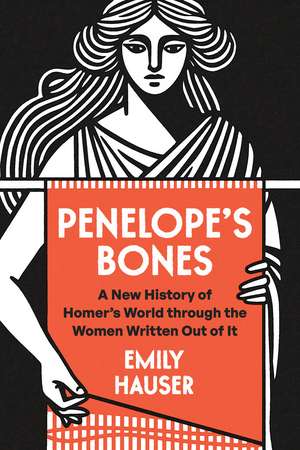
Penelope's Bones: A New History of Homer's World through the Women Written Out of It
Autor Emily Hauseren Limba Engleză Paperback – 4 iun 2026
Achilles. Agamemnon. Odysseus. Hector. The lives of these and many other men in the greatest epics of ancient Greece have been pored over endlessly in the past three millennia. But these are not just tales about heroic men. There are scores of women as well—complex, fascinating women whose stories have gone unexplored for far too long.
In Penelope’s Bones, award-winning classicist and historian Emily Hauser pieces together compelling evidence from archaeological excavations and scientific discoveries to unearth the richly textured lives of women in Bronze Age Greece—the era of Homer’s heroes. Here, for the first time, we come to understand the everyday lives and experiences of the real women who stand behind the legends of Helen, Briseis, Cassandra, Aphrodite, Circe, Athena, Hera, Calypso, Penelope, and more. In this captivating journey through Homer’s world, Hauser explains era-defining discoveries, such as the excavation of Troy and the decipherment of Linear B tablets that reveal thousands of captive women and their children; more recent finds like the tomb of the Griffin Warrior at Pylos, whose tomb contents challenge traditional gender attributes; DNA evidence showing that groups of warriors buried near the Black Sea with their weapons and steeds were, in fact, Amazon-like female fighters; a prehistoric dye workshop on Crete that casts fresh light on “women’s work” of dyeing, spinning, and weaving textiles; and a superbly preserved shipwreck off the coast of Turkey whose contents tell of the economic and diplomatic networks crisscrossing the Bronze Age Mediterranean.
Essential reading for fans of Madeline Miller or Natalie Haynes, this riveting new history brings to life the women of the Bronze Age Aegean as never before, offering a groundbreaking reassessment of the ancient world.
Preț: 131.56 lei
Puncte Express: 197
Carte disponibilă
Livrare economică 14-28 noiembrie
Livrare prin curier în România Termenul estimat este afișat lângă disponibilitate.
Transport gratuit de la 400.00 lei Plată online sau ramburs, în funcție de opțiunile comenzii.
Retur gratuit în 14 zile Comandă securizată și suport în română.
Specificații
ISBN-13: 9780226849218
ISBN-10: 022684921X
Pagini: 496
Ilustrații: 30 color plates, 70 halftones
Dimensiuni: 152 x 229 x 33 mm
Greutate: 0.7 kg
Ediția:First Edition
Editura: University of Chicago Press
Colecția University of Chicago Press
ISBN-10: 022684921X
Pagini: 496
Ilustrații: 30 color plates, 70 halftones
Dimensiuni: 152 x 229 x 33 mm
Greutate: 0.7 kg
Ediția:First Edition
Editura: University of Chicago Press
Colecția University of Chicago Press
Notă biografică
Emily Hauser is a senior lecturer in classics and ancient history at the University of Exeter, UK. She is the author of three novels reimagining the women of Greek myth: For the Most Beautiful, For the Winner, and For the Immortal. She is also the author, most recently, of How Women Became Poets.
Extras
As we dive into Homer’s story, we’re dropped into a world from over three thousand years back, an ancient land burnished to a sheen by legend and filled with a character cast of capricious gods, power-hungry kings and swaggering heroes. Greek citadels perch like crowns on rocky outcrops, each ruled by an overweening lord who spends his time doling out favours in his throne room or sallying abroad to loot gold and capture women, while wives and daughters crowd faceless in the palace shadows. What Homer is describing seems to look back (at least in part) to a real civilization of historical ancient Greeks who lived in the Late Bronze Age, called the Mycenaeans – named (by the archaeologists who discovered them) after the kingdom of Mycenae, one of the most overweening and gold-filled of them all. The ancient Greeks believed that Troy, the Trojan War, as well as the swarming Greek forces who invaded from Mycenae, Pylos and Sparta, were all certifiably, tangibly real: one ancient chronicler even gave the sack of Troy a specific date – 1184 BCE. This is (or at least, so the ancients imagined) the stamping ground of Odysseus, king of Ithaca, sacker of cities, master of disguise. And it’s also the world of Penelope.
Odysseus, so the tale goes, has been gone from Ithaca for nearly twenty years, swashbuckling away in the Trojan War of legend. He’d sworn to Menelaus – king of Sparta, according to Homer, and brother of Agamemnon, king of Mycenae – to protect Helen, Menelaus’ wife, the most beautiful woman in the world and so (naturally, to the lootminded men) a prize ripe for the taking. When Helen had run off with Paris, prince of Troy, Odysseus and the other Greek kings duly banded together to get her back. The legend tells us it took ten years and a siege against Troy, a protracted war of sufficient horror and greatness for one epic poem, centuries later, to be born: Homer’s Iliad. And then there were the exploits of the heroes’ years-long voyage back to Greece – enough to fill another epic, the Odyssey, charting Odysseus’ stunts and scrapes on his way home.
In all this, Odysseus’ wife Penelope lingers in the background, waiting (so the Homeric epics tell us) on rocky Ithaca and fending off her many suitors while Odysseus has all the adventures. At the very beginning of the Odyssey, we meet her coming downstairs from her bedroom to find a bard singing in the palace’s hall about the trials and tribulations of the Greeks on their return from Troy. Not surprisingly, Penelope, who has been spending ten years trying to forget the setbacks Odysseus must be facing, finds this a rather tactless choice of subject. In front of the suitors thronging the palace, all waiting until she finally gives up on Odysseus, she interrupts the bard, who has already struck up his tune, and tells him to sing something else. But it’s not going to be that easy. Penelope’s teenage son, Telemachus, who feels like flexing his authority in front of the other males, stands up and puts his mother in her place: ‘Go in and do your work. Stick to the loom and distaff. Tell your slaves to do their chores as well. It is for men to talk, especially me. I am the master.’ And off Penelope goes.
To all intents and purposes, then, one of the most famous of all the ancient texts, telling one of the most famous ancient legends, begins with something of a mission statement: that women aren’t meant to talk. Nor are they allowed to tell their own stories, their own myths, in their own words. The Greek term Telemachus uses for ‘talking’ is mythos – ‘word’ (it’s where the English ‘myth’ comes from). He essentially says not just ‘words are for men’, but ‘myths are for men’. Both the myths that get told, and the words employed to tell them, are – in this manifesto – a men’s-only zone.
It’s a statement that has, until recently, always been taken at face value – and it’s easy to see why. You can’t read many of the ancient Greek myths, let alone epics like Homer’s, without being told in one way or another that women are meant to be silent – seen and not heard (even better if they’re not seen). In Homer’s war epic, the Iliad, one particularly important woman – a trafficked and raped sex slave called Briseis, who is the reason the whole story exists (but we’ll get to that later) – speaks only once, and gets to say about as much as Achilles’ magical (male) talking horse. When women do try to have their say, then men will quickly close them down: Telemachus’ refusal to hear Penelope out, and to get the poet to tell the story that she’s asked for, is what Mary Beard calls ‘the first recorded example of a man telling a woman to “shut up”’ in Western literature.2 And it’s not just the mortals, either. In the first book of the Iliad, Hera – queen of the gods – gets slapped back (almost literally) by Zeus: when she tries to challenge him, he snaps at her to ‘sit down, be quiet, and do as I say’ (along with the threat of a beating if she doesn’t obey him).3 If the role of women is to shut up, it’s made abundantly clear, meanwhile, that great stories are only meant to be told about the adventures of men like Odysseus. The Odyssey’s opening line makes the instruction to the female Muse (goddess of song and poetry) quite clear: she’s only meant to inspire stories about men. ‘Muse: tell me about a man’, the story begins – where ‘man’ (andra) is the epic’s first word in Greek.4 In these legends of the Greek past, women are put firmly, and ever-so-silently, in the background, and the mythical world is made resolutely male.
But as I sit in my twenty-first-century library with the text of the Odyssey resting against the blinking screen of my open laptop, I wonder if there aren’t different questions to be asked. Is it possible that we might be able to read past Penelope’s shutting up? Can we, as modern historians, instead make space for her to speak for herself? Can we dig deeper into the past to begin to invoke the voices of Homer’s women – beyond, or behind, the tale that we’ve always been told?
Odysseus, so the tale goes, has been gone from Ithaca for nearly twenty years, swashbuckling away in the Trojan War of legend. He’d sworn to Menelaus – king of Sparta, according to Homer, and brother of Agamemnon, king of Mycenae – to protect Helen, Menelaus’ wife, the most beautiful woman in the world and so (naturally, to the lootminded men) a prize ripe for the taking. When Helen had run off with Paris, prince of Troy, Odysseus and the other Greek kings duly banded together to get her back. The legend tells us it took ten years and a siege against Troy, a protracted war of sufficient horror and greatness for one epic poem, centuries later, to be born: Homer’s Iliad. And then there were the exploits of the heroes’ years-long voyage back to Greece – enough to fill another epic, the Odyssey, charting Odysseus’ stunts and scrapes on his way home.
In all this, Odysseus’ wife Penelope lingers in the background, waiting (so the Homeric epics tell us) on rocky Ithaca and fending off her many suitors while Odysseus has all the adventures. At the very beginning of the Odyssey, we meet her coming downstairs from her bedroom to find a bard singing in the palace’s hall about the trials and tribulations of the Greeks on their return from Troy. Not surprisingly, Penelope, who has been spending ten years trying to forget the setbacks Odysseus must be facing, finds this a rather tactless choice of subject. In front of the suitors thronging the palace, all waiting until she finally gives up on Odysseus, she interrupts the bard, who has already struck up his tune, and tells him to sing something else. But it’s not going to be that easy. Penelope’s teenage son, Telemachus, who feels like flexing his authority in front of the other males, stands up and puts his mother in her place: ‘Go in and do your work. Stick to the loom and distaff. Tell your slaves to do their chores as well. It is for men to talk, especially me. I am the master.’ And off Penelope goes.
To all intents and purposes, then, one of the most famous of all the ancient texts, telling one of the most famous ancient legends, begins with something of a mission statement: that women aren’t meant to talk. Nor are they allowed to tell their own stories, their own myths, in their own words. The Greek term Telemachus uses for ‘talking’ is mythos – ‘word’ (it’s where the English ‘myth’ comes from). He essentially says not just ‘words are for men’, but ‘myths are for men’. Both the myths that get told, and the words employed to tell them, are – in this manifesto – a men’s-only zone.
It’s a statement that has, until recently, always been taken at face value – and it’s easy to see why. You can’t read many of the ancient Greek myths, let alone epics like Homer’s, without being told in one way or another that women are meant to be silent – seen and not heard (even better if they’re not seen). In Homer’s war epic, the Iliad, one particularly important woman – a trafficked and raped sex slave called Briseis, who is the reason the whole story exists (but we’ll get to that later) – speaks only once, and gets to say about as much as Achilles’ magical (male) talking horse. When women do try to have their say, then men will quickly close them down: Telemachus’ refusal to hear Penelope out, and to get the poet to tell the story that she’s asked for, is what Mary Beard calls ‘the first recorded example of a man telling a woman to “shut up”’ in Western literature.2 And it’s not just the mortals, either. In the first book of the Iliad, Hera – queen of the gods – gets slapped back (almost literally) by Zeus: when she tries to challenge him, he snaps at her to ‘sit down, be quiet, and do as I say’ (along with the threat of a beating if she doesn’t obey him).3 If the role of women is to shut up, it’s made abundantly clear, meanwhile, that great stories are only meant to be told about the adventures of men like Odysseus. The Odyssey’s opening line makes the instruction to the female Muse (goddess of song and poetry) quite clear: she’s only meant to inspire stories about men. ‘Muse: tell me about a man’, the story begins – where ‘man’ (andra) is the epic’s first word in Greek.4 In these legends of the Greek past, women are put firmly, and ever-so-silently, in the background, and the mythical world is made resolutely male.
But as I sit in my twenty-first-century library with the text of the Odyssey resting against the blinking screen of my open laptop, I wonder if there aren’t different questions to be asked. Is it possible that we might be able to read past Penelope’s shutting up? Can we, as modern historians, instead make space for her to speak for herself? Can we dig deeper into the past to begin to invoke the voices of Homer’s women – beyond, or behind, the tale that we’ve always been told?
Cuprins
Timeline
Maps
Author’s Note
Introduction
Muse: A New Invocation
Iliad: Women in War
1. Helen: The Face
2. Briseis: Slave
3. Chryseis: Daughter
4. Hecuba: Queen
5. Andromache: Wife
6. Cassandra: Prophet
7. Aphrodite and Hera: Seducer and Matriarch
8. Thetis: Mother
9. Penthesilea: Warrior
Odyssey: Women at Home and Away
10. Athena: Shapeshifter
11. Calypso: Weaver
12. Nausicaa: Bride
13. Arete: Host
14. Circe: Witch
15. Eurycleia: Handmaid
16. Penelope: The End
Coda
Aegea : A New History
List of Characters and Glossary
Notes
Bibliography
Acknowledgements
Chapter-Opening Illustrations
Picture Acknowledgements
Text Acknowledgements
Index
Maps
Author’s Note
Introduction
Muse: A New Invocation
Iliad: Women in War
1. Helen: The Face
2. Briseis: Slave
3. Chryseis: Daughter
4. Hecuba: Queen
5. Andromache: Wife
6. Cassandra: Prophet
7. Aphrodite and Hera: Seducer and Matriarch
8. Thetis: Mother
9. Penthesilea: Warrior
Odyssey: Women at Home and Away
10. Athena: Shapeshifter
11. Calypso: Weaver
12. Nausicaa: Bride
13. Arete: Host
14. Circe: Witch
15. Eurycleia: Handmaid
16. Penelope: The End
Coda
Aegea : A New History
List of Characters and Glossary
Notes
Bibliography
Acknowledgements
Chapter-Opening Illustrations
Picture Acknowledgements
Text Acknowledgements
Index
Recenzii
“A riveting narrative of the female figures of Homer’s Iliad and Odyssey . . . A close study of the epic poems, a meditation on the lives of women then and now, an engaging history of scholarship, and an overview of the archaeology of the Bronze Age Aegean and beyond. Written with a novelist’s flair, Penelope’s Bones, with its linked chapters, makes for a surprising page-turner.”
"Like the song of the Sirens, Penelope’s Bones tugs powerfully at its readers, an echoing summons from beyond the horizon. Hauser merges flawless aesthetic intuition about the Homeric epics with a superb command of scientific approaches to Bronze Age history from linguistics, genetics, cell biology, biophysics, and elsewhere."
"In this eloquent book, Hauser…aims to put the experiences of Homeric women and goddesses center stage, countering the silence imposed on them by the epics….[t]aking an innovative approach, Hauser engages with pathbreaking scientific techniques in addition to textual analysis and literary criticism to let these women’s silences 'speak.'"
“From the shadowy recesses of myth and epic poetry, step forth a host of women who once lived. A stirring, enlightening and fascinating exploration of the real lives of women written with expert knowledge, wit, and poetic flair. A true pleasure for the reader to lose themselves in.”
“A brilliant riposte to a millennia-old dilemma. Fascinating, enthralling, and insightful—Penelope’s Bones helps to recolor the world of epic for us for good!”
“If you are interested in the ancient world, I truly cannot recommend Penelope’s Bones highly enough. Just breathtaking—you HAVE to read it.”
"The rare book that will not only deepen your understanding of Homer, but open your mind to an entirely new, richer way of reading ancient epic."
“A timely reminder of how much has been left out of traditional myth and storytelling. Hauser deftly plumbs the depths of Greek myth to re-center the lives of mythical women.”
"A bold and intellectually-thrilling book, blending history and science, rigorous scholarship, and dazzling feats of imagination.”
"A masterpiece. Bringing together her stellar expertise and exquisitely artful prose style, her brilliant interpretation of these tales is destined to enthrall the expert and the general reader alike. Hauser shows us Homer in a new light: in a world inhabited by women uneclipsed by men."
"Someone once wrote that the world of Homer is immortal precisely because it never existed, except in the poetic imagination—a thought that award-winning classicist and novelist Hauser exploits and explores brilliantly in her eighteen character-sketches of ancient females both divine and human."
"Vividly brings the women of the Bronze Age to life, with a winning combination of sparkling, energetic writing and meticulous research into the archaeology of the time."
"A dazzling and compassionate achievement that throws brilliant light on the world of Homer. Impressively researched and beautifully written, this book is full of astonishing revelations."
"A book the world has been waiting for. Reveals the brilliant foundation for the reality of the myths that make all of us . . . I loved it."
"Scholarly and witty, curious and lyrical, Penelope’s Bones offers a dazzling new way of thinking about the ancient world. Blending archaeology, literary criticism and historical detective work, Hauser shows us how to read against the grain of Homer’s epic poems to uncover the female experience of life in the Bronze Age. Penelope’s Bones is a wonderful, beautifully written and important book."