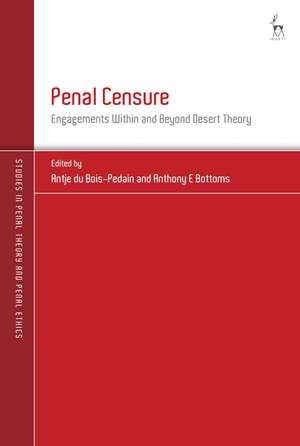
Penal Censure: Engagements Within and Beyond Desert Theory: Studies in Penal Theory and Penal Ethics
Editat de Antje du Bois-Pedain, Anthony E Bottomsen Limba Engleză Paperback – 19 noi 2020



Preț: 273.64 lei
Preț vechi: 361.53 lei
-24%
Puncte Express: 410
Carte tipărită la comandă
Livrare economică 07-21 decembrie
Livrare prin curier în România Termenul estimat este afișat lângă disponibilitate.
Transport gratuit de la 400.00 lei Plată online sau ramburs, în funcție de opțiunile comenzii.
Retur gratuit în 14 zile Comandă securizată și suport în română.
Specificații
ISBN-13: 9781509945672
ISBN-10: 1509945679
Pagini: 328
Dimensiuni: 152 x 232 x 20 mm
Greutate: 0.48 kg
Editura: Bloomsbury Publishing
Colecția Hart Publishing
Seria Studies in Penal Theory and Penal Ethics
Locul publicării:London, United Kingdom
ISBN-10: 1509945679
Pagini: 328
Dimensiuni: 152 x 232 x 20 mm
Greutate: 0.48 kg
Editura: Bloomsbury Publishing
Colecția Hart Publishing
Seria Studies in Penal Theory and Penal Ethics
Locul publicării:London, United Kingdom
V-ar putea interesa
-
 Transitional Amnesty in South AfricaAntje Du Bois-PedainPreț: 397.45 lei
 -
 -32%Preț: 554.05 lei818.06 lei
 -
 Deserved Criminal SentencesAndreas von Hirsch-35%Preț: 502.49 lei768.91 lei
 -
 Investigating European Fraud in the EU Member StatesProfessor Alessandro Bernardi-34%Preț: 549.89 lei830.25 lei
 -
 Criminal Law and the Authority of the StateAntje du Bois-Pedain-33%Preț: 615.24 lei911.59 lei
 -
 -38%Preț: 670.40 lei1076.12 lei
Cuprins
Introduction
Antje du Bois-Pedain and Anthony E Bottoms
PART I
CENSURE: MAPPING THE CONCEPTUAL TERRITORY
1. The Architecture of Censure
John Kleinig
2. Censure, Sanction and the Moral Psychology of Resentment and Punitiveness
Jonathan Jacobs
3. Reflective Censure: Punishment and Human Development
Liat Levanon
4. How Should We Argue for a Censure Theory of Punishment?
Christopher Bennett
PART II
CENSURE AND JUST DESERTS REVISITED: ISSUES FOR DESERT THEORY
5. Censure and Hard Treatment in the General Justification for Punishment: A Reconceptualisation of Desert-oriented Penal Theory
Andreas von Hirsch
6. Deserved Censure, Hard Treatment and Penal Restraint
Andrew Ashworth
7. Penal Censure, Repentance and Desistance
Anthony E Bottoms
8. The Evolution of Retributive Punishment: From Static Desert to Responsive Penal Censure
Julian V Roberts and Netanel Dagan
9. Dealing with Potential Terrorists within a Censure-based Model of Sentencing
Alessandro Corda
PART III
CENSURE, DESERT AND THE JURISPRUDENCE OF PUNISHMENT
10. Rootless Desert and Unanchored Censure
Matt Matravers
11. The Role of Victims' Rights in Punishment Theory
Tatjana Hörnle
12. Penal Desert and the Passage of Time
Antje du Bois-Pedain
13. Censure, Dialogue and Reconciliation
Rob Canton
14. Fairness, Equality, Proportionality and Parsimony: Towards a Comprehensive Jurisprudence of Just Punishment
Michael Tonry
Antje du Bois-Pedain and Anthony E Bottoms
PART I
CENSURE: MAPPING THE CONCEPTUAL TERRITORY
1. The Architecture of Censure
John Kleinig
2. Censure, Sanction and the Moral Psychology of Resentment and Punitiveness
Jonathan Jacobs
3. Reflective Censure: Punishment and Human Development
Liat Levanon
4. How Should We Argue for a Censure Theory of Punishment?
Christopher Bennett
PART II
CENSURE AND JUST DESERTS REVISITED: ISSUES FOR DESERT THEORY
5. Censure and Hard Treatment in the General Justification for Punishment: A Reconceptualisation of Desert-oriented Penal Theory
Andreas von Hirsch
6. Deserved Censure, Hard Treatment and Penal Restraint
Andrew Ashworth
7. Penal Censure, Repentance and Desistance
Anthony E Bottoms
8. The Evolution of Retributive Punishment: From Static Desert to Responsive Penal Censure
Julian V Roberts and Netanel Dagan
9. Dealing with Potential Terrorists within a Censure-based Model of Sentencing
Alessandro Corda
PART III
CENSURE, DESERT AND THE JURISPRUDENCE OF PUNISHMENT
10. Rootless Desert and Unanchored Censure
Matt Matravers
11. The Role of Victims' Rights in Punishment Theory
Tatjana Hörnle
12. Penal Desert and the Passage of Time
Antje du Bois-Pedain
13. Censure, Dialogue and Reconciliation
Rob Canton
14. Fairness, Equality, Proportionality and Parsimony: Towards a Comprehensive Jurisprudence of Just Punishment
Michael Tonry
Recenzii
Indirectly but firmly, the articles in this collection are, in fact, a challenging tribute to the extensive work of von Hirsch... These fourteen articles, especially through the volume's extensive footnoting and helpful indexing, also offer a comprehensive guide to, and impression of, the relevant literature and topics that have shaped the interaction of censure and desert over the past fifty years. And, lastly, these articles consistently offer suggestions for those un- or inadequately-addressed but relevant matters that await future treatment.