
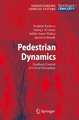
Pedestrian Dynamics: Understanding Complex Systems
Autor Pushkin Kachroo, Sadeq J. Al-Nasur, Sabiha Amin Wadoo, Apoorva Shendeen Limba Engleză Paperback – 16 noi 2010
Din seria Understanding Complex Systems
- 18%
 Preț: 1160.05 lei
-
 Preț: 452.41 lei
- 18%
 Preț: 988.65 lei
- 15%
 Preț: 661.12 lei
- 18%
 Preț: 1170.06 lei
- 18%
 Preț: 911.29 lei
- 15%
 Preț: 667.19 lei
- 15%
 Preț: 673.77 lei
- 15%
 Preț: 675.52 lei
- 18%
 Preț: 955.93 lei
- 18%
 Preț: 990.14 lei
- 15%
 Preț: 666.14 lei
- 15%
 Preț: 663.50 lei
-
 Preț: 442.26 lei
- 15%
 Preț: 661.83 lei
- 15%
 Preț: 677.28 lei
- 15%
 Preț: 666.40 lei
- 20%
 Preț: 674.28 lei
- 20%
 Preț: 677.98 lei
- 18%
 Preț: 982.53 lei
- 18%
 Preț: 1150.57 lei
- 18%
 Preț: 1280.17 lei
- 15%
 Preț: 668.60 lei
- 18%
 Preț: 983.43 lei
- 15%
 Preț: 669.20 lei
- 18%
 Preț: 1440.00 lei
- 18%
 Preț: 990.35 lei
-
 Preț: 414.85 lei
- 18%
 Preț: 980.03 lei
- 18%
 Preț: 1297.31 lei
- 15%
 Preț: 666.97 lei
- 5%
 Preț: 1465.64 lei
- 18%
 Preț: 984.66 lei
- 18%
 Preț: 982.96 lei
-
 Preț: 402.76 lei
- 20%
 Preț: 680.46 lei
- 18%
 Preț: 1047.87 lei
Preț: 946.75 lei
Preț vechi: 1154.58 lei
-18%
Puncte Express: 1420
Carte tipărită la comandă
Livrare economică 04-18 decembrie
Livrare prin curier în România Termenul estimat este afișat lângă disponibilitate.
Transport gratuit pentru acest produs Plată online sau ramburs, în funcție de opțiunile comenzii.
Retur gratuit în 14 zile Comandă securizată și suport în română.
Specificații
ISBN-13: 9783642094781
ISBN-10: 3642094783
Pagini: 260
Ilustrații: XIV, 246 p.
Dimensiuni: 155 x 235 x 15 mm
Greutate: 0.4 kg
Ediția:Softcover reprint of hardcover 1st edition 2008
Editura: Springer
Colecția Understanding Complex Systems
Seria Understanding Complex Systems
Locul publicării:Berlin, Heidelberg, Germany
ISBN-10: 3642094783
Pagini: 260
Ilustrații: XIV, 246 p.
Dimensiuni: 155 x 235 x 15 mm
Greutate: 0.4 kg
Ediția:Softcover reprint of hardcover 1st edition 2008
Editura: Springer
Colecția Understanding Complex Systems
Seria Understanding Complex Systems
Locul publicării:Berlin, Heidelberg, Germany
V-ar putea interesa
-
 From Calculus to Chaos: An Introduction to DynamicsDavid Acheson-28%Preț: 366.53 lei510.68 lei
-
 Elementary Fluid DynamicsD. J. Acheson-24%Preț: 563.52 lei743.61 lei
-
 -9%Preț: 1104.58 lei1213.83 lei
-
 Dynamic Stability of StructuresWei-Chau Xie-11%Preț: 428.56 lei481.53 lei
-
 Concepts in Submarine DesignRoy Burcher-8%Preț: 475.40 lei516.74 lei
-
 Sliding Mode Control and ObservationYuri Shtessel-54%Preț: 385.06 lei840.94 lei
-
 -23%Preț: 460.59 lei598.18 lei
-
 -27%Preț: 881.27 lei1207.22 lei
-
 Formulas for Dynamics, Acoustics and VibrationRobert D Blevins-9%Preț: 912.85 lei1003.13 lei
-
 -27%Preț: 841.56 lei1152.82 lei
-
 Engineering Vibroacoustic AnalysisStephen A Hambric-9%Preț: 917.94 lei1008.72 lei
-
 Applied Mechanics of SolidsAllan F. Bower-18%Preț: 856.95 lei1045.07 lei
-
 Time Series with Mixed SpectraTa-Hsin Li-18%Preț: 1282.73 lei1564.30 lei
-
 Vibration Simulation Using MATLAB and ANSYSMichael R. Hatch-18%Preț: 1501.85 lei1831.52 lei
-
 THEORY & PRACTICE OF HYDRODYNAMIC..(V20)Chakrabarti Subrata KPreț: 401.20 lei
Public țintă
ResearchCuprins
Tra?c Flow Theory for 1-D.- CrowdModels for 2-D.- Numerical Methods.- Feedback Linearization (1-D Patches).- Intelligent Evacuation Systems.- Discretized Feedback Control.- Discretized Optimal Control.- Distributed Feedback Control 1-D.- Distributed Feedback Control 2-D.- Robust Feedback Control.
Recenzii
From the reviews:
“The book is intended for researchers, engineers, and graduate students in applied complexity and nonlinear dynamics as well as in pedestrian dynamics.” (IEEE Control Systems Magazine, Vol. 29, October, 2009)
“This book is dedicated the developing pedestrian dynamic models that can be used in the control and investigation of crowd behavior. … This book is very interesting. It considered actual theme about evacuation strategy. The theory bases on the analogy with air dynamical processes and uses modern mathematical methods, as Lyapunov’s theory for estimation stability of control processes. This book may be very useful for scientists, post graduate students who work in area of control strategy evacuation.” (Yuri N. Sankin, Zentralblatt MATH, Vol. 1237, 2012)
Textul de pe ultima copertă
Effective evacuation of people from closed spaces is an extremely important topic, since it can save real lives in emergency situations that can be brought about by natural and human made disasters. Usually there are static maps posted at various places at buildings that illustrate routes that should be taken during emergencies. However, when disasters happen, some of these routes might not be valid because of structural problems due to the disaster itself and more importantly because of the distribution of congestion of people spread over the area. The average flow of traffic depends on the traffic density. Therefore, if all the people follow the same route, or follow a route without knowing the congestion situation, they can end up being part of the congestion which results in very low flow rate or worse a traffic jam. Hence it becomes extremely important to design evacuations that inform people how fast and in which direction to move based on real-time information obtained about the people distribution using various sensors. The sensors used can include cameras, infra red sensors etc., and the technology used to inform people about the desired movement can be communicated using light matrix, small speakers, and in the future using wireless PDAs. This book provides mathematical models of pedestrian movements that can be used specifically for designing feedback control laws for effective evacuation. The book also provides various feedback control laws to accomplish the effective evacuation. The book uses the hydrodynamic hyperbolic PDE macroscopic pedestrian models since they are amenable to feedback control design. The control designs are obtained through different nonlinear techniques including Lyapunov functional techniques, feedback linearization in the distributed model, and some discretized techniques.
Caracteristici
First book on pedestrian dynamics and crowd evacuation Presents a new approach to model the evacuation system based on partial differential equations Design of feedback control in both PDE and ODE setting in a single book Includes supplementary material: sn.pub/extras
Notă biografică
Pushkin Kachroo is the Lincy Professor of Transportation in the department of Electrical and Computer Engineering at the University of Nevada Las Vegas (UNLV). He was a Visiting Professor at the University of California at Berkeley working with Professor Shankar Sastry. He is the director of the Mendenhall Innovation Program at the Thomas a Hughes College of Engineering at UNLV. He was an Associate Professor at Virginia Tech before he joined UNLV in 2007. He obtained his Ph.D. in Mechanical Engineering from University of California at Berkeley performing research in Vehicle Control in 1993 under Professor Masayoshi Tomizuka, and obtained another Ph.D. in Mathematics from Virginia Tech in Mathematics in the area of hyperbolic system of partial differential equations with applications to Traffic Control and Evacuation under Professor Joseph A. Ball. He has authored 10 books on traffic and vehicle control. He has authored more than 120 publications that include books, research papers, and edited volumes. He has taught about 30 different courses in Virginia Tech in the areas of electrical and computer engineering, and mathematics. Similarly, he also taught 30 different courses at UNLV since 2007. He has graduated more than 35 graduate students, and has been P.I. or Co P.I. on projects worth more than 4 Million Dollars. He was awarded the most outstanding new professor at Virginia Tech, and also has received many teaching awards and certificates, both at Virginia Tech and UNLV. He also received the faculty excellence award from CSUN UNLV in 2011. He is pursuing an M.S. in Physics at UNLV with thesis work in Quantum Logic.
Kaan M.A. Özbay has joined Department of Civil and Urban engineering and Center for Urban Science and Progress (CUSP) at NYU on August 2013. Professor Ozbay was a tenured full Professor at the Rutgers University Department of Civil and Environmental Engineering until July 2013. He joined Rutgers University as an Assistant Professor in July, 1996. In 2008, he was a visiting scholar at the Operations Research and Financial Engineering (ORFE) Department of Princeton University. Dr. Ozbay's research interests in transportation cover a wide range of topics including the development of simulation models of large scale complex transportation systems, advanced technology and sensing applications for Intelligent Transportation Systems, modeling and evaluation of traffic incident and emergency management systems, feedback based on-line real-time traffic control techniques, traffic safety, application of operations research techniques in network optimization and humanitarian inventory control, and transportation economics. Dr. Ozbay is the recipient of the prestigious National Science Foundation (NSF) CAREER award. Dr. Ozbay is the co-editor of a new book titled "Dynamic Traffic Control & Guidance" published by Springer Verlag's "Complex Social, Economic and Engineered Networks" series in 2013. In addition to this book, Dr. Ozbay is the co-author of three other books titled "Feedback Based Ramp Metering for Intelligent Transportation Systems" published by Kluwer Academics in 2004, "Feedback Control Theory for Dynamic Traffic Assignment", Springer-Verlag and "Incident Management for Intelligent Transportation Systems" published by Artech House publishers both in 1999. Dr. Ozbay published approximately 300 refereed papers in scholarly journals and conference proceedings. Professor Ozbay serves as the "Associate Editor" of Networks and Spatial Economic journal and Transportmetrica B: Transportation Dynamics journal. He is a member of the editorial board of the ITS journal.
Since 1994, Dr. Ozbay, has been the Principal Investigator and Co-Principal Investigator of 80 projects funded at a level of more than $11,00,000 by National Science Foundation, NJDOT, NYMTC, NY State DOT, New Jersey Highway Authority, USDOT, FHWA, VDOT,CUNY University T