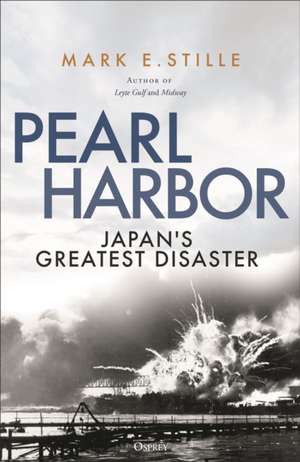
Pearl Harbor: Japan's Greatest Disaster
Autor Mark Stilleen Limba Engleză Hardback – 6 noi 2025
In this the first comprehensive treatment of Pearl Harbor since the early 1990s. respected Pacific War naval historian Mark E. Stille traces the road to war and the Japanese attack itself. He examines the role of the man behind the operation, Japanese Admiral Yamamoto, as well as the strengths and weaknesses of the plan. The American preparations for an attack are also carefully reviewed. The heart of the book is a comprehensive narrative of Pearl Harbor along with an appreciation of its results placed in proper perspective.
In common with many of the major campaigns of the Pacific War, many myths surround the Battle of Pearl Harbor, and, amongst others, Mark explores and dismantle the myth of Yamamoto as a military genius, as well as the myth that the attack was brilliantly planned. Long regarded as brilliant strike, Mark argues in Pearl Harbor that the attack was instead a tactical disappointment, an operational failure and a strategic disaster.
Preț: 138.59 lei
Preț vechi: 194.76 lei
-29%
Puncte Express: 208
Carte disponibilă
Livrare economică 18 noiembrie-02 decembrie
Livrare express 03-07 noiembrie pentru 101.26 lei
Livrare prin curier în România Termenul estimat este afișat lângă disponibilitate.
Transport gratuit de la 400.00 lei Plată online sau ramburs, în funcție de opțiunile comenzii.
Retur gratuit în 14 zile Comandă securizată și suport în română.
Specificații
ISBN-13: 9781472865311
ISBN-10: 1472865316
Pagini: 448
Ilustrații: 16-page plate section in black and white.
Dimensiuni: 162 x 236 x 44 mm
Greutate: 0.7 kg
Editura: Bloomsbury Publishing
Colecția Osprey Publishing
Locul publicării:London, United Kingdom
ISBN-10: 1472865316
Pagini: 448
Ilustrații: 16-page plate section in black and white.
Dimensiuni: 162 x 236 x 44 mm
Greutate: 0.7 kg
Editura: Bloomsbury Publishing
Colecția Osprey Publishing
Locul publicării:London, United Kingdom
V-ar putea interesa
-
 -23%Preț: 44.68 lei58.11 lei
 -
 Pacific CrucibleIan W TollPreț: 157.23 lei
 -
 The Pacific Campaign in World War II: From Pearl Harbor to GuadalcanalWilliam Bruce JohnsonPreț: 285.55 lei
 -
 Victory Against Japan 1944-1945: A Ladybird Expert BookJames Holland-22%Preț: 60.12 lei76.73 lei
 -
 Day of DeceitRobert StinnettPreț: 125.71 lei
 -
 FDR and High Treason at Pearl HarborCharles SprinklesPreț: 254.59 lei
 -
 Hirohito's War: The Pacific War, 1941-1945Dr Francis Pike-16%Preț: 248.50 lei295.89 lei
 -
 -24%Preț: 81.81 lei108.35 lei
 -
 Japanese Combined Fleet 1941-42Mark Stille-27%Preț: 82.52 lei112.84 lei
 -
 -40%Preț: 84.63 lei141.00 lei
 -
 -28%Preț: 80.43 lei112.30 lei
 -
 Midway: The Pacific War’s Most Famous BattleMark Stille-24%Preț: 83.85 lei110.61 lei
 -
 -26%Preț: 169.31 lei229.13 lei
 -
 Pearl Harbor: From Infamy to GreatnessCraig Nelson-24%Preț: 72.16 lei94.94 lei
 -
 Pearl HarborTakuma MelberPreț: 94.21 lei
 -
 Shattered Sword: The Untold Story of the Battle of MidwayJonathan ParshallPreț: 255.52 lei
 -
 Attack on Pearl HarbourChris Bowman-11%Preț: 88.07 lei98.46 lei
 -
 PearlDaniel Allen ButlerPreț: 147.35 lei
 -
 Pearl Harbor 1941: The day of infamyCarl Smith-39%Preț: 78.03 lei128.45 lei
Cuprins
Introduction: The Myths of Pearl Harbor
Chapter 1: The Road to Pearl Harbor
Chapter 2: Japanese Options and the Great Debate
Chapter 3: The Japanese Plan
Chapter 4: Imperial Japanese Navy Forces Employed in the Attack
Chapter 5: The US Pacific Fleet and Pearl Harbor Defenses
Chapter 6: The Japanese Striking Force Approaches Pearl Harbor
Chapter 7: The First Attack Wave
Chapter 8: The Second Attack Wave
Chapter 9: After the Attack
Chapter 10: The Forgotten Offensive: Japanese Submarines off Hawaii
Chapter 11: The Reckoning
Chapter 12: Why Pearl Harbor Matters
Chapter 13: Responsibility Misplaced?
Appendices
Chapter 1: The Road to Pearl Harbor
Chapter 2: Japanese Options and the Great Debate
Chapter 3: The Japanese Plan
Chapter 4: Imperial Japanese Navy Forces Employed in the Attack
Chapter 5: The US Pacific Fleet and Pearl Harbor Defenses
Chapter 6: The Japanese Striking Force Approaches Pearl Harbor
Chapter 7: The First Attack Wave
Chapter 8: The Second Attack Wave
Chapter 9: After the Attack
Chapter 10: The Forgotten Offensive: Japanese Submarines off Hawaii
Chapter 11: The Reckoning
Chapter 12: Why Pearl Harbor Matters
Chapter 13: Responsibility Misplaced?
Appendices
Recenzii
With a detailed, exciting examination of the Japanese plans and battle action, Mark Stille has addressed a considerable gap in the story of the Attack on Pearl Harbor. Highly recommended.
Mark Stille continues his yeoman's work in the field of Pacific War history by bringing his personal experience as a naval intelligence officer to bear on the most enduring and controversial surprise attack of them all-Pearl Harbor.
This is now the definitive history of the Pearl Harbor attack. Comprehensive details are provided, false assumptions corrected, and alternatives suggested. Above all, a persuasive explanation of why the end result was so disastrous for Japan.
Mark Stille continues his yeoman's work in the field of Pacific War history by bringing his personal experience as a naval intelligence officer to bear on the most enduring and controversial surprise attack of them all-Pearl Harbor.
This is now the definitive history of the Pearl Harbor attack. Comprehensive details are provided, false assumptions corrected, and alternatives suggested. Above all, a persuasive explanation of why the end result was so disastrous for Japan.