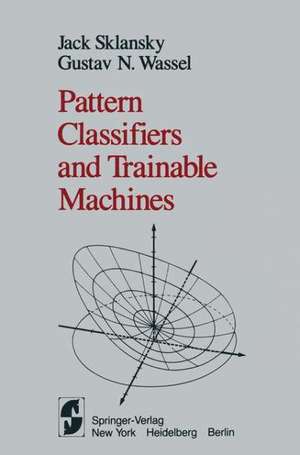
Pattern Classifiers and Trainable Machines
Autor J. Sklansky, G. N. Wasselen Limba Engleză Paperback – 12 oct 2011
Preț: 379.62 lei
Puncte Express: 569
Carte tipărită la comandă
Livrare economică 25 noiembrie-09 decembrie
Livrare prin curier în România Termenul estimat este afișat lângă disponibilitate.
Transport gratuit de la 400.00 lei Plată online sau ramburs, în funcție de opțiunile comenzii.
Retur gratuit în 14 zile Comandă securizată și suport în română.
Specificații
ISBN-13: 9781461258407
ISBN-10: 1461258405
Pagini: 352
Ilustrații: XII, 336 p.
Dimensiuni: 155 x 235 x 20 mm
Greutate: 0.53 kg
Ediția:Softcover reprint of the original 1st ed. 1981
Editura: Springer
Locul publicării:New York, NY, United States
ISBN-10: 1461258405
Pagini: 352
Ilustrații: XII, 336 p.
Dimensiuni: 155 x 235 x 20 mm
Greutate: 0.53 kg
Ediția:Softcover reprint of the original 1st ed. 1981
Editura: Springer
Locul publicării:New York, NY, United States
V-ar putea interesa
-
 The Verilog(r) Hardware Description LanguageDonald Thomas-15%Preț: 508.12 lei597.79 lei
 -
 Printed ElectronicsZheng Cui-9%Preț: 965.86 lei1061.38 lei
 -
 Applied Frequency-Domain ElectromagneticsRobert Paknys-27%Preț: 890.00 lei1219.18 lei
 -
 Grounding and Shielding 6e CMorrison-9%Preț: 721.52 lei792.88 lei
 -
 -27%Preț: 787.48 lei1078.73 lei
 -
 Geometric Methods and ApplicationsJean Gallier-15%Preț: 552.23 lei649.67 lei
 -
 Make: FireTim DeaganPreț: 174.31 lei
 -
 DIY Drone and Quadcopter ProjectsMake the Editors ofPreț: 83.78 lei
 -
 New Autonomous SystemsAlain Cardon-9%Preț: 983.92 lei1081.23 lei
 -
 From Prognosis And Health Systems 1Gouriveau-9%Preț: 1008.09 lei1107.79 lei
 -
 Digital Electronics, Volume 1Ndjountche Tertulien-9%Preț: 986.28 lei1083.83 lei
 -
 Model Predictive ControlEduardo F. Camacho-15%Preț: 512.40 lei602.82 lei
 -
 Mechatronic SystemsRolf Isermann-15%Preț: 605.64 lei712.51 lei
 -
 Lateral Power Transistors in Integrated CircuitsTobias Erlbacher-15%Preț: 666.74 lei784.40 lei
 -
 High-Efficiency Solar CellsXiaodong Wang-18%Preț: 1287.16 lei1569.71 lei
 -
 Preț: 396.47 lei
 -
 Automotive Mechatronics: Operational and Practical IssuesB. T. Fijalkowski-18%Preț: 1194.66 lei1456.91 lei
Public țintă
ResearchCuprins
1 Introduction and Overview.- 1.1 Basic Definitions.- 1.2 Trainable Classifiers and Training Theory.- 1.3 Assumptions and Notation.- 1.4 Illustrative Training Process.- 1.5 Linear Discriminant Functions.- 1.6 Expanding the Feature Space.- 1.7 Binary-Input Classifiers.- 1.8 Weight Space Versus Feature Space.- 1.9 Statistical Models.- 1.10 Evaluation of Performance.- 2 Linearly Separable Classes.- 2.1 Introduction.- 2.2 Convex sets, Summability, and Linear Separability.- 2.3 Notation and Terminology.- 2.4 The Perceptron and the Proportional Increment Training Procedure.- 2.5 The Fixed Fraction Training Procedure.- 2.6 A Multiclass Training Procedure.- 2.7 Synthesis by Game Theory.- 2.8 Symplifying Techniques.- 2.9 Illustrative Example.- 2.10 Gradient Descent.- 2.11 Conditions for Ensuring Desired Convergence.- 2.12 Gradient Descent for Designing Classifiers.- 2.13 The Ho—Kashyap Procedure.- 3 Nonlinear Classifiers.- 3.1 Introduction.- 3.2 ?-Classifiers.- 3.3 Bayes Estimation: Parametric Training.- 3.4 Smoothing Techniques: Nonparametric Training.- 3.5 Bar Graphs.- 3.6 Parzen Windows and Potential Functions.- 3.7 Storage Economies.- 3.8 Fixed-Base Bar Graphs.- 3.9 Sample Sets and Prototypes.- 3.10 Close Opposed Pairs of Prototypes.- 3.11 Locally Trained Piecewise Linear Classifiers.- 4 Loss Functions and Stochastic Approximation.- 4.1 Introduction.- 4.2 A Loss Function for the Proportional Increment Procedure.- 4.3 The Sample Gradient.- 4.4 The Use of Prior Knowledge.- 4.5 Loss Functions and Gradients of Some Important Training Procedures.- 4.6 Loss Functions Compared.- 4.7 Unequal Costs of Category Decisions.- 4.8 Stochastic Approximation.- 4.9 Gradients for Various Constituent Densities and Hyperplanes.- 4.10 Conclusion.- 5 Linear Classifiers for NonseparableClasses.- 5.1 Modifications of Gradient Descent.- 5.2 Normalization, Origin Selection, and Initial Vector.- 5.3 The Window Training Procedure.- 5.4 The Minimum Mean Square Error Training Procedure.- 5.5 The Equalized Error Training Procedure.- 5.6 Accounting for Unequal Costs.- 5.7 An Application.- 5.8 Summary.- 6 Markov Chain Training Models for Nonseparable Classes.- 6.1 Introduction.- 6.2 The Problem of Analyzing a Stochastic Difference Equation.- 6.3 Examples of Single-Feature Classifiers.- 6.4 A Single-Feature Classifier with Constant Increment Training.- 6.5 Basic Properties of Learning Dynamics.- 6.6 Erogodicity and Stability in the Large.- 6.7 Train-Work Schedules: Two-Mode Classes.- 6.8 Optimal Finite Memory Learning.- 6.9 Multidimensional Feature Space.- 7 Continuous-State Models.- 7.1 Introduction.- 7.2 The Centroid Equation.- 7.3 Proof that ?(n) = O(?)U for n? ? t < ?.- 7.4 The Covariance Equation.- 7.5 Learning Curves and Variance Curves.- 7.6 Normalization with Respect to t.- 7.7 Illustrative Examples.- 7.8 Shapes of Learning Curves in Single-Feature Classifiers.- 7.9 How Close are the Equal Error and Minimum Error Points?.- 7.10 Asymptotic Stability in the Large.- Appendix A Vectors and Matrices.- A.1 Vector Inequalities and Other Vector Notation.- A.2 Permutation Matrices.- Appendix B Proof of Convergence for the Window Procedure.- Appendix C Proof of Convergence for the Equalized Error Procedure.- C.2 Proof of Theorem 5.3.