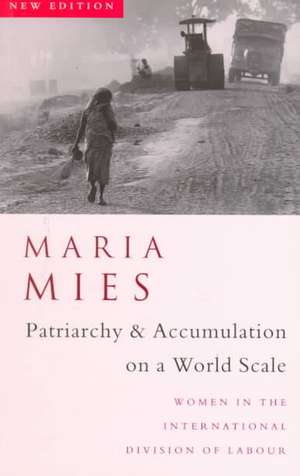
Patriarchy and Accumulation on a World Scale: Women in the International Division of Labour
Autor Maria Miesen Paperback – 31 ian 1999
Notăm cu interes reeditarea lucrării Patriarchy and Accumulation on a World Scale, un text fundamental pentru programele academice de sociologie, studii de gen și economie politică. Relevanța acestui volum pentru cercetarea contemporană este marcată de capacitatea Mariei Mies de a demonstra că acumularea capitalistă nu se bazează doar pe munca salariată, ci depinde structural de subordonarea femeilor și a coloniilor. Ediția actuală, publicată de Bloomsbury Publishing, beneficiază de o prefață semnată de Silvia Federici, consolidând legătura dintre teoria patriarhatului capitalist și mișcările sociale actuale.
Putem afirma că forța argumentului lui Mies rezidă în conceptul de 'casnicizare', prin care munca reproductivă și de subzistență este devalorizată pentru a susține producția industrială. Structura cărții urmărește o progresie logică riguroasă: de la originile sociale ale diviziunii muncii, la analiza proceselor de colonizare și până la impactul globalizării asupra femeilor din economiile emergente. Reținem capitolul dedicat acumulării primitive prin violență, care rămâne o analiză de o actualitate frapantă în contextul crizelor economice moderne.
Această lucrare reprezintă o alternativă conceptuală la volumul Feminism and Materialism (RLE Feminist Theory) de Annette Kuhn pentru cursurile de teorie feministă materialistă. În timp ce Kuhn se concentrează pe o abordare eseistică a modurilor de producție, Maria Mies aduce avantajul unei perspective globale care integrează experiența femeilor din afara spațiului occidental. Față de alte lucrări ale sale, precum Ecofeminism sau The Subsistence Perspective, acest titlu oferă fundamentul teoretic sistemic pe care s-au clădit ulterior cercetările sale despre ecologie și autonomie.
Preț: 164.71 lei
Carte tipărită la comandă
Livrare economică 11-23 decembrie
Specificații
ISBN-10: 1856497356
Pagini: 272
Dimensiuni: 138 x 216 x 18 mm
Greutate: 0.36 kg
Ediția:Da Capo Press.
Editura: ZED BOOKS
Colecția Zed Books
Locul publicării:United Kingdom
De ce să citești această carte
Recomandăm această carte studenților și cercetătorilor care doresc să înțeleagă mecanismele invizibile ale economiei globale. Cititorul câștigă o perspectivă critică asupra modului în care munca domestică și exploatarea colonială alimentează sistemul capitalist actual. Este o resursă esențială pentru oricine analizează intersecția dintre gen, clasă și dezvoltare internațională, oferind instrumente teoretice pentru a regândi structura muncii în societatea contemporană.
Despre autor
Maria Mies a fost o renumită profesoară de sociologie la Universitatea de Științe Aplicate din Köln și o figură centrală a feminismului marxist global. Activismul său, început în anii '60, s-a concretizat în fondarea programului 'Femei și Dezvoltare' la Haga în 1979. Opera sa este marcată de o critică profundă a patriarhatului capitalist, temă explorată și în alte lucrări de referință precum The Lace Makers of Narsapur și Women: The Last Colony. Prin scrierile sale, Mies a influențat decisiv teoria dezvoltării și ecofeminismul modern.
Descriere
'It is my thesis that this general production of life, or subsistence production - mainly performed through the non-wage labour of women and other non-wage labourers as slaves, contract workers and peasants in the colonies - constitutes the perennial basis upon which "capitalist productive labour" can be built up and exploited.'
First published in 1986, Maria Mies's progressive book was hailed as a major paradigm shift for feminist theory, and it remains a major contribution to development theory and practice today.
Tracing the social origins of the sexual division of labour, it offers a history of the related processes of colonization and 'housewifization' and extends this analysis to the contemporary new international division of labour. Mies's theory of capitalist patriarchy has become even more relevant today.
This new edition includes a substantial new introduction in which she both applies her theory to the new globalized world and answers her critics.
Cuprins
Preface to the critique influence change edition
Introduction
1. What is Feminism?
2. Social Origins of the Sexual Division of Labour
3. Colonization and Housewifization
4. Housewifization International: Women and the International Division of Labour
5. Violence Against Women and the Ongoing Primitive Accumulation of Capital
6. National Liberation and Women's Liberation
7. Towards a Feminist Perspective of a New Society
Recenzii
In Patriarchy and Accumulation on a World Scale, Maria Mies drew connections between two structures of domination that had previously been viewed separately. In showing the convergence between patriarchy and capitalism, she has pushed intellectual boundaries, and has enriched feminism, women's struggles, and movements for social and economic justice. If you want to understand the roots of the economic crisis, and of violence against women, read this book. If you want to create alternatives and participate in shaping living economies, read this book. Patriarchy and Accumulation is essential reading for all, more so today than when it was first written.
Maria Mies' vision is huge, the scale of her project breathtakingly bold.
Feminist theory at its very best.
A major contribution to authentic development theory and practice. Women cannot hope for justice from a mode of production built on subordination either as housewife in the West or cheap labour in the third world. Mies produces an alternative feminist concept of labour and some strategic elements of its implementation. The critique is compelling.