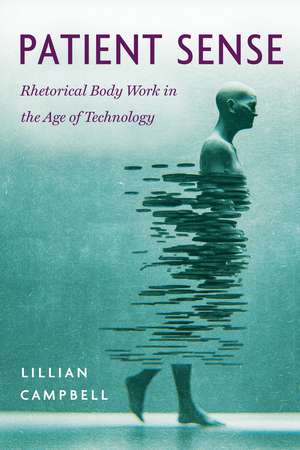
Patient Sense: Rhetorical Body Work in the Age of Technology: New Directions in Rhetoric and Materiality
Autor Lillian Campbellen Limba Engleză Hardback – 15 iul 2025
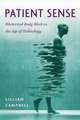
Technological innovations are rapidly changing the healthcare landscape. When nurses can complete portions of their clinical hours in virtual simulations and medical assistants might spend their entire careers providing patient care mediated by a screen, their understandings of their professional roles change. For future providers, rhetoric is at the heart of learning to communicate with patients and reframing their understandings of expertise. In Patient Sense, Lillian Campbell introduces a theory of rhetorical body work and applies it to three distinct healthcare contexts: clinical nursing simulations, physical therapy labs, and tele-observation in a virtual intensive care unit. Drawing on sociological frameworks, she defines rhetorical body work as paid physical, emotional, or discursive labor performed at the material or technological interface of worker–client bodies. Such work is devalued within social and institutional systems and often gendered and racialized. Campbell captures the value of providers’ intuitive patient sense in the face of increasingly technology-mediated healthcare and intervenes in conversations about the future of healthcare training. Ultimately, she demonstrates that we will always need responsive healthcare providers whose rhetorical body work and patient sense cannot be replaced by technicians or algorithms.
| Toate formatele și edițiile | Preț | Express |
|---|---|---|
| Paperback (1) | 249.97 lei 6-8 săpt. | |
| Ohio State University Press – 15 iul 2025 | 249.97 lei 6-8 săpt. | |
| Hardback (1) | 673.83 lei 6-8 săpt. | |
| Ohio State University Press – 15 iul 2025 | 673.83 lei 6-8 săpt. |



Preț: 673.83 lei
Preț vechi: 831.89 lei
-19%
Puncte Express: 1011
Preț estimativ în valută:
119.13€ • 141.60$ • 103.36£
119.13€ • 141.60$ • 103.36£
Carte tipărită la comandă
Livrare economică 12-26 martie
Specificații
ISBN-13: 9780814215913
ISBN-10: 0814215912
Pagini: 212
Ilustrații: 2 b&w images
Dimensiuni: 152 x 229 x 20 mm
Greutate: 0.45 kg
Editura: Ohio State University Press
Colecția Ohio State University Press
Seria New Directions in Rhetoric and Materiality
ISBN-10: 0814215912
Pagini: 212
Ilustrații: 2 b&w images
Dimensiuni: 152 x 229 x 20 mm
Greutate: 0.45 kg
Editura: Ohio State University Press
Colecția Ohio State University Press
Seria New Directions in Rhetoric and Materiality
Recenzii
“Patient Sense reveals the contours of medicine as it’s actually practiced in the twenty-first century, with all of its attendant tools. Campbell’s focus on healthcare practitioners and their working conditions provides a sorely needed new dimension of materiality to the field.” —Jenell Johnson, author of Every Living Thing: The Politics of Life in Common
“Patient Sense provides a compelling, timely exploration of the ways that new technologies have impacted health practitioner training and practice. Campbell expertly demonstrates that rhetorical body work and patient sense are more important now than ever.” —Emma Bedor Hiland, author of Therapy Tech: The Digital Transformation of Mental Healthcare
Notă biografică
Lillian Campbell is Associate Professor of English at Marquette University. Her research and teaching focus on rhetorics of health and medicine, feminist rhetorics, and professional and technical writing, as well as the impact of technology on how we communicate and learn.
Extras
Body Matters for the Future of Healthcare and Technology
In the opening to The Doctor and the Algorithm, Graham offers multiple perspectives on the rise of AI in healthcare—the pessimistic versions that highlight the inherent biases and stereotypes that are embedded in AI systems and the more optimistic takes on how AI might serve to humanize medical care. Summarizing Topol’s optimistic take, Graham says, "When AI frees physicians from the administrative burdens of electronic medical records, reading lab results, and performing analyses, then they will be better able to provide patients with the emotional labor so often lacking in contemporary medicine." What is interesting to me here and what I take up in this conclusion is the inherent separation between rhetorical labor and emotional labor that this statement sets out. By eliminating the rhetorical labor of doctors (electronic medical records, interpretation of lab results, analyses of data), Topol argues that doctors create space for emotional work.
However, as a rhetorical theory of body work demonstrates, these divisions are not so simple. We cannot expect to offload our rhetorical work onto algorithms or remote workers and still be able to perform the embodied and emotional labor that constitutes rhetorical body work. The documentation in electronic medical records, the interpretation of results: these are physical and emotion-filled tasks, guided by intuition, by prior knowledge, by embodied experience. And empathetic interactions with patients are highly rhetorical tasks, embedded in a deep awareness of audience and context that is tied to the interpretive patient knowledge that practitioners gain from their work. This is perhaps even more visible in the allied health professions, where the body is rarely cordoned off into parts as Wolkowitz describes and instead must be both understood and communicated holistically.
Thus, I conclude by returning to my three research questions from the introduction and considering the transformations and constants that emerge at the intersection of rhetorical body work and new health technologies. Overall, I emphasize that rhetorical work is body work and body work is rhetorical work. By highlighting the inherent interconnections between these concepts, we can begin to speak back to arguments in favor of offloading rhetorical and embodied labor onto machines and algorithms in the future, highlighting the risks of that approach.
Disciplinary Knowledge and Body Work
Each body chapter emphasized a key component of embodied, emotional, and discursive practice that is central to the field’s identity. In nursing, I demonstrated how empathy takes on a primary role in student learning alongside robotic patient manikins; being able to understand and identify with patient experience is understood as primary to nursing practice. Lessons about empathy manifest in clinical nursing simulations, as instructors design physical, emotional, and discursive cues to prompt students to engage empathetically with their robotic patients. These cues create imperfect lessons in patient sense as the robotic manikin is too large, too stiff, too male, and so forth. However, the simulation’s disruptions also help support student responsiveness, prompting reflection and revision of engrained embodied and emotional practices.
In physical therapy, the field’s historic relationship to mainstream biomedicine shapes its ongoing quest for legitimacy and professional recognition. Thus, rhetorical body work serves as boundary-work, reifying PTs’ professional expertise and distinguishing them from complementary and alternative medicine. Efforts to professionalize PTs’ patient sense emerge in both explicit lessons on physical interactions with and without technology and in the hidden curriculum of the lab. Overall, PTs are taught that their expertise is crucial to their professional identity, and they learn to enact this expertise through their physical, emotional, and discursive comportment. At times, however, this emphasis on expertise overshadows the field’s holistic attention to individual patient experience.
Finally, tele-observers bring to their practice a great deal of intuitive patient knowledge, acquired both in complementary hospital contexts and from other educational and workplace experiences. As they watch patient actions mediated by a video camera and microphone, they learn to “trust their gut” when something seems off about a patient and rely on intuition to shape their decisions about intervention. This intuition emerges at an intersection between their prior embodied knowledge and the physical patient actions that are mediated by their screens. It is reinforced in conversation with colleagues, challenged by floor nurses, and at times, must be defended or justified using discursive and emotional rhetorical body work.
In the opening to The Doctor and the Algorithm, Graham offers multiple perspectives on the rise of AI in healthcare—the pessimistic versions that highlight the inherent biases and stereotypes that are embedded in AI systems and the more optimistic takes on how AI might serve to humanize medical care. Summarizing Topol’s optimistic take, Graham says, "When AI frees physicians from the administrative burdens of electronic medical records, reading lab results, and performing analyses, then they will be better able to provide patients with the emotional labor so often lacking in contemporary medicine." What is interesting to me here and what I take up in this conclusion is the inherent separation between rhetorical labor and emotional labor that this statement sets out. By eliminating the rhetorical labor of doctors (electronic medical records, interpretation of lab results, analyses of data), Topol argues that doctors create space for emotional work.
However, as a rhetorical theory of body work demonstrates, these divisions are not so simple. We cannot expect to offload our rhetorical work onto algorithms or remote workers and still be able to perform the embodied and emotional labor that constitutes rhetorical body work. The documentation in electronic medical records, the interpretation of results: these are physical and emotion-filled tasks, guided by intuition, by prior knowledge, by embodied experience. And empathetic interactions with patients are highly rhetorical tasks, embedded in a deep awareness of audience and context that is tied to the interpretive patient knowledge that practitioners gain from their work. This is perhaps even more visible in the allied health professions, where the body is rarely cordoned off into parts as Wolkowitz describes and instead must be both understood and communicated holistically.
Thus, I conclude by returning to my three research questions from the introduction and considering the transformations and constants that emerge at the intersection of rhetorical body work and new health technologies. Overall, I emphasize that rhetorical work is body work and body work is rhetorical work. By highlighting the inherent interconnections between these concepts, we can begin to speak back to arguments in favor of offloading rhetorical and embodied labor onto machines and algorithms in the future, highlighting the risks of that approach.
Disciplinary Knowledge and Body Work
Each body chapter emphasized a key component of embodied, emotional, and discursive practice that is central to the field’s identity. In nursing, I demonstrated how empathy takes on a primary role in student learning alongside robotic patient manikins; being able to understand and identify with patient experience is understood as primary to nursing practice. Lessons about empathy manifest in clinical nursing simulations, as instructors design physical, emotional, and discursive cues to prompt students to engage empathetically with their robotic patients. These cues create imperfect lessons in patient sense as the robotic manikin is too large, too stiff, too male, and so forth. However, the simulation’s disruptions also help support student responsiveness, prompting reflection and revision of engrained embodied and emotional practices.
In physical therapy, the field’s historic relationship to mainstream biomedicine shapes its ongoing quest for legitimacy and professional recognition. Thus, rhetorical body work serves as boundary-work, reifying PTs’ professional expertise and distinguishing them from complementary and alternative medicine. Efforts to professionalize PTs’ patient sense emerge in both explicit lessons on physical interactions with and without technology and in the hidden curriculum of the lab. Overall, PTs are taught that their expertise is crucial to their professional identity, and they learn to enact this expertise through their physical, emotional, and discursive comportment. At times, however, this emphasis on expertise overshadows the field’s holistic attention to individual patient experience.
Finally, tele-observers bring to their practice a great deal of intuitive patient knowledge, acquired both in complementary hospital contexts and from other educational and workplace experiences. As they watch patient actions mediated by a video camera and microphone, they learn to “trust their gut” when something seems off about a patient and rely on intuition to shape their decisions about intervention. This intuition emerges at an intersection between their prior embodied knowledge and the physical patient actions that are mediated by their screens. It is reinforced in conversation with colleagues, challenged by floor nurses, and at times, must be defended or justified using discursive and emotional rhetorical body work.
Cuprins
List of Illustrations Acknowledgments Introduction The New Healthcare Landscape Chapter 1 Rhetorical Body Work Chapter 2 A Feeling for the Robot: Embodying Empathy in Nursing Simulations Chapter 3 More Than a Massage: Body Work as Boundary-Work in a Physical Therapy Lab Chapter 4 Reaching through the Screen: Mediated Body Work in a Virtual Intensive Care Unit Conclusion Body Matters for the Future of Healthcare and Technology Appendix 1 Nursing Simulation Interview Questions Appendix 2 Physical Therapy Interview Questions Appendix 3 Tele-Observation Interview Questions Works Cited Index
Descriere
Develops a theory of rhetorical body work through observations of three healthcare contexts, demonstrating the value of providers’ intuitive patient sense in the face of increasingly technology-mediated healthcare.