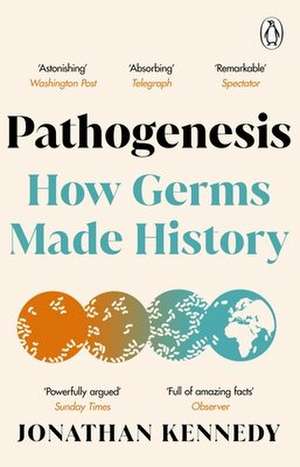
Pathogenesis
Autor Jonathan Kennedyen Limba Engleză Paperback – 4 apr 2024
În volumul Pathogenesis, Jonathan Kennedy propune o schimbare radicală de paradigmă pentru clinicieni și istorici deopotrivă: înțelegerea bolilor infecțioase nu doar ca amenințări externe, ci ca forțe constitutive ale biologiei și civilizației noastre. Notăm cu interes modul în care autorul utilizează genetica modernă pentru a demonstra că identitatea noastră biologică este, în esență, un produs al interacțiunii cu lumea microscopică. Un exemplu frapant oferit este cel al placentei umane, a cărei evoluție a fost determinată de integrarea unui cod viral în ADN-ul strămoșilor noștri. Descoperim aici o analiză clinică aplicată asupra istoriei globale, unde prăbușirea Romei sau succesul colonialismului nu sunt atribuite doar strategiilor militare, ci dinamicii patogenilor. Considerăm că această perspectivă transformă fundamental modul în care un specialist în [Boli infecțioase și contagioase](bic_category) privește epidemiologia. Clinicienii care folosesc Plagues Upon the Earth de Kyle Harper ca referință pentru istoria economică a bolilor vor găsi în Pathogenesis o completare esențială axată pe mecanismele biologice intime și pe modul în care crizele pandemice forțează inovația socială. Textul evită determinismul simplist, oferind în schimb o structură narativă densă, susținută de date din antropologie și microbiologie, care explică de ce sănătatea publică a devenit pilonul statului modern.
Preț: 62.57 lei
Preț vechi: 86.95 lei
-28%
Carte disponibilă
Livrare economică 12-18 noiembrie
Livrare express 24-30 octombrie pentru 42.84 lei
Specificații
ISBN-10: 1804991899
Pagini: 384
Dimensiuni: 129 x 195 x 30 mm
Greutate: 0.29 kg
Editura: Transworld Publishers Ltd
Colecția Penguin
De ce să citești această carte
Recomandăm această lectură oricărui medic sau student interesat de intersecția dintre microbiologie și sociologie. Jonathan Kennedy oferă argumente solide pentru a înțelege bolile nu ca accidente istorice, ci ca arhitecți ai lumii moderne. Cititorul câștigă o perspectivă profundă asupra modului în care agenții patogeni forțează evoluția speciilor și a sistemelor politice, oferind un context vital pentru gestionarea viitoarelor crize sanitare.
Descriere scurtă
'Powerfully argued... Fascinating and pacy' Sunday Times, Book of the Week
'Superbly written... sure to please readers of Yuval Noah Harari or Rutger Bregman' The Times
'Full of amazing facts' Observer
In this revelatory book, Dr Jonathan Kennedy argues that germs have shaped humanity at every stage, from the first success of Homo sapiens over the equally intelligent Neanderthals to the fall of Rome and the rise of Islam.
How did an Indonesian volcano help cause the Black Death, setting Europe on the road to capitalism? How could 168 men extract the largest ransom in history from an opposing army of eighty thousand? And why did the Industrial Revolution lead to the birth of the modern welfare state?
The latest science reveals that infectious diseases are not just something that happens to us, but a fundamental part of who we are. Indeed, the only reason humans don't lay eggs is that a virus long ago inserted itself into our DNA, and there are as many bacteria in your body as there are human cells. We have been thinking about the survival of the fittest all wrong: evolution is not simply about human strength and intelligence, but about how we live and thrive in a world dominated by microbes.
By exploring the startling intimacy of our relationship with infectious diseases, Kennedy shows how they have been responsible for some of the seismic revolutions of the past 50,000 years. Provocative and brimming with insight, Pathogenesis transforms our understanding of the human story.
Challenges some of the greatest cliches about colonialism... A revelation' SATHNAM SANGHERA
'Thrilling and eye-opening' LEWIS DARTNELL
'Science and history at its best' MARK HONIGSBAUM
'Unpicks everything we thought we knew... Mind blowing' CAL FLYN
A TIMES SCIENCE BOOK OF THE YEAR 2023
A SUNDAY TIMES SCIENCE BOOK OF THE YEAR 2023