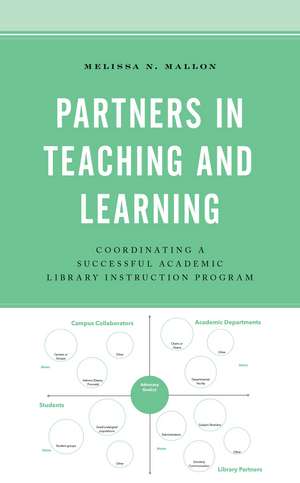
Partners in Teaching and Learning: Coordinating a Successful Academic Library Instruction Program: Beta Phi Mu Scholars Series
Autor Melissa N. Mallonen Limba Engleză Paperback – 15 sep 2020



Preț: 253.44 lei
Preț vechi: 332.92 lei
-24%
Puncte Express: 380
Carte tipărită la comandă
Livrare economică 20 noiembrie-04 decembrie
Livrare prin curier în România Termenul estimat este afișat lângă disponibilitate.
Transport gratuit de la 400.00 lei Plată online sau ramburs, în funcție de opțiunile comenzii.
Retur gratuit în 14 zile Comandă securizată și suport în română.
Specificații
ISBN-13: 9781538118849
ISBN-10: 153811884X
Pagini: 168
Ilustrații: 1 b/w illustration;2 tables; 6 textboxes
Dimensiuni: 153 x 219 x 13 mm
Greutate: 0.2 kg
Editura: Bloomsbury Publishing
Colecția Rowman & Littlefield
Seria Beta Phi Mu Scholars Series
Locul publicării:New York, United States
ISBN-10: 153811884X
Pagini: 168
Ilustrații: 1 b/w illustration;2 tables; 6 textboxes
Dimensiuni: 153 x 219 x 13 mm
Greutate: 0.2 kg
Editura: Bloomsbury Publishing
Colecția Rowman & Littlefield
Seria Beta Phi Mu Scholars Series
Locul publicării:New York, United States
Cuprins
Acknowledgements
Table of Contents
List of Textboxes, Tables, and Figures
Preface
Introduction
Chapter 1: The Intentional Instruction Coordinator
Chapter 2: Taking Stock of an Instruction Program
Chapter 3: Creating a Culture of Teaching & Learning in the Library
Chapter 4: To Frame or Not to Frame?
Chapter 5: Writing an Instruction Program Statement
Chapter 6: Advocating for an Instruction Program
Chapter 7: Assessing an Instruction Program
Chapter 8: When an Instruction Program Goes Astray
Chapter 9: Growing as an Instruction Coordinator
Conclusion
Appendix A: An Instruction Coordinator's Bookshelf
References
Index
About the Author
Table of Contents
List of Textboxes, Tables, and Figures
Preface
Introduction
Chapter 1: The Intentional Instruction Coordinator
Chapter 2: Taking Stock of an Instruction Program
Chapter 3: Creating a Culture of Teaching & Learning in the Library
Chapter 4: To Frame or Not to Frame?
Chapter 5: Writing an Instruction Program Statement
Chapter 6: Advocating for an Instruction Program
Chapter 7: Assessing an Instruction Program
Chapter 8: When an Instruction Program Goes Astray
Chapter 9: Growing as an Instruction Coordinator
Conclusion
Appendix A: An Instruction Coordinator's Bookshelf
References
Index
About the Author
Recenzii
This book is intended for library instruction coordinators and librarians who make decisions about shaping library instruction programs. The volume focuses on identifying leadership strategies and approaches for instruction coordinators at academic libraries who are developing the pedagogical skills for teaching librarians, assessing instruction programs, and achieving success in integrating those programs into libraries and on their campuses. The text stresses that library instruction is contextualized by differences in institutions and organizational cultures. Chapters include discussions about the role of the instructional coordinator, how to assess one's instructional program, how to develop a culture of teaching and learning, how to understand the impact of the ACRL Frameworkfor Information Literacy for Higher Education, how to create an instructional program identity and advocate for a library instruction program, and how to identify where programs can fail. Along with references, the work includes an appendix of readings specifically for instructional coordinators and a list of professional organizations that offer support and growth. . . this title updates instructional improvement practices in light of the ACRL Framework. Summing Up: Recommended. Professionals.
Coordinating a library instruction program is a complex enterprise requiring a librarian to demonstrate expertise in areas such as leadership, mentorship, assessment, collaboration, promotion, and strategic planning. Mallon (director, teaching and learning, Vanderbilt Univ. Libs.) draws upon extensive background to provide a solid framework. Readers will come away with an understanding the role of instruction coordinators, the value of assessing a library's current instruction program, and the importance of identifying pertinent institutional partners. Mallon introduces readers to standards from the Association of College and Research Libraries, and offers guidance on whether it makes sense for individual institutions to embrace these standards. In addition, she explains how to create a formal program statement, and how to advocate for and promote a program. She stresses the importance of evaluating instruction programs, correcting deficiencies, and even discontinuing any program component that is no longer viable. The book also covers avenues for continued development, such as personal learning networks, conferences, and workshops. Mallon lays out a solid foundation and offers sage advice that instruction coordinators will find useful.
Partners in Teaching and Learning is the eighth title to be published in the Beta Phi Mu Scholars Series, which publishes titles that contribute significantly to library and information sciences. The book is written in a way that offers practical resources and strategies for a multitude of instruction programs. . . . The reference list is extensive, and the index is useful. Overall, this book is highly recommended for current and future library instruction coordinators and other library staff members charged with library instruction responsibilities
'The goal of this book is to provide a roadmap for the successful development and maintenance of a library's teaching and learning program.' The author recognizes the need to take institutional context into account, so is careful to identify a range of alternatives rather than prescribe a particular approach. As noted in the Conclusion: 'While an instruction program can take many different shapes and sizes (from formal to informal and from small to large), it is a crucial and necessary component for positioning the library as a comprehensive and integral leader of teaching and learning on campus.' The Appendix 'An Instruction Coordinator's Bookshelf ' provides helpful guidance for further study of library instruction, teaching and learning beyond libraries, and keeping up with higher education. The book should be useful to instruction coordinators seeking to enhance their effectiveness in various facets of their role (e.g., creating a culture of teaching and learning in the library, advocating for an instruction program, assessing an instruction program) as well as helping to better equip those who aspire to fill such roles in the future.
Melissa Mallon's book examines an instruction program as a whole and explores issues librarians face while leading instruction programs. It addresses a gap in the scholarly literature on coordinating library instruction programs and is a must-read for librarians who direct instruction programs. I wish that Partners in Teaching and Learning had been published during the time that I served as Coordinator of Library Instruction. It would have made my life a lot easier!
Coordinating a library instruction program is a complex enterprise requiring a librarian to demonstrate expertise in areas such as leadership, mentorship, assessment, collaboration, promotion, and strategic planning. Mallon (director, teaching and learning, Vanderbilt Univ. Libs.) draws upon extensive background to provide a solid framework. Readers will come away with an understanding the role of instruction coordinators, the value of assessing a library's current instruction program, and the importance of identifying pertinent institutional partners. Mallon introduces readers to standards from the Association of College and Research Libraries, and offers guidance on whether it makes sense for individual institutions to embrace these standards. In addition, she explains how to create a formal program statement, and how to advocate for and promote a program. She stresses the importance of evaluating instruction programs, correcting deficiencies, and even discontinuing any program component that is no longer viable. The book also covers avenues for continued development, such as personal learning networks, conferences, and workshops. Mallon lays out a solid foundation and offers sage advice that instruction coordinators will find useful.
Partners in Teaching and Learning is the eighth title to be published in the Beta Phi Mu Scholars Series, which publishes titles that contribute significantly to library and information sciences. The book is written in a way that offers practical resources and strategies for a multitude of instruction programs. . . . The reference list is extensive, and the index is useful. Overall, this book is highly recommended for current and future library instruction coordinators and other library staff members charged with library instruction responsibilities
'The goal of this book is to provide a roadmap for the successful development and maintenance of a library's teaching and learning program.' The author recognizes the need to take institutional context into account, so is careful to identify a range of alternatives rather than prescribe a particular approach. As noted in the Conclusion: 'While an instruction program can take many different shapes and sizes (from formal to informal and from small to large), it is a crucial and necessary component for positioning the library as a comprehensive and integral leader of teaching and learning on campus.' The Appendix 'An Instruction Coordinator's Bookshelf ' provides helpful guidance for further study of library instruction, teaching and learning beyond libraries, and keeping up with higher education. The book should be useful to instruction coordinators seeking to enhance their effectiveness in various facets of their role (e.g., creating a culture of teaching and learning in the library, advocating for an instruction program, assessing an instruction program) as well as helping to better equip those who aspire to fill such roles in the future.
Melissa Mallon's book examines an instruction program as a whole and explores issues librarians face while leading instruction programs. It addresses a gap in the scholarly literature on coordinating library instruction programs and is a must-read for librarians who direct instruction programs. I wish that Partners in Teaching and Learning had been published during the time that I served as Coordinator of Library Instruction. It would have made my life a lot easier!