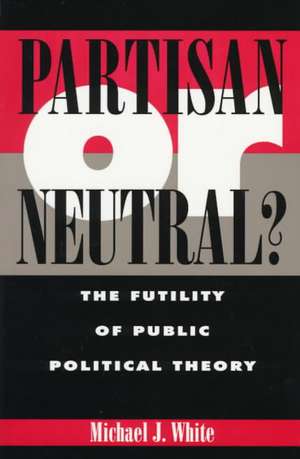
Partisan or Neutral?: The Futility of Public Political Theory: Studies in Social, Political, and Legal Philosophy
Autor Michael Whiteen Limba Engleză Paperback – 12 iun 1997
Din seria Studies in Social, Political, and Legal Philosophy
- 42%
 Preț: 139.39 lei
 - 20%
 Preț: 312.58 lei
 - 23%
 Preț: 278.65 lei
 - 24%
 Preț: 317.50 lei
 - 33%
 Preț: 368.35 lei
 - 15%
 Preț: 483.26 lei
 - 26%
 Preț: 176.61 lei
 - 32%
 Preț: 740.05 lei
 - 19%
 Preț: 324.30 lei
 - 20%
 Preț: 307.43 lei
 - 19%
 Preț: 323.17 lei
 - 30%
 Preț: 829.95 lei
 - 19%
 Preț: 315.74 lei
 - 24%
 Preț: 349.16 lei
 - 25%
 Preț: 363.41 lei
 - 21%
 Preț: 366.91 lei
 - 19%
 Preț: 315.65 lei
 - 35%
 Preț: 344.51 lei
 - 25%
 Preț: 221.53 lei
 - 31%
 Preț: 880.04 lei
 - 25%
 Preț: 217.58 lei
 - 28%
 Preț: 348.91 lei
 - 23%
 Preț: 314.50 lei
 - 26%
 Preț: 348.91 lei
 - 18%
 Preț: 331.39 lei
 - 25%
 Preț: 180.18 lei
 - 30%
 Preț: 357.53 lei
 - 24%
 Preț: 349.46 lei
Preț: 321.42 lei
Preț vechi: 398.75 lei
-19%
Puncte Express: 482
Carte tipărită la comandă
Livrare economică 07-21 decembrie
Livrare prin curier în România Termenul estimat este afișat lângă disponibilitate.
Transport gratuit de la 400.00 lei Plată online sau ramburs, în funcție de opțiunile comenzii.
Retur gratuit în 14 zile Comandă securizată și suport în română.
Specificații
ISBN-13: 9780847684540
ISBN-10: 0847684547
Pagini: 210
Dimensiuni: 147 x 229 x 17 mm
Greutate: 0.33 kg
Editura: Bloomsbury Publishing
Colecția Rowman & Littlefield
Seria Studies in Social, Political, and Legal Philosophy
Locul publicării:New York, United States
ISBN-10: 0847684547
Pagini: 210
Dimensiuni: 147 x 229 x 17 mm
Greutate: 0.33 kg
Editura: Bloomsbury Publishing
Colecția Rowman & Littlefield
Seria Studies in Social, Political, and Legal Philosophy
Locul publicării:New York, United States
Recenzii
This is a judicious and fair treatment of a number of crucial issues in contemporary political theory. It ought to be required reading for anyone in political theory, and highly recommended reading for anyone in moral philosophy, Christian ethics, or moral theology.
A very sensible, if not scintillating, treatment of a subject that is too susceptible to scintillation.
. . .pragmatic, unpredictable and marked by robust but civil argument.
In this thoughtful book, White criticizes the attempt by contemporary liberal theorists . . . to imagine liberal political principles to occupy an epistemic/moral status above the pluralistic fray of competing visions of the good.
Professor White explores a neglected but perennial issue- the partisan roots of political philosophy. Although his theme has been treated by others-the unmasking of the claim of neutrality or impartiality made by liberal public philosophy-White makes the case with a rich and impressive set of resources and arguments, and he comes up with many new insights and formulations. It is highly recommended as a lively and persuasive way into the core issues of contemporary liberal public philosophy.
A very sensible, if not scintillating, treatment of a subject that is too susceptible to scintillation.
. . .pragmatic, unpredictable and marked by robust but civil argument.
In this thoughtful book, White criticizes the attempt by contemporary liberal theorists . . . to imagine liberal political principles to occupy an epistemic/moral status above the pluralistic fray of competing visions of the good.
Professor White explores a neglected but perennial issue- the partisan roots of political philosophy. Although his theme has been treated by others-the unmasking of the claim of neutrality or impartiality made by liberal public philosophy-White makes the case with a rich and impressive set of resources and arguments, and he comes up with many new insights and formulations. It is highly recommended as a lively and persuasive way into the core issues of contemporary liberal public philosophy.
Notă biografică
Ex-drummer, Ex-software author and Ex-flares wearer Michael White was born and lives in the northwest of England. In a previous life he was the author of many text adventure games that were popular in the early 1980's. Realising that the creation of these games was in itself a form of writing he has since made the move into self-publishing, resulting in many short stories and novellas. Covering an eclectic range of subjects, the stories fall increasingly into that "difficult to categorise" genre, causing on-going headaches for the marketing department of his one man publishing company, Eighth Day Publishing.
Having accidentally sacked his marketing director (himself) three times in the last two years, he has now retired to a nice comfortable room where, if he behaves himself, they leave him to write in peace.
In his spare time (!) Michael likes to listen to all kinds of music, and is a big fan of Steven Moffat, whether he likes it or not.
Michael is currently working on several new projects and can be contacted on my own website at http://mikewhiteauthor.wordpress.com or via twitter on @mikewhiteauthor
Having accidentally sacked his marketing director (himself) three times in the last two years, he has now retired to a nice comfortable room where, if he behaves himself, they leave him to write in peace.
In his spare time (!) Michael likes to listen to all kinds of music, and is a big fan of Steven Moffat, whether he likes it or not.
Michael is currently working on several new projects and can be contacted on my own website at http://mikewhiteauthor.wordpress.com or via twitter on @mikewhiteauthor