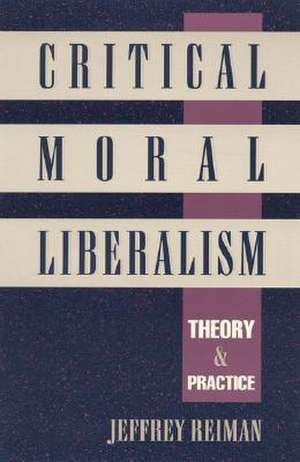
Critical Moral Liberalism: Theory and Practice: Studies in Social, Political, and Legal Philosophy
Autor Jeffrey Reimanen Limba Engleză Hardback – 30 dec 1996
Din seria Studies in Social, Political, and Legal Philosophy
- 43%
 Preț: 129.08 lei
 - 20%
 Preț: 300.63 lei
 - 24%
 Preț: 268.03 lei
 - 24%
 Preț: 305.38 lei
 - 34%
 Preț: 354.21 lei
 - 15%
 Preț: 460.78 lei
 - 27%
 Preț: 168.14 lei
 - 33%
 Preț: 705.17 lei
 - 20%
 Preț: 309.09 lei
 - 20%
 Preț: 307.43 lei
 - 20%
 Preț: 309.66 lei
 - 20%
 Preț: 301.03 lei
 - 25%
 Preț: 333.52 lei
 - 21%
 Preț: 306.36 lei
 - 26%
 Preț: 346.45 lei
 - 22%
 Preț: 351.56 lei
 - 20%
 Preț: 301.21 lei
 - 36%
 Preț: 329.37 lei
 - 26%
 Preț: 211.19 lei
 - 32%
 Preț: 842.83 lei
 - 27%
 Preț: 207.25 lei
 - 29%
 Preț: 332.69 lei
 - 24%
 Preț: 300.14 lei
 - 26%
 Preț: 348.91 lei
 - 20%
 Preț: 309.08 lei
 - 26%
 Preț: 171.58 lei
 - 30%
 Preț: 343.82 lei
 - 25%
 Preț: 334.02 lei
Preț: 790.81 lei
Preț vechi: 1148.79 lei
-31%
Puncte Express: 1186
Carte tipărită la comandă
Livrare economică 10-24 iunie
Specificații
ISBN-13: 9780847683130
ISBN-10: 0847683133
Pagini: 248
Dimensiuni: 155 x 235 x 22 mm
Greutate: 0.54 kg
Ediția:0294
Editura: Bloomsbury Publishing
Colecția Rowman & Littlefield
Seria Studies in Social, Political, and Legal Philosophy
Locul publicării:New York, United States
ISBN-10: 0847683133
Pagini: 248
Dimensiuni: 155 x 235 x 22 mm
Greutate: 0.54 kg
Ediția:0294
Editura: Bloomsbury Publishing
Colecția Rowman & Littlefield
Seria Studies in Social, Political, and Legal Philosophy
Locul publicării:New York, United States
Cuprins
Chapter 1 Preface
Chapter 2 Acknowledgments
Chapter 3 Introduction: Critical Moral Liberalism, an Overview
Part 4 Part I: Theory
Chapter 5 Liberalism, Feminism, and Multiculturalism: The Ironic Destiny of Western Philosophy
Chapter 6 Postmodern Argumentation and Post-postmodern Liberalism, with Comments on Levinas, Habermas, and Rawls
Chapter 7 Drug Addiction, Liberal Virtue, and Moral Responsibility
Chapter 8 The Labor Theory of the Difference Principle
Chapter 9 The Constitution, Rights, and the Conditions of Legitimacy
Part 10 Part II: Practice
Chapter 11 Privacy, Intimacy, and Personhood
Chapter 12 Driving to the Panopticon: A Philosophical Exploration of the Risks to Privacy Posed by the Information Technology of the Future
Chapter 13 Abortion, Infanticide, and the Asymmetric Value of Human Life
Chapter 14 On euthanasia and Health Care
Chapter 15 Is Police Discretion Justified in a Free Society? Justice, Civilization, and the Death Penalty
Chapter 16 Index
Chapter 2 Acknowledgments
Chapter 3 Introduction: Critical Moral Liberalism, an Overview
Part 4 Part I: Theory
Chapter 5 Liberalism, Feminism, and Multiculturalism: The Ironic Destiny of Western Philosophy
Chapter 6 Postmodern Argumentation and Post-postmodern Liberalism, with Comments on Levinas, Habermas, and Rawls
Chapter 7 Drug Addiction, Liberal Virtue, and Moral Responsibility
Chapter 8 The Labor Theory of the Difference Principle
Chapter 9 The Constitution, Rights, and the Conditions of Legitimacy
Part 10 Part II: Practice
Chapter 11 Privacy, Intimacy, and Personhood
Chapter 12 Driving to the Panopticon: A Philosophical Exploration of the Risks to Privacy Posed by the Information Technology of the Future
Chapter 13 Abortion, Infanticide, and the Asymmetric Value of Human Life
Chapter 14 On euthanasia and Health Care
Chapter 15 Is Police Discretion Justified in a Free Society? Justice, Civilization, and the Death Penalty
Chapter 16 Index
Recenzii
Friends of liberalism will be grateful to Jeffrey Reiman for his lucid and persuasive account . . . Skeptics and critics of liberalism must read this book be cause of the challenge it presents to their attempts to discredit liberalism. Rieman effectively shows that those very criticisms presuppose the principles of the critical moral liberalism he espouses.
These essays are unified by the author's powerful and interesting vision of liberalism. Of special note is the large-spirited and resourceful way in which Reiman incorporates insights from feminist, Marxist, and post-modernist critics without abandoning a commitment to Enlightenment ideas.
Reiman's final product is an important and stimulating work that adds fuel to the debates raging both within and over liberal theory.
This book challenges the presuppostion among professional philosophers. This striking re-evlaution of the acheivement of Descartes opens the hsitory of Western philosophy to radical reinterpretation.
The essays that make up the chapters if this book are uniformly interesting, lucidly written, and well argueddddd
Jeffrey Reiman has done what I thought was impossible. He has broadened and deepened traditional Western liberalism with feminist, multicultural, and postmodern critiques . . . he shows us how to use 'critical moral liberal' theory to provide promising new solutions to some of our oldest practical problems.
Critical Moral Liberalism is an interesting book often insightful into the symptoms of some of liberalism's recent ills. The practical questions Reiman covers demonstrade a wide range of intellectually tough issues that he addresses with thoughtful understanding and rigor. Those that think that 'liberalism' is dead do not mean by this word what Reiman means, and they will likely find their claim challenged by this newest contribution to the field of arguments.
This is a terrific book.
These essays are unified by the author's powerful and interesting vision of liberalism. Of special note is the large-spirited and resourceful way in which Reiman incorporates insights from feminist, Marxist, and post-modernist critics without abandoning a commitment to Enlightenment ideas.
Reiman's final product is an important and stimulating work that adds fuel to the debates raging both within and over liberal theory.
This book challenges the presuppostion among professional philosophers. This striking re-evlaution of the acheivement of Descartes opens the hsitory of Western philosophy to radical reinterpretation.
The essays that make up the chapters if this book are uniformly interesting, lucidly written, and well argueddddd
Jeffrey Reiman has done what I thought was impossible. He has broadened and deepened traditional Western liberalism with feminist, multicultural, and postmodern critiques . . . he shows us how to use 'critical moral liberal' theory to provide promising new solutions to some of our oldest practical problems.
Critical Moral Liberalism is an interesting book often insightful into the symptoms of some of liberalism's recent ills. The practical questions Reiman covers demonstrade a wide range of intellectually tough issues that he addresses with thoughtful understanding and rigor. Those that think that 'liberalism' is dead do not mean by this word what Reiman means, and they will likely find their claim challenged by this newest contribution to the field of arguments.
This is a terrific book.