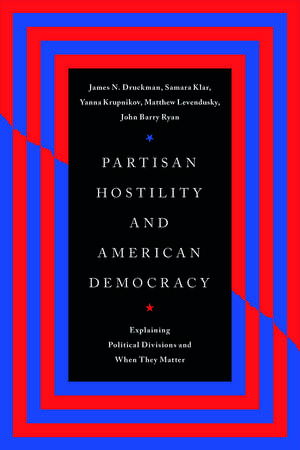
Partisan Hostility and American Democracy: Explaining Political Divisions and When They Matter: Chicago Studies in American Politics
Autor James N. Druckman, Samara Klar, Yanna Krupnikov, Matthew Levendusky, John Barry Ryanen Limba Engleză Paperback – 12 iun 2024
For generations, experts argued that American politics needed cohesive parties to function effectively. Now many fear that strong partisan views, particularly hostility to the opposing party, are damaging democracy. Is partisanship as dangerous as we fear it is?
To provide an answer, this book offers a nuanced evaluation of when and how partisan animosity matters in today’s highly charged, dynamic political environment, drawing on panel data from some of the most tumultuous years in recent American history, 2019 through 2021. The authors show that partisanship powerfully shapes political behaviors, but its effects are conditional, not constant. Instead, it is most powerful when politicians send clear signals and when an issue is unlikely to bring direct personal consequences. In the absence of these conditions, other factors often dominate decision-making.
The authors argue that while partisan hostility has degraded US politics—for example, politicizing previously non-political issues and undermining compromise—it is not in itself an existential threat. As their research shows, the future of American democracy depends on how politicians, more than ordinary voters, behave.
Din seria Chicago Studies in American Politics
-
 Preț: 175.14 lei
 -
 Preț: 202.67 lei
 - 8%
 Preț: 610.00 lei
 -
 Preț: 199.72 lei
 -
 Preț: 150.48 lei
 -
 Preț: 215.46 lei
 -
 Preț: 178.54 lei
 -
 Preț: 216.39 lei
 -
 Preț: 240.50 lei
 -
 Preț: 215.46 lei
 -
 Preț: 258.05 lei
 -
 Preț: 185.97 lei
 -
 Preț: 175.96 lei
 -
 Preț: 216.08 lei
 -
 Preț: 252.97 lei
 -
 Preț: 253.78 lei
 - 23%
 Preț: 649.82 lei
 -
 Preț: 136.84 lei
 -
 Preț: 210.15 lei
 -
 Preț: 217.39 lei
 -
 Preț: 475.52 lei
 -
 Preț: 217.06 lei
 -
 Preț: 167.85 lei
 -
 Preț: 237.17 lei
 -
 Preț: 221.41 lei
 -
 Preț: 225.92 lei
 - 23%
 Preț: 548.01 lei
 -
 Preț: 231.79 lei
 -
 Preț: 199.46 lei
 - 23%
 Preț: 558.05 lei
 - 23%
 Preț: 559.78 lei
 -
 Preț: 254.89 lei
 -
 Preț: 199.34 lei
 -
 Preț: 226.10 lei
 -
 Preț: 240.73 lei
 -
 Preț: 133.39 lei
 -
 Preț: 249.56 lei
 -
 Preț: 247.80 lei
 -
 Preț: 224.93 lei
 -
 Preț: 214.53 lei
 -
 Preț: 234.81 lei
Preț: 199.77 lei
Puncte Express: 300
Carte disponibilă
Livrare economică 19 mai-02 iunie
Livrare express 02-08 mai pentru 24.14 lei
Specificații
ISBN-13: 9780226833675
ISBN-10: 0226833674
Pagini: 272
Ilustrații: 46 line drawings, 15 tables
Dimensiuni: 152 x 229 x 28 mm
Greutate: 0.34 kg
Ediția:First Edition
Editura: University of Chicago Press
Colecția University of Chicago Press
Seria Chicago Studies in American Politics
ISBN-10: 0226833674
Pagini: 272
Ilustrații: 46 line drawings, 15 tables
Dimensiuni: 152 x 229 x 28 mm
Greutate: 0.34 kg
Ediția:First Edition
Editura: University of Chicago Press
Colecția University of Chicago Press
Seria Chicago Studies in American Politics
Notă biografică
James N. Druckman is professor of political science at the University of Rochester. Samara Klar is professor of political science at the University of Arizona. Yanna Krupnikov is professor of communication and media at the University of Michigan. Matthew Levendusky is professor of political science at the University of Pennsylvania. John Barry Ryan is associate professor in the Department of Communication and Media and the Department of Political Science at the University of Michigan.
Cuprins
1. Partisan Hostility in America
2. Animosity in American Politics
3. Analyzing the Impact of Partisan Animosity
4. How Animosity Can Fuel Issue Polarization
5. A Political Virus: How Partisan Animus Polarized Voters’ Responses to the COVID-19 Pandemic
6. Animus and Evaluations of Political Leaders
7. Partisan Animus and Political Compromise
8. A Democratic Paradox: Opposing the Practices and Norms That Uphold a Popular Democracy, with Jon Kingzette
9. The Challenges of Partisan Hostility for American Democracy
Acknowledgments
Appendixes
Notes
References
Index
2. Animosity in American Politics
3. Analyzing the Impact of Partisan Animosity
4. How Animosity Can Fuel Issue Polarization
5. A Political Virus: How Partisan Animus Polarized Voters’ Responses to the COVID-19 Pandemic
6. Animus and Evaluations of Political Leaders
7. Partisan Animus and Political Compromise
8. A Democratic Paradox: Opposing the Practices and Norms That Uphold a Popular Democracy, with Jon Kingzette
9. The Challenges of Partisan Hostility for American Democracy
Acknowledgments
Appendixes
Notes
References
Index
Recenzii
"This interesting and timely book empirically assesses the dangers presented to American democracy by partisan hostility or animosity and ideological polarization."
“Partisan Hostility and American Democracy is essential reading for those who fear that partisan hostility has pernicious consequences for mass-elite linkages as well as for the functioning (and ongoing degradation) of American democracy...The authors present a rigorous theoretical and empirical analysis of how (and when) partisanship—and more particularly animus towards political opponents—affects contemporary American partisans’ beliefs and behaviors. This is an extremely insightful, provocative, and important book.”
"Partisan Hostility and American Democracy explores the degree to which hostility affects political beliefs and behaviors, promoting the view that while partisan animosity is unlikely to directly lead to democratic breakdown or collapse, it does have deleterious effects on democracy that could contribute to erosion over time."
“The growing divide between Democrats and Republicans has sparked hundreds of academic papers and books documenting the damaging effects of affective polarization on both the quality of governance and the social fabric of political life in the United States. In this abundance of literature, Partisan Hostility and American Democracy stands out. The authors provide a comprehensive and, more importantly, nuanced account of how the rise in partisan hostility—identity-driven divisions between the political parties—shapes Americans’ perceptions of the political world, including their support for public figures and policies, political compromise, as well as democratic norms and practices.”
"Partisan Hostility and American Democracy [cites] studies on affective polarization showing that the gap between the positive feelings toward one’s own party and the negative feelings for the other party has grown in the past 20 years."
“Timely and rich, this is the best book yet written on partisan animosity in the United States. Harnessing impressive data, the authors convincingly show the powerful role of elected officials in magnifying tensions in the citizenry.”
“Although there's been extensive documentation of the existence of partisan animosity and affective polarization, there's been little research attempting to understand whether this behavior affects democratic governance. Through extensive data collection and rigorous research design, the authors show that partisan animosity won't lead to immediate democratic collapse but instead can lead to long-term erosion of norms.”