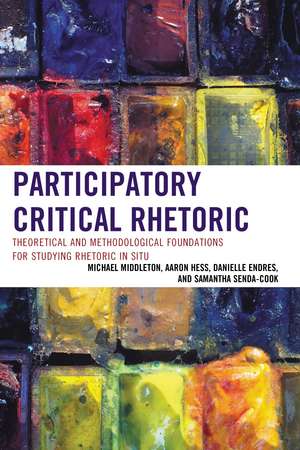
Participatory Critical Rhetoric: Theoretical and Methodological Foundations for Studying Rhetoric In Situ: Lexington Books
Autor Michael Middleton, Aaron Hess, Danielle Endres, Samantha Senda-Cooken Limba Engleză Paperback – 17 iul 2017
Din seria Lexington Books
- 32%
 Preț: 729.63 lei
 - 59%
 Preț: 427.24 lei
 - 35%
 Preț: 574.44 lei
 - 22%
 Preț: 341.76 lei
 - 31%
 Preț: 437.25 lei
 - 28%
 Preț: 352.50 lei
 - 23%
 Preț: 321.53 lei
 - 23%
 Preț: 333.36 lei
 - 23%
 Preț: 327.54 lei
 - 35%
 Preț: 593.04 lei
 - 33%
 Preț: 358.06 lei
 - 26%
 Preț: 363.28 lei
 - 24%
 Preț: 374.46 lei
 - 22%
 Preț: 330.56 lei
 - 28%
 Preț: 346.74 lei
 - 24%
 Preț: 308.07 lei
 - 23%
 Preț: 321.63 lei
 - 27%
 Preț: 263.04 lei
 - 24%
 Preț: 369.89 lei
 - 25%
 Preț: 884.44 lei
 - 36%
 Preț: 730.77 lei
 - 29%
 Preț: 345.71 lei
 - 33%
 Preț: 556.03 lei
 - 33%
 Preț: 428.79 lei
 - 34%
 Preț: 616.07 lei
 - 29%
 Preț: 342.12 lei
 - 26%
 Preț: 362.85 lei
 - 22%
 Preț: 338.89 lei
 - 28%
 Preț: 356.18 lei
 - 23%
 Preț: 321.63 lei
 - 28%
 Preț: 346.74 lei
 - 22%
 Preț: 340.40 lei
 - 29%
 Preț: 345.71 lei
 - 22%
 Preț: 329.89 lei
 - 37%
 Preț: 660.07 lei
 - 27%
 Preț: 355.41 lei
 - 32%
 Preț: 727.58 lei
 - 24%
 Preț: 313.51 lei
 - 28%
 Preț: 614.62 lei
 - 24%
 Preț: 309.62 lei
 - 34%
 Preț: 630.22 lei
 - 34%
 Preț: 575.26 lei
 - 34%
 Preț: 607.70 lei
 - 33%
 Preț: 639.19 lei
 - 33%
 Preț: 642.37 lei
 - 33%
 Preț: 640.95 lei
 - 25%
 Preț: 369.74 lei
Preț: 329.37 lei
Preț vechi: 426.35 lei
-23%
Puncte Express: 494
Carte tipărită la comandă
Livrare economică 08-22 decembrie
Livrare prin curier în România Termenul estimat este afișat lângă disponibilitate.
Transport gratuit de la 400.00 lei Plată online sau ramburs, în funcție de opțiunile comenzii.
Retur gratuit în 14 zile Comandă securizată și suport în română.
Specificații
ISBN-13: 9781498513821
ISBN-10: 1498513824
Pagini: 242
Dimensiuni: 150 x 230 x 19 mm
Greutate: 0.36 kg
Editura: Bloomsbury Publishing
Colecția Lexington Books
Seria Lexington Books
Locul publicării:New York, United States
ISBN-10: 1498513824
Pagini: 242
Dimensiuni: 150 x 230 x 19 mm
Greutate: 0.36 kg
Editura: Bloomsbury Publishing
Colecția Lexington Books
Seria Lexington Books
Locul publicării:New York, United States
V-ar putea interesa
-
 Rhetoric and Educational Discourse: Persuasive TextsRichard Edwards-18%Preț: 1252.01 lei1526.85 lei
 -
 Introducing English SemanticsCharles Kreidler-18%Preț: 1297.28 lei1582.05 lei
 -
 -32%Preț: 561.66 lei830.78 lei
 -
 Logical Structure and Linguistic StructureC-T James HuangPreț: 402.21 lei
 -
 Preț: 301.62 lei
 -
 Preț: 281.00 lei
 -
 Language and TimeVyvyan Evans-14%Preț: 756.27 lei879.38 lei
 -
 A Handbook of Precis-WritingE. Derry EvansPreț: 253.45 lei
 -
 Using Corpora to Analyze GenderPaul Baker-25%Preț: 1025.71 lei1359.68 lei
 -
 Circus as Multimodal Discourse: Performance, Meaning, and RitualProfessor Emeritus Paul Bouissac-22%Preț: 287.47 lei368.98 lei
 -
 IcescapeGerry O. NolanPreț: 123.81 lei
 -
 Integrative Document and Content ManagementMichael Middleton-15%Preț: 497.30 lei585.06 lei
 -
 Social Movement to Address Climate ChangeDanielle Endres-9%Preț: 746.00 lei819.78 lei
 -
 The Critical Writer: Inquiry and the Writing ProcessJoyce Armstrong Carroll-36%Preț: 203.52 lei319.94 lei
 -
 Trained CapacitiesBrian JacksonPreț: 467.45 lei
 -
 -23%Preț: 1712.64 lei2224.21 lei
 -
 Typology of Kinship TermsLarysa Nikolayeva-23%Preț: 481.02 lei624.70 lei
 -
 Preț: 424.87 lei
 -
 Preț: 323.51 lei
 -
 -23%Preț: 786.87 lei1021.90 lei
 -
 Knowledge and LanguageF. R. AnkersmitPreț: 373.00 lei
Cuprins
Dedication
Acknowledgments
Introduction
1.Theorizing Participatory Critical Rhetoric
2.The Politics of Participatory Critical Rhetoric
3.An Embodied Critical Presence
4.From Context to Field in Participatory Critical Rhetoric
5.Participants and Perspectives
Conclusion
Acknowledgments
Introduction
1.Theorizing Participatory Critical Rhetoric
2.The Politics of Participatory Critical Rhetoric
3.An Embodied Critical Presence
4.From Context to Field in Participatory Critical Rhetoric
5.Participants and Perspectives
Conclusion
Recenzii
Since its inception in ancient Greece, rhetoric has been inseparable from public life. Born of the polis, where orality had not yet ceded its eminence to literacy, rhetoric developed as a verbal art in response to exigencies inevitable in urban communal affairs ruled by citizens through more or less deliberative processes. Little wonder then that one finds Aristotle's formulation of rhetoric as one of technique (techne), in contradistinction to poetics, which is concerned with pure making (poiesis) as reflected in the Attic drama or tragedy. Participatory Critical Rhetoric is a timely addition to the time-honored tradition of Western rhetorical scholarship. Reflective of a time when rhetorical perspective is proving to be as salutary as any discipline in the humanities and social sciences, this book brings the study of rhetoric to the cusp of 21st-century social theories and criticism in general. It does so-and this is the collection's most distinguishing feature-by updating rhetorical studies with such research tools as participatory observation, interview, and related qualitative methods. Well organized, clearly written, and rich in ethnographic insights, this book will be a useful guide for scholars interested in recapturing the rhetors' voices, unavoidably muffled by dominant media and conventional documentation. Summing Up: Highly recommended. Upper-division undergraduates through faculty.
Overall, Participatory Critical Rhetoric makes significant developments by providing numerous helpful heuristics for theorizing and carrying out field-based rhetorical work. It will be indispensable for scholars interested in critical rhetoric or in situ rhetorical analysis. It will also be helpful for scholars invested in activism, body rhetoric, affect, or rhetoric and place.
Participatory Critical Rhetoric heralds a watershed moment in rhetorical studies, in which the field is no longer accepting the characterization of such approaches as merely marginal or experimental. Embodying the collaborative spirit they wish to encourage, Middleton, Hess, Endres, and Senda-Cook weave their own fieldwork notes and insights throughout their synthesis of key terms and figures of this scholarly tradition.
Written by the leading proponents and practitioners of rhetorical field methods, this book combines deep scholarship and the authors' personal experiences to illustrate the scholarly and political importance of studying rhetorical places. I recommend this book to my students and colleagues who are exploring place, space, and progressive political practice.
Participatory Critical Rhetoric is a timely contribution to the growing conversation surrounding field methods, critical rhetoric, and participatory research. By focusing on four topoi-immanent politics, critical embodiment, emplaced fields of rhetoric, and gaining perspectives from participants-this book elegantly weaves on-the-ground experiences and sense making with conceptual and theoretical understandings of rhetoric. The result is a truly novel accounting of participatory critical rhetoric that illuminates its comprehensive character.
Participatory Critical Rhetoric provides a valuable framework for conducting participatory and critical field research that can contribute to social and political change. Clearly written and including the four authors' illustrative "tales from the field," it is an excellent text for graduate and upper-level undergraduate students as well as scholar-activists in rhetoric.
Overall, Participatory Critical Rhetoric makes significant developments by providing numerous helpful heuristics for theorizing and carrying out field-based rhetorical work. It will be indispensable for scholars interested in critical rhetoric or in situ rhetorical analysis. It will also be helpful for scholars invested in activism, body rhetoric, affect, or rhetoric and place.
Participatory Critical Rhetoric heralds a watershed moment in rhetorical studies, in which the field is no longer accepting the characterization of such approaches as merely marginal or experimental. Embodying the collaborative spirit they wish to encourage, Middleton, Hess, Endres, and Senda-Cook weave their own fieldwork notes and insights throughout their synthesis of key terms and figures of this scholarly tradition.
Written by the leading proponents and practitioners of rhetorical field methods, this book combines deep scholarship and the authors' personal experiences to illustrate the scholarly and political importance of studying rhetorical places. I recommend this book to my students and colleagues who are exploring place, space, and progressive political practice.
Participatory Critical Rhetoric is a timely contribution to the growing conversation surrounding field methods, critical rhetoric, and participatory research. By focusing on four topoi-immanent politics, critical embodiment, emplaced fields of rhetoric, and gaining perspectives from participants-this book elegantly weaves on-the-ground experiences and sense making with conceptual and theoretical understandings of rhetoric. The result is a truly novel accounting of participatory critical rhetoric that illuminates its comprehensive character.
Participatory Critical Rhetoric provides a valuable framework for conducting participatory and critical field research that can contribute to social and political change. Clearly written and including the four authors' illustrative "tales from the field," it is an excellent text for graduate and upper-level undergraduate students as well as scholar-activists in rhetoric.