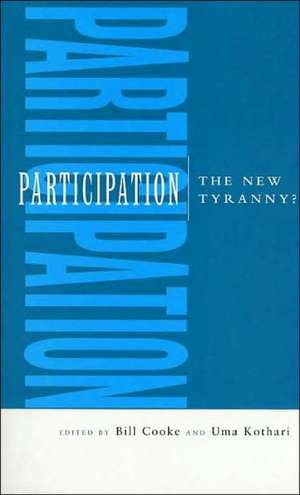
Participation
Editat de Bill Cooke, Uma Kotharien Limba Engleză Hardback – 31 ian 2001
Preț: 415.10 lei
Puncte Express: 623
Carte tipărită la comandă
Livrare economică 20 noiembrie-01 decembrie
Livrare prin curier în România Termenul estimat este afișat lângă disponibilitate.
Transport gratuit pentru acest produs Plată online sau ramburs, în funcție de opțiunile comenzii.
Retur gratuit în 14 zile Comandă securizată și suport în română.
Specificații
ISBN-13: 9781856497930
ISBN-10: 1856497933
Pagini: 224
Ilustrații: figures, notes, bibliography, index
Dimensiuni: 140 x 223 x 20 mm
Greutate: 0.3 kg
Editura: ZED BOOKS
Locul publicării:United Kingdom
ISBN-10: 1856497933
Pagini: 224
Ilustrații: figures, notes, bibliography, index
Dimensiuni: 140 x 223 x 20 mm
Greutate: 0.3 kg
Editura: ZED BOOKS
Locul publicării:United Kingdom
V-ar putea interesa
-
 -14%Preț: 854.30 lei993.37 lei
 -
 -15%Preț: 435.49 lei512.34 lei
 -
 -14%Preț: 1360.17 lei1581.59 lei
 -
 -18%Preț: 1266.13 lei1544.07 lei
 -
 The Bird of EnduranceBill CookePreț: 134.10 lei
 -
 Shades of Gray, Splashes of ColorBill CookePreț: 107.77 lei
 -
 GorgoBill CookePreț: 180.02 lei
 -
 -21%Preț: 165.03 lei207.68 lei
 -
 The New Development Management: Critiquing the Dual ModernizationAssociate Professor in Interdisciplinary Global Management Sadhvi Dar-17%Preț: 245.24 lei294.93 lei
 -
 Earth Summit 2002: A New DealFelix DoddsPreț: 317.78 lei
 -
 -20%Preț: 159.72 lei199.96 lei
Descriere
Descriere de la o altă ediție sau format:
This book is about participatory development's potential for tyranny, showing how it can lead to the unjust and illegitimate exercise of power. It is the first book-length treatment to address the gulf between the almost universally fashionable rhetoric of participation, which promises empowerment and appropriate development on the one hand, and what actually happens when consultants and activists promote and practise participatory development, on the other.
The contributors, all social scientists and development specialists, come from various disciplines and a wide variety of hands on experience. Their aim is to provide a sharp contrast to the seductive claims of participation, and to warn its advocates of the pitfalls and limitations of participatory development. The book also challenges participatory practitioners and theorists to reassess their own role in promoting a set of practices which are at best naive about questions of power, and at worst serve systematically to reinforce, rather than overthrow, existing inequalities.
For the recipients of participatory development this book provides critical insights into the history, institutions, and day-to-day activities through which participation is 'done to' them. It provides them with a range of arguments which support the legitimate decision not to participate on others' terms.
This rigorous and provocative understanding of participatory development is one which donors, academics and practitioners will find hard to ignore.
This book is about participatory development's potential for tyranny, showing how it can lead to the unjust and illegitimate exercise of power. It is the first book-length treatment to address the gulf between the almost universally fashionable rhetoric of participation, which promises empowerment and appropriate development on the one hand, and what actually happens when consultants and activists promote and practise participatory development, on the other.
The contributors, all social scientists and development specialists, come from various disciplines and a wide variety of hands on experience. Their aim is to provide a sharp contrast to the seductive claims of participation, and to warn its advocates of the pitfalls and limitations of participatory development. The book also challenges participatory practitioners and theorists to reassess their own role in promoting a set of practices which are at best naive about questions of power, and at worst serve systematically to reinforce, rather than overthrow, existing inequalities.
For the recipients of participatory development this book provides critical insights into the history, institutions, and day-to-day activities through which participation is 'done to' them. It provides them with a range of arguments which support the legitimate decision not to participate on others' terms.
This rigorous and provocative understanding of participatory development is one which donors, academics and practitioners will find hard to ignore.
Cuprins
1. The Case for Participation as Tyranny - Bill Cooke and Uma Kothari
2. 'People's Knowledge', Participation and Patronage: Operations and Representations in Rural Development - David Mosse
3. Institutions, Agency and the Limitations of Participatory Approaches to Development - Frances Cleaver
4. Pluralism, Participation and Power: Joint Forest Management in India - Nicholas Hildyard, Pandurang Hegde, Paul Wolvekamp, Somasekhare Reddy
5. Participatory Development at the World Bank: The Primacy of Process - Paul Francis
6. Beyond the Formulaic: Process and Practice in South Asian NGOs - John Hailey
7. The Social-Psychological Limits of Participation? - Bill Cooke
8. Insights into Participation from Critical Management and Labour Process Perspectives - Harry Taylor
9. Participatory Development: Power, Knowledge and Social Control - Uma Kothari
10. Beyond Participation: Strategies for Deeper Empowerment - Giles Mohan
11. Participation as Spiritual Duty: Empowerment as Secular Subjection - Heiko Henkel and Roderick Stirrat
Bibliography
2. 'People's Knowledge', Participation and Patronage: Operations and Representations in Rural Development - David Mosse
3. Institutions, Agency and the Limitations of Participatory Approaches to Development - Frances Cleaver
4. Pluralism, Participation and Power: Joint Forest Management in India - Nicholas Hildyard, Pandurang Hegde, Paul Wolvekamp, Somasekhare Reddy
5. Participatory Development at the World Bank: The Primacy of Process - Paul Francis
6. Beyond the Formulaic: Process and Practice in South Asian NGOs - John Hailey
7. The Social-Psychological Limits of Participation? - Bill Cooke
8. Insights into Participation from Critical Management and Labour Process Perspectives - Harry Taylor
9. Participatory Development: Power, Knowledge and Social Control - Uma Kothari
10. Beyond Participation: Strategies for Deeper Empowerment - Giles Mohan
11. Participation as Spiritual Duty: Empowerment as Secular Subjection - Heiko Henkel and Roderick Stirrat
Bibliography
Recenzii
Unmasks the moral tyranny imposed through the language of participation which has come to dominate the discourse of 'devspeak'. In exploring participatory practices from several points of view - social psychology, sociology of management, Goffman's analysis of social performance, Foucauldian analysis of discourses and their power - it shows how radical and democratic language may be co-opted with the aim of bringing people's views and expectations into line with the plans devised, with their participation, by their betters. Makes a vital contribution to the sociology of development.
A timely critique of the participation discourse and expose of the seductive arts of official incorporation. Essential reading for all those studying and practising international development as well as social policy nearer home.
A timely critique of the participation discourse and expose of the seductive arts of official incorporation. Essential reading for all those studying and practising international development as well as social policy nearer home.