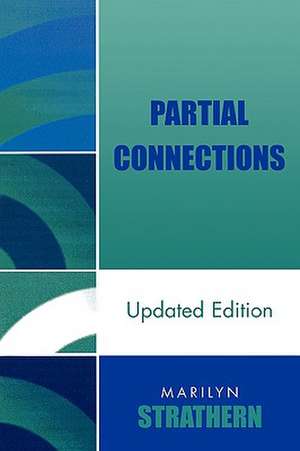
Partial Connections
Autor Marilyn Strathernen Limba Engleză Paperback – 3 mar 2005
Observăm în această ediție actualizată a lucrării Partial Connections o rafinare a metodologiei prin care Marilyn Strathern chestionează modul în care antropologii gestionează volumul și complexitatea materialelor de teren. Structura volumului este organizată în două secțiuni majore care ghidează cititorul de la procesul scrierii etnografice („Writing Anthropology”) către o explorare a legăturilor interconectate („Partial Connections”). Remarcăm modul în care autoarea utilizează exemplele din Melanesia nu doar ca date brute, ci ca un comentariu asupra percepției și a modului în care formele indigene se întrepătrund cu teoriile occidentale.
Apreciem progresia logică a conținutului, care începe cu evocarea etnografică și cunoașterea incompletă în societățile complexe, trecând prin critica feministă și ajungând la concepte inovatoare precum „extensiile protetice”. Această abordare extinde cadrul propus de Comparison in Anthropology de Matei Candea, aducând o perspectivă critică asupra modului în care scara și proporția influențează validitatea comparațiilor cross-culturale. Dacă în Relations – An Anthropological Account, Strathern analiza conceptul de relație ca instrument central al disciplinei, în Partial Connections ea se concentrează pe limitările inerente ale acestor conexiuni, argumentând că nicio descriere nu poate fi exhaustivă.
Merită menționat că lucrarea reușește să echilibreze dezbaterile teoretice actuale cu detaliile culturale fine, oferind o soluție metodologică pentru problema „excesului de informație” în antropologia contemporană. Stilul este dens și tehnic, reflectând rigoarea academică specifică operei lui Strathern, dar rămâne accesibil prin utilizarea unor imagini vizuale puternice și a unei structuri care invită la reflecție asupra propriilor instrumente de cercetare.
Preț: 283.82 lei
Carte tipărită la comandă
Livrare economică 26 noiembrie-10 decembrie
Specificații
ISBN-10: 0759107602
Pagini: 153
Dimensiuni: 148 x 226 x 12 mm
Greutate: 0.31 kg
Ediția:Updated
Editura: Bloomsbury Publishing
Colecția AltaMira Press
Locul publicării:New York, United States
V-ar putea interesa
-
 Culture EvolvesAndrew Whiten-31%Preț: 923.98 lei1336.84 lei
 -
 IndographyJ. Harris-15%Preț: 669.54 lei787.70 lei
 -
 Starting from Quirpini – The Travels and Places of a Bolivian PeopleStuart Alexande RockefellerPreț: 160.91 lei
 -
 Memorials and Martyrs in Modern LebanonLucia VolkPreț: 158.13 lei
 -
 Preț: 200.07 lei
 -
 Myth, Ritual and the OralJack GoodyPreț: 182.71 lei
 -
 How Modernity ForgetsPaul ConnertonPreț: 179.99 lei
 -
 Social Anthropology and Human OriginsAlan BarnardPreț: 220.43 lei
 -
 War and the Crisis of Youth in Sierra LeoneKrijn Peters-15%Preț: 512.49 lei603.37 lei
 -
 The Nature of CollegeJames J. FarrellPreț: 99.03 lei
 -
 -15%Preț: 426.44 lei501.70 lei
 -
 Magic: A Beginner's GuideRobert RalleyPreț: 74.78 lei
De ce să citești această carte
Recomandăm această carte cercetătorilor și studenților la antropologie care doresc să depășească modelele clasice de reprezentare a societăților complexe. Cititorul câștigă o înțelegere profundă a modului în care scara analizei influențează rezultatele cercetării. Este o lectură esențială pentru a înțelege tranziția de la etnografia tradițională la critica post-structuralistă, oferind instrumente conceptuale pentru a naviga între detaliul local și comparația globală.
Despre autor
Marilyn Strathern este profesor emerit de antropologie socială „William Wyse” la Universitatea din Cambridge și fostă conducătoare a colegiului Girton. Recunoscută la nivel internațional pentru cercetările sale de teren în zonele muntoase din Papua Noua Guinee, ea a influențat decisiv antropologia contemporană, fiind distinsă în 2003 cu Medalia Viking Fund. Opera sa, care include titluri de referință precum The Gender of the Gift și After Nature, explorează teme complexe legate de gen, rudenie, proprietate și natura relațiilor sociale, poziționând-o ca o figură centrală în teoria etnografică modernă.
Descriere
Cuprins
Chapter 2 Ethnography as Evocation
Chapter 3 Complex society; incomplete knowledge
Chapter 4 Feminist critique
Chapter 5 Intrusions and comparisons
Part 6 Partial Connections
Chapter 7 Full of trees, full of flutes
Chapter 8 Center and periphery
Chapter 9 Historical critique
Chapter 10 Prosthetic extensions
Recenzii
On its initial publication in 1991, Partial Connections provided a bracing, subtle, and brilliantly wrought complex of forays into questions at the center of anthropology, among them history, comparison, representation, and the productively partial character of our shared enterprise. On rereading more than ten years later, it speaks with even greater clarity and insight to anthropological practice. Fresh, brilliant, and deeply rewarding, this is a contemporary classic.
Strathern's Partial Connections, perhaps her most theoretically exhilarating and accessible work to date, offers a potent antidote to any disenchanting effects of the comparative project in anthropology...More than a spectacular collection of provocative throught bites, Partial Connections has far-reaching implications for the way we think about the future of anthropology, and about problems of authoring and athorizing criteria for comparison...This is essential reading for serious students of cultural criticism and, quite simply, a brilliant piece of anthropological discourse