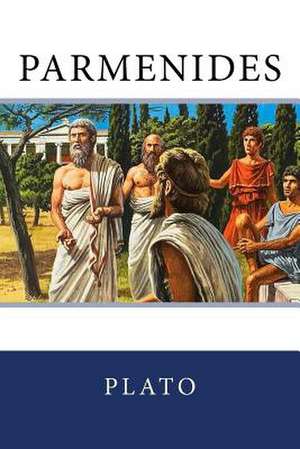
Parmenides
Autor Plato Traducere de Benjamin Jowetten Limba Engleză Paperback
Preț: 87.88 lei
Puncte Express: 132
Carte disponibilă
Livrare economică 17 noiembrie-01 decembrie
Livrare prin curier în România Termenul estimat este afișat lângă disponibilitate.
Transport gratuit de la 400.00 lei Plată online sau ramburs, în funcție de opțiunile comenzii.
Retur gratuit în 14 zile Comandă securizată și suport în română.
Specificații
ISBN-13: 9781983869914
ISBN-10: 1983869910
Pagini: 132
Dimensiuni: 152 x 229 x 7 mm
Greutate: 0.19 kg
ISBN-10: 1983869910
Pagini: 132
Dimensiuni: 152 x 229 x 7 mm
Greutate: 0.19 kg
V-ar putea interesa
-
 RepublicPlatoPreț: 30.76 lei
 -
 SymposiumPlatoPreț: 27.76 lei
 -
 -24%Preț: 222.90 lei294.14 lei
 -
 -24%Preț: 224.75 lei296.10 lei
 -
 -22%Preț: 307.53 lei391.95 lei
 -
 Parmenides: New PerspectivesA.G. Long-27%Preț: 535.89 lei737.10 lei
 -
 Preț: 84.27 lei
 -
 Great Dialogues of PlatoPlatoPreț: 54.11 lei
 -
 A History of Western PhilosophyBertrand RussellPreț: 196.21 lei
 -
 Preț: 233.34 lei
 -
 -14%Preț: 522.41 lei607.45 lei
 -
 The Pocket Book of PlatoMichael MoorePreț: 72.54 lei
 -
 Preț: 66.00 lei
 -
 Why Plato Matters NowAngie Hobbs-24%Preț: 93.14 lei122.47 lei
 -
 TimaeusPlatoPreț: 39.06 lei
 -
 CratylusPlatoPreț: 44.59 lei
 -
 TheaetetusPlatoPreț: 46.76 lei
 -
 PhaedoPlatoPreț: 43.59 lei
 -
 Preț: 58.13 lei
Descriere
Descriere de la o altă ediție sau format:
This is an English translation of one of the more challenging and enigmatic of Plato's dialogues between Socrates and Parmenides and Zeno of Elea, that begins with Zeno defending his treatise of Parmenidean monism against those partisans of plurality.
Focus Philosophical Library translations are close to and are non-interpretative of the original text, with the notes and a glossary intending to provide the reader with some sense of the terms and the concepts as they were understood by Plato’s immediate audience.
Recenzii
Keith Whitaker's insightful introduction to this notoriously daunting text is valuable for its clarity and sobriety. The lucid interpretation will be of interest to those versed in the text and will be of great help to any who encounter the dialogue for the first time. The engaging translation humanizes the discourse without compromising its precision - a notable achievement that will earn the gratitude of readers.
--Joseph Cropsey, University of Chicago
Translation in English, including an introduction and a brief glossary. This dialogue is among Plato’s most difficult. Whitaker provides a clear entry to Plato and Platonic thinking and a succinct translation of the work itself.
Notă biografică
Plato was an ancient Greek philosopher born in Athens during the Classical period in Ancient Greece. In Athens, Plato founded the Academy, a philosophical school where he taught the philosophical doctrines that would later become known as Platonism. Plato (or Platon) was a pen name derived, apparently, from the nickname given to him by his wrestling coach - allegedly a reference to his physical broadness. According to Alexander of Miletus quoted by Diogenes of Sinope his actual name was Aristocles, son of Ariston, of the deme Collytus (Collytus being a district of Athens).Plato was an innovator of the written dialogue and dialectic forms in philosophy. He raised problems for what later became all the major areas of both theoretical philosophy and practical philosophy. His most famous contribution is the Theory of forms, which has been interpreted as advancing a solution to what is now known as the problem of universals. He is also the namesake of Platonic love and the Platonic solids.His own most decisive philosophical influences are usually thought to have been, along with Socrates, the pre-Socratics Pythagoras, Heraclitus, and Parmenides, although few of his predecessors' works remain extant and much of what we know about these figures today derives from Plato himself.[a]Along with his teacher, Socrates, and his student, Aristotle, Plato is a central figure in the history of philosophy.[b] Unlike the work of nearly all of his contemporaries, Plato's entire body of work is believed to have survived intact for over 2,400 years.[6] Although their popularity has fluctuated, Plato's works have consistently been read and studied. Through Neoplatonism Plato also greatly influenced both Christian and Islamic philosophy (through e.g. Al-Farabi). In modern times, Alfred North Whitehead famously said: "the safest general characterization of the European philosophical tradition is that it consists of a series of footnotes to Plato.