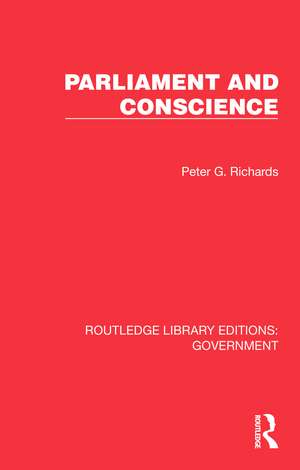
Parliament and Conscience: Routledge Library Editions: Government
Autor Peter G. Richardsen Limba Engleză Hardback – 26 iun 2024




Preț: 685.81 lei
Preț vechi: 836.35 lei
-18%
Puncte Express: 1029
Carte tipărită la comandă
Livrare economică 03-17 decembrie
Livrare prin curier în România Termenul estimat este afișat lângă disponibilitate.
Transport gratuit pentru acest produs Plată online sau ramburs, în funcție de opțiunile comenzii.
Retur gratuit în 14 zile Comandă securizată și suport în română.
Specificații
ISBN-13: 9781032782751
ISBN-10: 1032782757
Pagini: 230
Dimensiuni: 138 x 216 x 14 mm
Greutate: 0.59 kg
Ediția:1
Editura: Taylor & Francis
Colecția Routledge
Seria Routledge Library Editions: Government
Locul publicării:Oxford, United Kingdom
ISBN-10: 1032782757
Pagini: 230
Dimensiuni: 138 x 216 x 14 mm
Greutate: 0.59 kg
Ediția:1
Editura: Taylor & Francis
Colecția Routledge
Seria Routledge Library Editions: Government
Locul publicării:Oxford, United Kingdom
Public țintă
Postgraduate and Undergraduate AdvancedCuprins
1.Introduction Through History 2. The Basis of the Present System 3. Central Control of Local Government 4. Finance 5. The Constitution of a Local Authority 6. Committees 7. The Quest for Efficiency 8. The Reorganization of Structure 9. Local Government and Society. Appendices: A: Distribution of Functions B: Local Authority Populations C: Representation on Outside Bodies: The Association of Municipal Corporations
Descriere
Originally published in 1970, this book has a dual purpose. Firstly, it is a study of how Parliament works when the party whips are withdrawn. The author shows how backbenchers can create legislation of great importance; he demonstrates the obstacles, political and procedural to social reform.