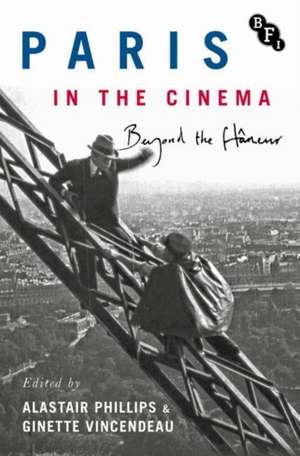
Paris in the Cinema: Beyond the Flâneur
Editat de Alastair Phillips, Ginette Vincendeauen Limba Engleză Paperback – 29 noi 2017
Preț: 221.37 lei
Preț vechi: 299.99 lei
-26%
Puncte Express: 332
Carte disponibilă
Livrare economică 16-30 noiembrie
Livrare prin curier în România Termenul estimat este afișat lângă disponibilitate.
Transport gratuit de la 400.00 lei Plată online sau ramburs, în funcție de opțiunile comenzii.
Retur gratuit în 14 zile Comandă securizată și suport în română.
Specificații
ISBN-13: 9781844578177
ISBN-10: 1844578178
Pagini: 278
Ilustrații: 50 bw illus
Dimensiuni: 154 x 234 x 18 mm
Greutate: 0.46 kg
Ediția:1st ed. 2018
Editura: Bloomsbury Publishing
Colecția British Film Institute
Locul publicării:London, United Kingdom
ISBN-10: 1844578178
Pagini: 278
Ilustrații: 50 bw illus
Dimensiuni: 154 x 234 x 18 mm
Greutate: 0.46 kg
Ediția:1st ed. 2018
Editura: Bloomsbury Publishing
Colecția British Film Institute
Locul publicării:London, United Kingdom
Cuprins
Acknowledgements.- Beyond the flâneur: an introduction; Alastair Phillips and Ginette Vincendeau.- PART 1: LOCATIONS.- The Eiffel Tower: a Parisian film star; Nicoleta Bazgan.- Working-class Paris and post-war noir: Les Portes de la nuit; Thomas Pillard.- The caves of Saint-Germain-des-Prés in 1950s French cinema; Sébastien Layerle.- Le Signe du lion: Paris in the summer of 1959; Michel Marie.- Truffaut's apartments; Hilary Radner and Alistair Fox.- The New Wave hotel; Roland-François Lack.- The vanishing of Les Halles; Catherine E. Clark.- The Parisian banlieue on screen: so close, yet so far; Ginette Vincendeau.- PART 2: CHARACTERS.- Maigret from across the Channel; Charlotte Brunsdon.- Parisian cinephiles and the Mac-Mahon; Leila Wimmer.- Beyond the flâneuse: the uniqueness of Cléo de 5 à 7; Jennifer Wallace.- Amateur filmmakers' Paris: home movies at the Forum des images; Roger Odin.- The concierge in contemporary French Cinema; Raphaëlle Moine.- Parisian lovers in the contemporary romcom; Mary Harrod.- The enduring glamour of the Parisienne; Stephen Gundle.- PART 3: HISTORY.- Charles Dickens's Two Cities; Colin Jones.- From Meryon to Ulmer's Bluebeard: a Baudelairian iconography; Jean-Loup Bourget.- Site of infamy: the Vel' d'Hiv in French cinema; Sandy Flitterman-Lewis.- 'Unremarkable Paris': Jacques Becker's Urban Everyday; Alastair Phillips.- Television and the renewal of Paris, from official discourse to social criticism; Hélène Jannière.- Parisian building sites (1945-1975): from modernity to abstraction; Marie Gaimard and Marguerite Vappereau.- The mirror of a city: the 'Parisian Collection' of the Forum des images; Jean-Yves de Lépinay.- INTERVIEW.- Filming Paris: an interview with Jean-Pierre Jeunet.- Contributors.- Select bibliography.
Recenzii
Contributors ... include rich and valuable reflections on a range of issues, such as Parisian amateur film-making, Charles Dickens' debt to Paris and contemporary cinema's representation of les banlieues. In addition to the remarkable essays, this book includes Isabelle Vanderschelden's brilliant interview with Jean-Pierre Jeunet (director of Amélie, 2001).
This is a compelling selection of stimulating essays for all lovers of Paris and French cinema ... Vincendeau and Phillips have produced a seminal work which doubles as a leading reference and an accessible entry point for those of us who enjoy learning how to read French cinema as the reflection of a complex and troubling society that, at its best, succeeds in challenging clichés and uncovering taboos.
This is a compelling selection of stimulating essays for all lovers of Paris and French cinema ... Vincendeau and Phillips have produced a seminal work which doubles as a leading reference and an accessible entry point for those of us who enjoy learning how to read French cinema as the reflection of a complex and troubling society that, at its best, succeeds in challenging clichés and uncovering taboos.