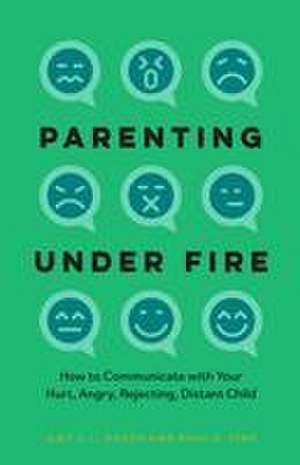
Parenting Under Fire: How to Communicate with Your Hurt, Angry, Rejecting, Distant Child
Autor Amy J.L. Baker, PhD, Paul R. Fine, LCSWen Limba Engleză Hardback – 15 aug 2023
Children who are hurt, angry, rejecting, and distant (HARD) can be challenging for parents. They can be rude, uncooperative, and disagreeable. They are often hard to relate to or connect with. Parents are left wondering how to handle such children before their relationship is irrevocably damaged. They need help!
Parenting Under Fire provides parents of hurt, angry, rejecting, distant children the guidance and support they need to connect with their children and repair relationships while opening the lines of communication. The book is divided into three sections, each focusing on a different form of communication: in-person, via text messages, and through letters--the latter especially beneficial for those wanting to bridge gaps and repair wounds with older children. It offers parents with the science-based hope and inspiration they need, as well as hundreds of practical suggestions about how to keep the communication loving, appropriate, and connected.
Losing or feeling like you are about to lose a relationship with a beloved child, regardless of the cause, is one of the most painful scenarios a parent will ever experience. Parenting Under Fire gives parents the tools and strategies to repair that relationship so their family can move forward with love, empathy, and understanding.
Preț: 181.98 lei
Preț vechi: 240.77 lei
-24%
Puncte Express: 273
Carte tipărită la comandă
Livrare economică 18 noiembrie-02 decembrie
Livrare prin curier în România Termenul estimat este afișat lângă disponibilitate.
Transport gratuit de la 400.00 lei Plată online sau ramburs, în funcție de opțiunile comenzii.
Retur gratuit în 14 zile Comandă securizată și suport în română.
Specificații
ISBN-13: 9781538179062
ISBN-10: 1538179067
Pagini: 252
Dimensiuni: 144 x 218 x 22 mm
Greutate: 0.47 kg
Editura: Bloomsbury Publishing
Colecția Rowman & Littlefield
Locul publicării:New York, United States
ISBN-10: 1538179067
Pagini: 252
Dimensiuni: 144 x 218 x 22 mm
Greutate: 0.47 kg
Editura: Bloomsbury Publishing
Colecția Rowman & Littlefield
Locul publicării:New York, United States
Cuprins
Part 1: How to Communicate In-Person with a Hurt, Angry, Rejecting, Distant Child
1. Enhance the Attachment
2. Don't Take the Bait
3. Foster Three Values
4. Teach Critical Thinking Skills
5. Invite Criticism
6. Be a Positive Parent
Part 2: How to Communicate by Text Message with a Hurt, Angry, Rejecting, Distant Child
7. How and Why to Text with a Child
8. Basic Messaging Techniques
9. Messaging Tips and Considerations
10. Thirty Types of Text Messages
11. Responding to the Responses
Part 3: How to Communicate by Letter with a Hurt, Angry, Rejecting, Distant Child
12. The Philosophy of the Letter
13. Homework for the Letter
14. Components of the letter
15. Possible Responses to the Letter
1. Enhance the Attachment
2. Don't Take the Bait
3. Foster Three Values
4. Teach Critical Thinking Skills
5. Invite Criticism
6. Be a Positive Parent
Part 2: How to Communicate by Text Message with a Hurt, Angry, Rejecting, Distant Child
7. How and Why to Text with a Child
8. Basic Messaging Techniques
9. Messaging Tips and Considerations
10. Thirty Types of Text Messages
11. Responding to the Responses
Part 3: How to Communicate by Letter with a Hurt, Angry, Rejecting, Distant Child
12. The Philosophy of the Letter
13. Homework for the Letter
14. Components of the letter
15. Possible Responses to the Letter
Recenzii
This fourth collaboration by Baker and Fine offers strategies to alleviate various forms of conflict that develop between a parent and child.. The authors propose that the parent is responsible for resolving any differences, and the divisiveness or estrangement reflects a child's unfulfilled needs. They instruct parents to maintain a positive demeanor, avoid placing expectations on results, and persevere despite rejection. The dynamics of competition and rancor between divorced parents are heavily emphasized and direct much of the book's therapeutic objectives. Comprehensive examples are given spanning from the creative to the obvious.
Baker and Fine have provided a fantastic book of the nitty gritty Do's and Don'ts for parents facing "HARD" children-which can be a minefield! They give hundreds of words and phrases that parents usually wish for when stressed and on the defensive with their own children, especially when they are in a potentially high conflict dispute with their co-parent. They give many great strategies (step-by-step) for managing a shaky relationship with such a child (from how to avoid taking the bait, how to respond to a child's false allegations, how to avoid touching your child in anger, how to strengthen your attachment, and many more tips). They are experts in this field and this book is an excellent addition to their previous books on managing difficult parent-child relationships.
For readers undermined by or in serious conflict with the other parent of their child, Parenting Under Fire:How to Communicate with Your Hurt, Angry, Rejecting, Distant (HARD) Child is a gift. With its practical advice on parenting better by connecting productively and compassionately with your hurting kid(s), Baker and Fine's ultimate help-book for parents of dysregulated, alienated children will guide you through the wilderness of parent/child estrangement to a place of self-awareness and empowerment. Neatly organized by communication medium--face-to-face, text, letter--the book offers readers a bounty of tactics for approaching painful, flummoxing, and often exasperating encounters with kids who may be dealing with trauma or manipulation by another adult in their life. Frankly, this is one of those parenting books we all could benefit from, whether our children have existentially unfriended us or regale us with every florid and mundane detail of their lives. Positive communication is tricky. Raise the stakes one-hundredfold and toss in a tween or an adolescent? That's what this book is for.
Ultimately, as it should, Parenting Under Fire emphasizes protecting the children caught in stressed, often triangulated relationships by teaching the adults in their lives how to make them feel safe and loved through better connection. As I see it, the book also illuminates a heartbreaking truth: here in America, parents or not, we are profoundly under-resourced, and our most vulnerable people--especially our youngsters--are the first to suffer the consequences. Access to in-the-flesh behavioral healthcare has become increasingly challenging for ordinary folks. Still, we are lucky to have experts proffering their wisdom in tidy, readable packages, like this one, which we can buy or borrow to read at home. These books save lives.
Baker and Fine have provided a fantastic book of the nitty gritty Do's and Don'ts for parents facing "HARD" children-which can be a minefield! They give hundreds of words and phrases that parents usually wish for when stressed and on the defensive with their own children, especially when they are in a potentially high conflict dispute with their co-parent. They give many great strategies (step-by-step) for managing a shaky relationship with such a child (from how to avoid taking the bait, how to respond to a child's false allegations, how to avoid touching your child in anger, how to strengthen your attachment, and many more tips). They are experts in this field and this book is an excellent addition to their previous books on managing difficult parent-child relationships.
For readers undermined by or in serious conflict with the other parent of their child, Parenting Under Fire:How to Communicate with Your Hurt, Angry, Rejecting, Distant (HARD) Child is a gift. With its practical advice on parenting better by connecting productively and compassionately with your hurting kid(s), Baker and Fine's ultimate help-book for parents of dysregulated, alienated children will guide you through the wilderness of parent/child estrangement to a place of self-awareness and empowerment. Neatly organized by communication medium--face-to-face, text, letter--the book offers readers a bounty of tactics for approaching painful, flummoxing, and often exasperating encounters with kids who may be dealing with trauma or manipulation by another adult in their life. Frankly, this is one of those parenting books we all could benefit from, whether our children have existentially unfriended us or regale us with every florid and mundane detail of their lives. Positive communication is tricky. Raise the stakes one-hundredfold and toss in a tween or an adolescent? That's what this book is for.
Ultimately, as it should, Parenting Under Fire emphasizes protecting the children caught in stressed, often triangulated relationships by teaching the adults in their lives how to make them feel safe and loved through better connection. As I see it, the book also illuminates a heartbreaking truth: here in America, parents or not, we are profoundly under-resourced, and our most vulnerable people--especially our youngsters--are the first to suffer the consequences. Access to in-the-flesh behavioral healthcare has become increasingly challenging for ordinary folks. Still, we are lucky to have experts proffering their wisdom in tidy, readable packages, like this one, which we can buy or borrow to read at home. These books save lives.