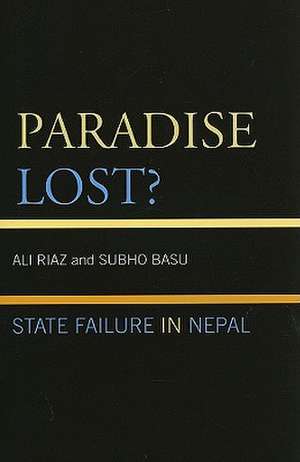
Paradise Lost?: State Failure in Nepal
Autor Ali Riaz, Subho Basuen Limba Engleză Paperback – 8 iul 2010
Preț: 342.63 lei
Preț vechi: 482.47 lei
-29%
Puncte Express: 514
Carte tipărită la comandă
Livrare economică 27 noiembrie-11 decembrie
Livrare prin curier în România Termenul estimat este afișat lângă disponibilitate.
Transport gratuit de la 400.00 lei Plată online sau ramburs, în funcție de opțiunile comenzii.
Retur gratuit în 14 zile Comandă securizată și suport în română.
Specificații
ISBN-13: 9780739146644
ISBN-10: 0739146645
Pagini: 219
Dimensiuni: 155 x 232 x 15 mm
Greutate: 0.3 kg
Editura: Bloomsbury Publishing
Colecția Lexington Books
Locul publicării:New York, United States
ISBN-10: 0739146645
Pagini: 219
Dimensiuni: 155 x 232 x 15 mm
Greutate: 0.3 kg
Editura: Bloomsbury Publishing
Colecția Lexington Books
Locul publicării:New York, United States
V-ar putea interesa
-
 For All the Tea in ChinaSarah Rose-19%Preț: 64.12 lei78.97 lei
 -
 Hiroshima: The World's BombAndrew J. Rotter-19%Preț: 125.16 lei155.20 lei
 -
 A History of JapanK. Henshall-18%Preț: 851.87 lei1038.86 lei
 -
 Arming the PeripheryE. ChewPreț: 409.28 lei
 -
 The Eaves of HeavenAndrew X. PhamPreț: 123.00 lei
 -
 Defeat Into VictoryWilliam Slim-32%Preț: 85.30 lei124.83 lei
 -
 Zen at WarBrian Daizen Victoria-20%Preț: 317.22 lei397.48 lei
 -
 To Live or to Perish ForeverNicholas SchmidlePreț: 126.90 lei
 -
 -29%Preț: 73.37 lei104.06 lei
 -
 The Last Mughal: The Fall of Delhi, 1857William Dalrymple-33%Preț: 82.31 lei123.39 lei
 -
 Samurai Women 1184–1877Stephen Turnbull-36%Preț: 73.05 lei114.65 lei
 -
 Preț: 193.15 lei
Cuprins
Chapter 1 Introduction: Understanding the Crisis in Nepal and State Failure
Chapter 2 State Formation and Political Transition in Nepal (1768-2005)
Chapter 3 Ethnicity and Politics in Nepal
Chapter 4 Economic Crisis and the Lack of Performance Legitimacy
Chapter 5 Maoist Insurgency and the Militarization of the Nepali Polity and Society
Chapter 6 Popular Uprising 2006
Chapter 7 Problems and Prospects
Chapter 8 Appendix 1: Nepal: The Fundamentals
Chapter 9 Appendix 2: Memorandum from UNPF to the Prime Minister
Chapter 10 Appendix 3: The Letter of Understanding Between the 7-party Coalition and the Communist Party of Nepal
Chapter 11 Appendix 4: The Eight-point Agreement between SPA and the CPN (M)
Chapter 2 State Formation and Political Transition in Nepal (1768-2005)
Chapter 3 Ethnicity and Politics in Nepal
Chapter 4 Economic Crisis and the Lack of Performance Legitimacy
Chapter 5 Maoist Insurgency and the Militarization of the Nepali Polity and Society
Chapter 6 Popular Uprising 2006
Chapter 7 Problems and Prospects
Chapter 8 Appendix 1: Nepal: The Fundamentals
Chapter 9 Appendix 2: Memorandum from UNPF to the Prime Minister
Chapter 10 Appendix 3: The Letter of Understanding Between the 7-party Coalition and the Communist Party of Nepal
Chapter 11 Appendix 4: The Eight-point Agreement between SPA and the CPN (M)
Recenzii
While Nepal is the oldest nation-state in South Asia, 'nation-building' is very much a work-in-progress. In the modern era which began in Nepal with the demise of the Rana shogunate in 1950, the country remained under an autocratic kingship till 1990. A 12-year democratic interlude was marked by a violent Maoist insurgency and followed by yet another royal adventure, which was finally crushed by the People's Movement of April 2006. The task of 'nation-building' has now resumed , with the goal of restructuring the state through a constituent assembly and a new constitution. Any place is complex, but Nepal is perhaps less understood than others in the South Asian neighbourhood. I believe that this work by Ali Riaz and Subho Basu will help in the understanding of a country that has seen the compressed political evolution over a few years that other countries of South Asia realised over decades. Only the analysis of Nepal as a thus-far failed state can make it a successful one.
An outstanding achievement in explaining current political developments in Nepal whilst placing them insightfully and concisely within a historical context. A timely book which will be an invaluable resource for those keen to learn about the origins of Nepal's present-day dilemmas and the prospects for her future.
A useful resource not only for scholars in the fields of South Asian studies and/or Himalayan studies but should also, equally, be of interest to political theorists.
Ali Riaz and Subho Basu's Paradise Lost is an informative and engaging examination of the contemporary political crisis facing Nepal and its historical and structural causes. One of a spate of recently published books to examine the Maoist insurgency in Nepal, Paradise Lost places the insurgency, and its attendant political crises, within a broader historical narrative of state failure in Nepal . . . Riaz and Basu's book provides a compelling account less of state failure than of the necessity of institutional political reform. They provide important suggestions as to what reforms the government might want to prioritize, and they make an effective case for the necessity of land reform in particular. Paradise Lost , for this reason, serves as an important and timely examination of recent Nepalese history, and of the lessons to be learned from its recent past.
One of the longstanding frustrations of being a 'Nepal scholar' is that one's peers comprise almost entirely of other 'Nepal scholars', and that those who might be capable of bringing broader comparative or theoretical perspectives to bear on Nepali political topics, have remained clustered around issues further south in the subcontinent. It has also seemed to us that recent developments in Nepal, where the world's last Hindu monarchy and the world's latest and most successful Maoist insurgency have faced one another across a society that cries out for a participative and egalitarian democracy, should be of interest to more than just us. So it is very good indeed that these two researchers have turned their attention northward and allowed us all to benefit from their clear-eyed and perceptive assessment of the current state of Nepal and of the challenges that now faces that country's leaders and people.
A timely analysis of Nepal's second experiment in democratic politics....The breadth of the analysis must surely be commended. The authors have centred their study on the role of the state in Nepal's post-1990 political impasse and have successfully linked it to other factors....The book is a pioneering attempt in the field of Nepali Studies, combining a political science approach to the state with a socio-historical analysis of Nepal's developments to explain the country's current political situation. This makes Riaz and Basu's volume a precious and timely contribution to the debate on Nepal's political developments which will provide readers with a number of ideas to engage and wrestle with.
An outstanding achievement in explaining current political developments in Nepal whilst placing them insightfully and concisely within a historical context. A timely book which will be an invaluable resource for those keen to learn about the origins of Nepal's present-day dilemmas and the prospects for her future.
A useful resource not only for scholars in the fields of South Asian studies and/or Himalayan studies but should also, equally, be of interest to political theorists.
Ali Riaz and Subho Basu's Paradise Lost is an informative and engaging examination of the contemporary political crisis facing Nepal and its historical and structural causes. One of a spate of recently published books to examine the Maoist insurgency in Nepal, Paradise Lost places the insurgency, and its attendant political crises, within a broader historical narrative of state failure in Nepal . . . Riaz and Basu's book provides a compelling account less of state failure than of the necessity of institutional political reform. They provide important suggestions as to what reforms the government might want to prioritize, and they make an effective case for the necessity of land reform in particular. Paradise Lost , for this reason, serves as an important and timely examination of recent Nepalese history, and of the lessons to be learned from its recent past.
One of the longstanding frustrations of being a 'Nepal scholar' is that one's peers comprise almost entirely of other 'Nepal scholars', and that those who might be capable of bringing broader comparative or theoretical perspectives to bear on Nepali political topics, have remained clustered around issues further south in the subcontinent. It has also seemed to us that recent developments in Nepal, where the world's last Hindu monarchy and the world's latest and most successful Maoist insurgency have faced one another across a society that cries out for a participative and egalitarian democracy, should be of interest to more than just us. So it is very good indeed that these two researchers have turned their attention northward and allowed us all to benefit from their clear-eyed and perceptive assessment of the current state of Nepal and of the challenges that now faces that country's leaders and people.
A timely analysis of Nepal's second experiment in democratic politics....The breadth of the analysis must surely be commended. The authors have centred their study on the role of the state in Nepal's post-1990 political impasse and have successfully linked it to other factors....The book is a pioneering attempt in the field of Nepali Studies, combining a political science approach to the state with a socio-historical analysis of Nepal's developments to explain the country's current political situation. This makes Riaz and Basu's volume a precious and timely contribution to the debate on Nepal's political developments which will provide readers with a number of ideas to engage and wrestle with.