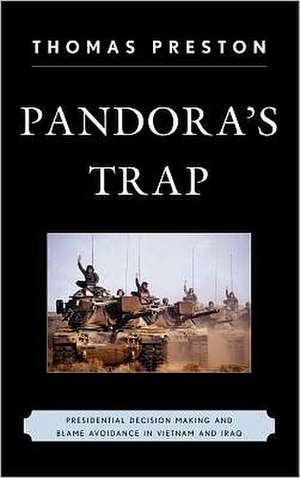
Pandora's Trap: Presidential Decision Making and Blame Avoidance in Vietnam and Iraq
Autor Thomas Prestonen Limba Engleză Hardback – sep 2011
Preț: 628.91 lei
Preț vechi: 898.60 lei
-30%
Puncte Express: 943
Carte tipărită la comandă
Livrare economică 07-21 decembrie
Livrare prin curier în România Termenul estimat este afișat lângă disponibilitate.
Transport gratuit pentru acest produs Plată online sau ramburs, în funcție de opțiunile comenzii.
Retur gratuit în 14 zile Comandă securizată și suport în română.
Specificații
ISBN-13: 9780742562639
ISBN-10: 0742562638
Pagini: 252
Dimensiuni: 152 x 232 x 22 mm
Greutate: 0.56 kg
Ediția:New.
Editura: Bloomsbury Publishing
Colecția Rowman & Littlefield
Locul publicării:New York, United States
ISBN-10: 0742562638
Pagini: 252
Dimensiuni: 152 x 232 x 22 mm
Greutate: 0.56 kg
Ediția:New.
Editura: Bloomsbury Publishing
Colecția Rowman & Littlefield
Locul publicării:New York, United States
Cuprins
Chapter 1: Introduction
Chapter 2: A Tale of Two Texans: the Leadership Styles of George W. Bush and Lyndon Johnson
Chapter 3: The Politics of Blame Avoidance: Presidential Strategies for Surviving the Washington 'Blame Game'
Chapter 4: Opening Pandora's Box: Blame Avoidance, 9/11, and the Push for War with Iraq
Chapter 5: Opening Pandora's Box: Blame Avoidance During the Iraq War
Chapter 6: Bush and Iraq: Revisiting the Vietnam Analogy
Bibliography
Chapter 2: A Tale of Two Texans: the Leadership Styles of George W. Bush and Lyndon Johnson
Chapter 3: The Politics of Blame Avoidance: Presidential Strategies for Surviving the Washington 'Blame Game'
Chapter 4: Opening Pandora's Box: Blame Avoidance, 9/11, and the Push for War with Iraq
Chapter 5: Opening Pandora's Box: Blame Avoidance During the Iraq War
Chapter 6: Bush and Iraq: Revisiting the Vietnam Analogy
Bibliography
Recenzii
Thomas Preston illuminates the unattractive underside of the making of U.S. foreign policy. He shows how and why the public face of some major decisions has diverged substantially from the inside reality.
Preston's work adds significantly to the key scholarly debate in presidential studies over whether institutional forces or idiosyncratic aspects of each president determine policy outcomes. The author argues that 'leaders matter!' Preston uses his earlier work on leadership style to compare the decision-making styles of Lyndon Johnson during Vietnam and George W. Bush during the Iraq War. Though the political contexts of Vietnam and Iraq differed greatly, the Johnson and G.W. Bush decision-making styles were similar enough--lack of foreign policy experience, lack of nuanced thinking, passionate belief that they were right, and insular decision making--that both followed a path to intervention. The book is theoretically elegant and empirically dense. Rooted in literature on cognitive styles, the theoretical structure is based on two frameworks. The first measures the leader's need for control and his prior experience in the policy area. The second measures the leader's sensitivity to context and conceptual complexity. Through this framework a typology of leadership styles is developed for use in comparing actual decision making in case studies, here Iraq and Vietnam. An outstanding contribution to the literature. Summing Up: Highly recommended. All readership levels.
Preston's work adds significantly to the key scholarly debate in presidential studies over whether institutional forces or idiosyncratic aspects of each president determine policy outcomes. The author argues that 'leaders matter!' Preston uses his earlier work on leadership style to compare the decision-making styles of Lyndon Johnson during Vietnam and George W. Bush during the Iraq War. Though the political contexts of Vietnam and Iraq differed greatly, the Johnson and G.W. Bush decision-making styles were similar enough--lack of foreign policy experience, lack of nuanced thinking, passionate belief that they were right, and insular decision making--that both followed a path to intervention. The book is theoretically elegant and empirically dense. Rooted in literature on cognitive styles, the theoretical structure is based on two frameworks. The first measures the leader's need for control and his prior experience in the policy area. The second measures the leader's sensitivity to context and conceptual complexity. Through this framework a typology of leadership styles is developed for use in comparing actual decision making in case studies, here Iraq and Vietnam. An outstanding contribution to the literature. Summing Up: Highly recommended. All readership levels.