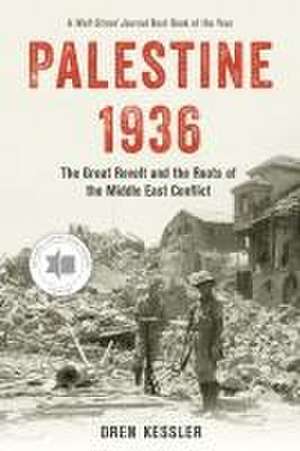
Palestine 1936: The Great Revolt and the Roots of the Middle East Conflict
Autor Oren Kessleren Limba Engleză Hardback – 15 feb 2023
"Kessler has done an exceptional job and opened new vistas on troubles past and present." - Wall Street Journal
"Kessler's history is key to understanding the current situation between Israelis and Palestinians." -Booklist, Starred Review
A gripping, profoundly human, yet even-handed narrative of the origins of the Middle East conflict, with enduring resonance and relevance for our time.
In spring 1936, the Holy Land erupted in a rebellion that targeted both the local Jewish community and the British Mandate authorities that for two decades had midwifed the Zionist project. The Great Arab Revolt would last three years, cost thousands of lives-Jewish, British, and Arab-and cast the trajectory for the Middle East conflict ever since. Yet incredibly, no history of this seminal, formative first "Intifada" has ever been published for a general audience.
The 1936-1939 revolt was the crucible in which Palestinian identity coalesced, uniting rival families, city and country, rich and poor in a single struggle for independence. Yet the rebellion would ultimately turn on itself, shredding the social fabric, sidelining pragmatists in favor of extremists, and propelling waves of refugees from their homes. British forces' aggressive counterinsurgency took care of the rest, finally quashing the uprising on the eve of World War II. The revolt to end Zionism had instead crushed the Arabs themselves, leaving them crippled in facing the Jews' own drive for statehood a decade later.
To the Jews, the insurgency would leave a very different legacy. It was then that Zionist leaders began to abandon illusions over Arab acquiescence, to face the unnerving prospect that fulfilling their dream of sovereignty might mean forever clinging to the sword. The revolt saw thousands of Jews trained and armed by Britain-the world's supreme military power-turning their ramshackle guard units into the seed of a formidable Jewish army. And it was then, amid carnage in Palestine and the Hitler menace in Europe, that portentous words like "partition" and "Jewish state" first appeared on the international diplomatic agenda.
This is the story of two national movements and the first sustained confrontation between them. The rebellion was Arab, but the Zionist counter-rebellion-the Jews' military, economic, and psychological transformation-is a vital, overlooked element in the chronicle of how Palestine became Israel.
Today, eight decades on, the revolt's legacy endures. Hamas's armed wing and rockets carry the name of the fighter-preacher whose death sparked the 1936 rebellion. When Israel builds security barriers, sets up checkpoints, or razes homes, it is evoking laws and methods inherited from its British predecessor. And when Washington promotes a "two-state solution," it is invoking a plan with roots in this same pivotal period.
Based on extensive archival research on three continents and in three languages, Palestine 1936 is the origin story of the world's most intractable conflict, but it is also more than that. In Oren Kessler's engaging, journalistic voice, it reveals world-changing events through extraordinary individuals on all sides: their loves and their hatreds, their deepest fears and profoundest hopes.
Preț: 109.83 lei
Preț vechi: 156.64 lei
-30%
Puncte Express: 165
Carte disponibilă
Livrare economică 29 octombrie-12 noiembrie
Livrare prin curier în România Termenul estimat este afișat lângă disponibilitate.
Transport gratuit de la 400.00 lei Plată online sau ramburs, în funcție de opțiunile comenzii.
Retur gratuit în 14 zile Comandă securizată și suport în română.
Specificații
ISBN-13: 9781538148808
ISBN-10: 1538148803
Pagini: 336
Ilustrații: 20 b/w illustration
Dimensiuni: 156 x 232 x 30 mm
Greutate: 0.6 kg
Editura: Bloomsbury Publishing
Colecția Rowman & Littlefield
Locul publicării:New York, United States
ISBN-10: 1538148803
Pagini: 336
Ilustrații: 20 b/w illustration
Dimensiuni: 156 x 232 x 30 mm
Greutate: 0.6 kg
Editura: Bloomsbury Publishing
Colecția Rowman & Littlefield
Locul publicării:New York, United States
Cuprins
Acknowledgments
Glossary of Names
Introduction: The Forgotten Uprising
Chapter 1: Flash Floods in the Desert
Chapter 2: The Bloody Day in Jaffa
Chapter 3: The Two-State Solution
Chapter 4: Black Sunday
Chapter 5: Pray for the Peace of Jerusalem
Chapter 6: Lawrence of Judea
Chapter 7: The Burning Ground
Epilogue: The Revolt Rages On
Notes
Selected Bibliography
About the Author
Glossary of Names
Introduction: The Forgotten Uprising
Chapter 1: Flash Floods in the Desert
Chapter 2: The Bloody Day in Jaffa
Chapter 3: The Two-State Solution
Chapter 4: Black Sunday
Chapter 5: Pray for the Peace of Jerusalem
Chapter 6: Lawrence of Judea
Chapter 7: The Burning Ground
Epilogue: The Revolt Rages On
Notes
Selected Bibliography
About the Author
Recenzii
The struggle between Jews and Arabs for the territory between the Jordan River and the Mediterranean Sea is a modern war fought with ancient maps. When did the conflict assume its current parameters? . . . In Palestine 1936, the Tel Aviv-based political analyst Oren Kessler argues that the crucial moment was an overlooked episode a decade before Israel's birth. He makes a convincing case. . . . [Kessler] is the first to tell this story from all three sides (British, Arab, Jewish) and use sources in all three languages (English, Arabic, Hebrew). He has done an exceptional job and opened new vistas on troubles past and present.
Kessler perceives the start of the massive displacement caused by the founding of Israel in 1948 in the Great Arab Revolt of 1936-39, the longest sustained rebellion against British control of the region. . . . While there is plenty of blame to go around, Kessler exposes the arrogance of British imperialism at its worst. . . . With indelible portraits of such leaders as Musa Alami, George Antonius, David Ben-Gurion, Mohammed Amin al-Husseini, Vladimir Jabotinsky, and Chaim Weizmann, Kessler's history is key to understanding the current situation between Israelis and Palestinians.
The brilliance of Palestine 1936 lies in the fact that Kessler took a truly archetypical yet understudied event in the history of the world's most intractable conflict and, following extremely intensive research, made that event - in the historical context in which it happened, as well as the decades-long conflict which has ensued - supremely approachable.
A lucid writer, [Kessler] deals not only with the revolt itself - the first major clash between the Zionist and the Palestinian national movements - but also delves into its causes and legacy. Kessler provides readers with a thorough and thoughtful history of Palestine before addressing the theme at hand . . . [and] convincingly argues that the Jews of Palestine consolidated the demographic, geographic and political basis of their state during this period rather than in 1948, when the first Arab-Israeli war broke out.
The history of the Arab-Israeli conflict cannot be understood without a thorough investigation of the 1936 revolt, and Oren Kessler has written the definitive study. Palestine 1936 is an accessible and essential source for scholars, journalists, decision makers, and serious students of the Middle East.
Refreshingly unbiased and captivating . . . Palestine 1936 provides a revealing understanding of the origin of today's Israel-Palestine conflict-it also makes the situation seem all the more impossible to untangle
Kessler sets out fastidious research into 1930s Palestine and the tensions that culminated in the Great Arab Revolt of 1936, bringing that era back to life and suggesting how it influences contemporary debates. . . . Kessler's exquisitely clear, fair-minded account of the period, and how it changed thinking on all sides, might produce more informed discussion both in the media and on the ramparts.
Oren Kessler's book is an informative, well-documented, scholarly portrayal of life in 1936-1939 Mandate Palestine. It is a remarkable work that blends religion, history, and politics. I strongly recommend its translation to Arabic so that it is available to a wide Palestinian audience.
In Palestine 1936, Oren Kessler has given us a clear, fast-paced, and accessible account of a crucial chapter in the Middle East, introducing a general readership to a fascinating piece of overlooked history while shedding light on the present. I learned a great deal from this book.
Kessler has taken up a topic that ought to be well studied but, as he notes, is not. His impressive immersion in the sources and his lively writing bring the "Great Arab Revolt" of 1936-39 to life and show its continued significance.. It is a great book.
An overall history of the Arab Revolt of 1936-1939-the biggest and most significant nationalist uprising against the British Empire in the twentieth century-has long been a lacuna in the historiography of Palestine/Israel. Oren Kessler has at last plugged that gap with this very well-researched, highly readable, and balanced study, studded with fine portraits of the main actors and moving stories of personal tragedy and accomplishment. Highly recommended reading for anyone interested in the history of the Zionist-Arab conflict.
With his narrative style of history, Oren Kessler offers a compelling account of the seminal events that helped shape Palestine during the British mandate and for many years to come. His welcome focus on a series of riveting Arab Palestinian, Jewish, and British personalities makes Palestine 1936 a brisk and relatable read. Basing his work on rigorous and impressive research in both primary and secondary sources, Kessler helpfully pays attention to seemingly small details that come together to weave the tapestry of history. This is both a delightful and a necessary read that will be of interest both to specialists and to those approaching the topic for the first time.
Oren Kessler proposes a new and under-explored starting point for the conflict. . . . As Kessler demonstrates in this sobering and engaging history, 1936 crystallized the many elements of the Arab-Israeli conflict in ways that other hinge dates did not.
An eminently readable account of how the State of Israel emerged from the flames of Mandate Palestine, but it is much more. It is the first scholarly, extensively researched, investigation into the formative events of 1936-39 in the Holy Land. . . . It is his journalistic skills that make Palestine 1936 so absorbing a read for everyone, scholar and general public alike. This detailed account of a seminal period in the history of both Israel and the Arab world is highly recommended.
Oren Kessler's brave new history book Palestine 1936 reveals the deep roots of today's Israel-Palestine conflict.
Kessler examines a period that is as formative as it is overlooked in this well-written volume. Kessler utilizes recently declassified documents and memoirs, among other sources, to paint a briskly moving picture of what might properly be considered the first Palestinian Intifada. Kessler skillfully tells the tale, relying on deft character sketches and lively prose to convey a story whose tragic consequences echo to the present day.
The book proves to be a valuable and accessible resource that provides a digestible account of the events, motivations, identities, and backgrounds of critical players. It is an engaging read regardless of background knowledge, offering insights into how British control of the region and their decisions led to tensions in the 1930s.
The Arab Revolt essentially set the frame work of the subsequent Arab-Israeli conflict. Kessler's reminder of the historical importance of the revolt makes his book an integral part of the literature on the conflict.
Kessler does a very good job of explaining the context and the Revolt itself. His first book is a must read for serious students of the Arab-Israeli conflict, as well as for the general public.
Kessler's exacting and evenhanded debut granularly examines for the first time the conflict between Arabs and Jews in Palestine from 1936 to 1939-otherwise known as The Great Revolt-and convincingly makes the case that it formed the foundation and blueprint for a century-old dispute that continues today. As well, Kessler illuminates the world's role in the prewar conflict: its foibles, biases, pragmatism, and, ultimately, its failures.
Proof that yesterday's history is today's news, Oren Kessler's account of the Great Arab Revolt of 1936 in the British-controlled Palestine Mandate shows how Jewish-Arab relations were altered ever after. The author skillfully uses English, Hebrew and Arabicsources to find human stories in a battle of ideas and identities, providing rare insight into the grim pattern of conflict that grinds onin the region.
A gradual and precise narration of the 1936-39 Arab revolt in Palestine, using personal experiences of British, Palestinian, and Jewish figures.
Kessler succeeds in shaping a narrative that is both comprehensive and easy to follow. While he focuses mainly on the Arab revolt of 1936, he also takes the story back and forth in time in a manner that helps us understand our world today.
Kessler's thesis is that the events of 1936-1939 deserve to be recognized more as pivotal to the history of the region as a whole. There are also voluminous parallels and lessons for contemporary times in his review of that era.
Oren Kessler has filled an important gap early in the modern era. . . . It carefully and accessibly describes the opening acts of this pivotal period, and his introduction and conclusion helpfully show its meaning for the present. The history cannot be changed but perhaps clarifying it can help heal its wounds and make progress toward peace today.
A thorough, well-documented journalistic history of the Great Revolt of 1936. Kessler provides voices from all the key players: Jewish, Arab, and English. And within each of these groups, he brings forward the continuum of the views. . . . The book is indispensable for anyone wanting to get a much deeper understanding of the roots of the current conflict.
Kessler perceives the start of the massive displacement caused by the founding of Israel in 1948 in the Great Arab Revolt of 1936-39, the longest sustained rebellion against British control of the region. . . . While there is plenty of blame to go around, Kessler exposes the arrogance of British imperialism at its worst. . . . With indelible portraits of such leaders as Musa Alami, George Antonius, David Ben-Gurion, Mohammed Amin al-Husseini, Vladimir Jabotinsky, and Chaim Weizmann, Kessler's history is key to understanding the current situation between Israelis and Palestinians.
The brilliance of Palestine 1936 lies in the fact that Kessler took a truly archetypical yet understudied event in the history of the world's most intractable conflict and, following extremely intensive research, made that event - in the historical context in which it happened, as well as the decades-long conflict which has ensued - supremely approachable.
A lucid writer, [Kessler] deals not only with the revolt itself - the first major clash between the Zionist and the Palestinian national movements - but also delves into its causes and legacy. Kessler provides readers with a thorough and thoughtful history of Palestine before addressing the theme at hand . . . [and] convincingly argues that the Jews of Palestine consolidated the demographic, geographic and political basis of their state during this period rather than in 1948, when the first Arab-Israeli war broke out.
The history of the Arab-Israeli conflict cannot be understood without a thorough investigation of the 1936 revolt, and Oren Kessler has written the definitive study. Palestine 1936 is an accessible and essential source for scholars, journalists, decision makers, and serious students of the Middle East.
Refreshingly unbiased and captivating . . . Palestine 1936 provides a revealing understanding of the origin of today's Israel-Palestine conflict-it also makes the situation seem all the more impossible to untangle
Kessler sets out fastidious research into 1930s Palestine and the tensions that culminated in the Great Arab Revolt of 1936, bringing that era back to life and suggesting how it influences contemporary debates. . . . Kessler's exquisitely clear, fair-minded account of the period, and how it changed thinking on all sides, might produce more informed discussion both in the media and on the ramparts.
Oren Kessler's book is an informative, well-documented, scholarly portrayal of life in 1936-1939 Mandate Palestine. It is a remarkable work that blends religion, history, and politics. I strongly recommend its translation to Arabic so that it is available to a wide Palestinian audience.
In Palestine 1936, Oren Kessler has given us a clear, fast-paced, and accessible account of a crucial chapter in the Middle East, introducing a general readership to a fascinating piece of overlooked history while shedding light on the present. I learned a great deal from this book.
Kessler has taken up a topic that ought to be well studied but, as he notes, is not. His impressive immersion in the sources and his lively writing bring the "Great Arab Revolt" of 1936-39 to life and show its continued significance.. It is a great book.
An overall history of the Arab Revolt of 1936-1939-the biggest and most significant nationalist uprising against the British Empire in the twentieth century-has long been a lacuna in the historiography of Palestine/Israel. Oren Kessler has at last plugged that gap with this very well-researched, highly readable, and balanced study, studded with fine portraits of the main actors and moving stories of personal tragedy and accomplishment. Highly recommended reading for anyone interested in the history of the Zionist-Arab conflict.
With his narrative style of history, Oren Kessler offers a compelling account of the seminal events that helped shape Palestine during the British mandate and for many years to come. His welcome focus on a series of riveting Arab Palestinian, Jewish, and British personalities makes Palestine 1936 a brisk and relatable read. Basing his work on rigorous and impressive research in both primary and secondary sources, Kessler helpfully pays attention to seemingly small details that come together to weave the tapestry of history. This is both a delightful and a necessary read that will be of interest both to specialists and to those approaching the topic for the first time.
Oren Kessler proposes a new and under-explored starting point for the conflict. . . . As Kessler demonstrates in this sobering and engaging history, 1936 crystallized the many elements of the Arab-Israeli conflict in ways that other hinge dates did not.
An eminently readable account of how the State of Israel emerged from the flames of Mandate Palestine, but it is much more. It is the first scholarly, extensively researched, investigation into the formative events of 1936-39 in the Holy Land. . . . It is his journalistic skills that make Palestine 1936 so absorbing a read for everyone, scholar and general public alike. This detailed account of a seminal period in the history of both Israel and the Arab world is highly recommended.
Oren Kessler's brave new history book Palestine 1936 reveals the deep roots of today's Israel-Palestine conflict.
Kessler examines a period that is as formative as it is overlooked in this well-written volume. Kessler utilizes recently declassified documents and memoirs, among other sources, to paint a briskly moving picture of what might properly be considered the first Palestinian Intifada. Kessler skillfully tells the tale, relying on deft character sketches and lively prose to convey a story whose tragic consequences echo to the present day.
The book proves to be a valuable and accessible resource that provides a digestible account of the events, motivations, identities, and backgrounds of critical players. It is an engaging read regardless of background knowledge, offering insights into how British control of the region and their decisions led to tensions in the 1930s.
The Arab Revolt essentially set the frame work of the subsequent Arab-Israeli conflict. Kessler's reminder of the historical importance of the revolt makes his book an integral part of the literature on the conflict.
Kessler does a very good job of explaining the context and the Revolt itself. His first book is a must read for serious students of the Arab-Israeli conflict, as well as for the general public.
Kessler's exacting and evenhanded debut granularly examines for the first time the conflict between Arabs and Jews in Palestine from 1936 to 1939-otherwise known as The Great Revolt-and convincingly makes the case that it formed the foundation and blueprint for a century-old dispute that continues today. As well, Kessler illuminates the world's role in the prewar conflict: its foibles, biases, pragmatism, and, ultimately, its failures.
Proof that yesterday's history is today's news, Oren Kessler's account of the Great Arab Revolt of 1936 in the British-controlled Palestine Mandate shows how Jewish-Arab relations were altered ever after. The author skillfully uses English, Hebrew and Arabicsources to find human stories in a battle of ideas and identities, providing rare insight into the grim pattern of conflict that grinds onin the region.
A gradual and precise narration of the 1936-39 Arab revolt in Palestine, using personal experiences of British, Palestinian, and Jewish figures.
Kessler succeeds in shaping a narrative that is both comprehensive and easy to follow. While he focuses mainly on the Arab revolt of 1936, he also takes the story back and forth in time in a manner that helps us understand our world today.
Kessler's thesis is that the events of 1936-1939 deserve to be recognized more as pivotal to the history of the region as a whole. There are also voluminous parallels and lessons for contemporary times in his review of that era.
Oren Kessler has filled an important gap early in the modern era. . . . It carefully and accessibly describes the opening acts of this pivotal period, and his introduction and conclusion helpfully show its meaning for the present. The history cannot be changed but perhaps clarifying it can help heal its wounds and make progress toward peace today.
A thorough, well-documented journalistic history of the Great Revolt of 1936. Kessler provides voices from all the key players: Jewish, Arab, and English. And within each of these groups, he brings forward the continuum of the views. . . . The book is indispensable for anyone wanting to get a much deeper understanding of the roots of the current conflict.