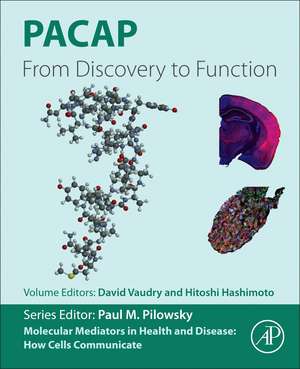
PACAP: From Discovery to Function: Molecular Mediators in Health and Disease: How Cells Communicate
Editat de David Vaudry, Hitoshi Hashimotoen Limba Engleză Paperback – 15 noi 2026
- Provides a comprehensive overview of PACAP from a molecular, biochemical and pharmacological standpoint
- Covers the effects of PACAP across a range of peripheral organs including the eye, liver, and respiratory system
- Explores PACAP in the context of various conditions including neurodegenerative diseases and psychiatric disorders


Preț: 888.13 lei
Preț vechi: 1282.19 lei
-31% Precomandă
Puncte Express: 1332
Carte nepublicată încă
Livrare prin curier în România Precomanda se expediază când titlul devine disponibil.
Transport gratuit pentru acest produs Plată online sau ramburs, în funcție de opțiunile comenzii.
Retur gratuit în 14 zile Comandă securizată și suport în română.
Doresc să fiu notificat când acest titlu va fi disponibil:
Se trimite...
Specificații
ISBN-13: 9780443290541
ISBN-10: 0443290547
Pagini: 500
Dimensiuni: 191 x 235 mm
Editura: ELSEVIER SCIENCE
Colecția Molecular Mediators in Health and Disease: How Cells Communicate
Seria Molecular Mediators in Health and Disease: How Cells Communicate
ISBN-10: 0443290547
Pagini: 500
Dimensiuni: 191 x 235 mm
Editura: ELSEVIER SCIENCE
Colecția Molecular Mediators in Health and Disease: How Cells Communicate
Seria Molecular Mediators in Health and Disease: How Cells Communicate
Cuprins
I. Introduction
II. Pituitary adenylate cyclase-activating polypeptide
1. Discovery and biochemical properties of PACAP (Secondary structure of PACAP, Structure of the PACAP precursor and post-translational processing)
2. Cloning and phylogenetic evolution of the PACAP gene
3. Development of PACAP peptidic analogs for structure-activity characterization
4. Development of PACAP small molecule agonists / antagonists for therapeutic applications III. PACAP receptors
5. Pharmacological, Biochemical and Signaling characterization of PACAP receptors
6. Cloning and phylogenetic evolution of PACAP receptors IV. Expression of PACAP and its receptors
7. Distribution of PACAP and its receptors in the central nervous system (at adulthood and during development)
8. Distribution of PACAP and its receptors in peripheral organs (at adulthood and during development)
9. Presence of PACAP in biological fluids
10. Expression and functional implication of PACAP and its receptors in tumor cells V. Biological actions of PACAP in normal and pathological conditions A. Actions of the CNS
11. Actions on the hypothalamus
12. Actions of PACAP on the pineal gland and circadian rhythms
13. Actions on glial cells
14. Effects of PACAP on the pituitary gland
15. PACAP transport across the BBB and therapeutic implication
16. Neurotrophic actions during development and protective effects in acute brain injuries (stroke and spinal cord)
17. Protective effect of PACAP in neurodegenerative diseases
18. PACAP in migraine
19. Action of PACAP in the central regulation of energy homeostasis, including food intake
20. Behavioral actions of PACAP
21. PACAP and stress
22. PACAP and pain
23. PACAP and psychiatric disorders B. Actions on peripheral organs
24. Effects of PACAP on the eye
25. Effects of PACAP on the thyroid gland
26. Effects of PACAP on the gonads
27. Effects of PACAP on the adrenal gland
28. Effects of PACAP on the gastrointestinal tract
29. Effects of PACAP on the liver
30. Effects of PACAP on the pancreas
31. Effects of PACAP on the respiratory system
32. Effects of PACAP on the cardiovascular system
33. Effects of PACAP on immune cells
34. Effects of PACAP on bones
II. Pituitary adenylate cyclase-activating polypeptide
1. Discovery and biochemical properties of PACAP (Secondary structure of PACAP, Structure of the PACAP precursor and post-translational processing)
2. Cloning and phylogenetic evolution of the PACAP gene
3. Development of PACAP peptidic analogs for structure-activity characterization
4. Development of PACAP small molecule agonists / antagonists for therapeutic applications III. PACAP receptors
5. Pharmacological, Biochemical and Signaling characterization of PACAP receptors
6. Cloning and phylogenetic evolution of PACAP receptors IV. Expression of PACAP and its receptors
7. Distribution of PACAP and its receptors in the central nervous system (at adulthood and during development)
8. Distribution of PACAP and its receptors in peripheral organs (at adulthood and during development)
9. Presence of PACAP in biological fluids
10. Expression and functional implication of PACAP and its receptors in tumor cells V. Biological actions of PACAP in normal and pathological conditions A. Actions of the CNS
11. Actions on the hypothalamus
12. Actions of PACAP on the pineal gland and circadian rhythms
13. Actions on glial cells
14. Effects of PACAP on the pituitary gland
15. PACAP transport across the BBB and therapeutic implication
16. Neurotrophic actions during development and protective effects in acute brain injuries (stroke and spinal cord)
17. Protective effect of PACAP in neurodegenerative diseases
18. PACAP in migraine
19. Action of PACAP in the central regulation of energy homeostasis, including food intake
20. Behavioral actions of PACAP
21. PACAP and stress
22. PACAP and pain
23. PACAP and psychiatric disorders B. Actions on peripheral organs
24. Effects of PACAP on the eye
25. Effects of PACAP on the thyroid gland
26. Effects of PACAP on the gonads
27. Effects of PACAP on the adrenal gland
28. Effects of PACAP on the gastrointestinal tract
29. Effects of PACAP on the liver
30. Effects of PACAP on the pancreas
31. Effects of PACAP on the respiratory system
32. Effects of PACAP on the cardiovascular system
33. Effects of PACAP on immune cells
34. Effects of PACAP on bones