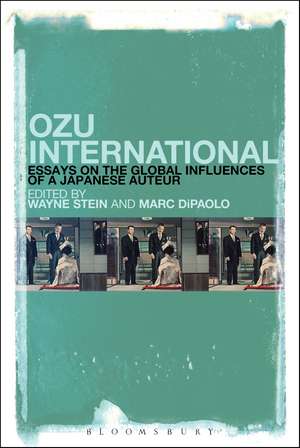
Ozu International: Essays on the Global Influences of a Japanese Auteur
Editat de Wayne Stein, Prof Marc DiPaoloen Limba Engleză Hardback – 7 mai 2015
With the recent release of more than 15 Ozu DVDs in the Criterion Collection, covering every phase of his career at least in part (including silent films, black-and-white talkies, and color films), Ozu International helps to fill a lingering gap in English-language scholarship on Ozu by giving this new generation of scholars a book-length forum to explore new critical perspectives on an unfairly neglected director. Contributions include specialists in Japanese culture, academics from a range of disciplines, and professional films critics.
| Toate formatele și edițiile | Preț | Express |
|---|---|---|
| Paperback (1) | 264.71 lei 6-8 săpt. | |
| Bloomsbury Publishing – 22 sep 2016 | 264.71 lei 6-8 săpt. | |
| Hardback (1) | 794.75 lei 6-8 săpt. | |
| Bloomsbury Publishing – 7 mai 2015 | 794.75 lei 6-8 săpt. |
Preț: 794.75 lei
Preț vechi: 1202.92 lei
-34%
Puncte Express: 1192
Preț estimativ în valută:
140.67€ • 163.100$ • 121.87£
140.67€ • 163.100$ • 121.87£
Carte tipărită la comandă
Livrare economică 27 februarie-13 martie
Preluare comenzi: 021 569.72.76
Specificații
ISBN-13: 9781628922875
ISBN-10: 1628922877
Pagini: 224
Ilustrații: 35 bw illus
Dimensiuni: 152 x 229 x 20 mm
Greutate: 0.47 kg
Editura: Bloomsbury Publishing
Colecția Bloomsbury Academic
Locul publicării:New York, United States
ISBN-10: 1628922877
Pagini: 224
Ilustrații: 35 bw illus
Dimensiuni: 152 x 229 x 20 mm
Greutate: 0.47 kg
Editura: Bloomsbury Publishing
Colecția Bloomsbury Academic
Locul publicării:New York, United States
V-ar putea interesa
-
 -7%Preț: 235.24 lei252.84 lei
 -
 Roadshow!: The Fall of Film Musicals in the 1960sMatthew Kennedy-17%Preț: 333.44 lei402.09 lei
 -
 Preț: 337.20 lei
 -
 Brecht On Film & RadioBertolt Brecht-12%Preț: 331.57 lei378.45 lei
 -
 A Companion to Fritz LangJoe Mcelhaney-9%Preț: 1217.12 lei1337.48 lei
 -
 Preț: 226.00 lei
 -
 -18%Preț: 369.01 lei450.72 lei
 -
 The Art of NoirEddie MullerPreț: 264.89 lei
 -
 Reframing Italy: New Trends in Italian Women's FilmmakingBernadette LucianoPreț: 341.76 lei
 -
 -18%Preț: 196.26 lei240.39 lei
 -
 Desire UnlimitedPaul Julian SmithPreț: 167.39 lei
 -
 -22%Preț: 377.92 lei482.67 lei
Cuprins
Preface - Ozu, Ray Carney, and the Problem of Ethical Spectatorship
Marc DiPaolo, Oklahoma City University, USA
Acknowledgements
Introduction
Part I. Ozu in Cultural Context: Considering Class, Gender, and Domestic Spaces
Chapter One. Tokyo is a Nice Place: The Suburban, the Urban, and the Space In-Between in Early Ozu
John Berra, Nanjing University, China
Chapter Two. Vanished Men, Complex Women: Gender, Remembrance, and Reform in Ozu's Postwar Films
Mauricio Castro, Purdue University, USA
Chapter Three. Tokyo Twilight: Alienation, Belonging and the Fractured Family
Elyssa Faison, University of Oklahoma, USA
Chapter Four. A Sensitivity to Things: mono no aware and Zen in Late Spring and Equinox Flower
J. M. Hammond, University of London, UK
Part II. Ozu's International Reception and Influences
Chapter Five. Too Slow to Handle? Ozu, Malick, and the Art-House Family Drama
Isolde Vanhee, LUCA School of Arts, Belgium
Chapter Six. Good Morning: The Limits of Cinema and the Issue of Order
Suzanne Beth, University of Montreal, Canada
Chapter Seven. In Yoko's Room: Hou, Ozu, and the Poetics of Space
Tom Paulus, University of Antwerp, Belgium
Chapter Eight. The Representation of Time as Death: Authentic Being in Tokyo Story and Last Year at Marienbad
Jack Lichten, Sophia University, Japan
Afterword - The Samsara of Ozu Cinema:Death and Rebirth in our Daily Struggles
Wayne Stein, University of Central Oklahoma, USA
About the Contributors
Index
A Mantra of Liberation
Marc DiPaolo, Oklahoma City University, USA
Acknowledgements
Introduction
Part I. Ozu in Cultural Context: Considering Class, Gender, and Domestic Spaces
Chapter One. Tokyo is a Nice Place: The Suburban, the Urban, and the Space In-Between in Early Ozu
John Berra, Nanjing University, China
Chapter Two. Vanished Men, Complex Women: Gender, Remembrance, and Reform in Ozu's Postwar Films
Mauricio Castro, Purdue University, USA
Chapter Three. Tokyo Twilight: Alienation, Belonging and the Fractured Family
Elyssa Faison, University of Oklahoma, USA
Chapter Four. A Sensitivity to Things: mono no aware and Zen in Late Spring and Equinox Flower
J. M. Hammond, University of London, UK
Part II. Ozu's International Reception and Influences
Chapter Five. Too Slow to Handle? Ozu, Malick, and the Art-House Family Drama
Isolde Vanhee, LUCA School of Arts, Belgium
Chapter Six. Good Morning: The Limits of Cinema and the Issue of Order
Suzanne Beth, University of Montreal, Canada
Chapter Seven. In Yoko's Room: Hou, Ozu, and the Poetics of Space
Tom Paulus, University of Antwerp, Belgium
Chapter Eight. The Representation of Time as Death: Authentic Being in Tokyo Story and Last Year at Marienbad
Jack Lichten, Sophia University, Japan
Afterword - The Samsara of Ozu Cinema:Death and Rebirth in our Daily Struggles
Wayne Stein, University of Central Oklahoma, USA
About the Contributors
Index
A Mantra of Liberation
Recenzii
These sophisticated essays certainly challenge, deepen and complicate our standard understanding of Ozu. All the more refreshing is that they are written in a clear, lively style, without a hint of academic jargon.
From new perspectives on canonical films to new entries into the canon, this scintillating study of Ozu's cinema is truly a must-read for anyone who cares about its subject. No less important than new contextual understandings of Ozu's films drawn from the range of his career are the ways, often surprising but always convincing, that these essays demonstrate Ozu's influence on global cinema. No appreciation of Ozu is complete without this latest addition to the ever-growing literature on Japan's most fascinating and increasingly influential filmmaker.
From new perspectives on canonical films to new entries into the canon, this scintillating study of Ozu's cinema is truly a must-read for anyone who cares about its subject. No less important than new contextual understandings of Ozu's films drawn from the range of his career are the ways, often surprising but always convincing, that these essays demonstrate Ozu's influence on global cinema. No appreciation of Ozu is complete without this latest addition to the ever-growing literature on Japan's most fascinating and increasingly influential filmmaker.