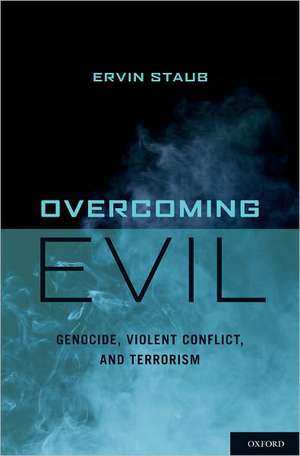
Overcoming Evil: Genocide, Violent Conflict, and Terrorism
Autor Ervin Stauben Limba Engleză Hardback – 13 ian 2011
Preț: 572.92 lei
Preț vechi: 826.94 lei
-31%
Puncte Express: 859
Carte tipărită la comandă
Livrare economică 10-16 decembrie
Livrare prin curier în România Termenul estimat este afișat lângă disponibilitate.
Transport gratuit pentru acest produs Plată online sau ramburs, în funcție de opțiunile comenzii.
Retur gratuit în 14 zile Comandă securizată și suport în română.
Specificații
ISBN-13: 9780195382044
ISBN-10: 0195382048
Pagini: 600
Dimensiuni: 160 x 236 x 46 mm
Greutate: 0.98 kg
Editura: Oxford University Press
Colecția OUP USA
Locul publicării:New York, United States
ISBN-10: 0195382048
Pagini: 600
Dimensiuni: 160 x 236 x 46 mm
Greutate: 0.98 kg
Editura: Oxford University Press
Colecția OUP USA
Locul publicării:New York, United States
V-ar putea interesa
-
 Golden Harvest: Events at the Periphery of the HolocaustJan Tomasz Gross-21%Preț: 76.97 lei97.15 lei
 -
 -26%Preț: 482.46 lei651.30 lei
 -
 -20%Preț: 261.58 lei326.55 lei
 -
 Genocide: A ReaderJens Meierhenrich-30%Preț: 1038.39 lei1479.23 lei
 -
 Writing the Holocaust: Identity, Testimony, RepresentationZoe Vania Waxman-30%Preț: 698.46 lei999.97 lei
 -
 -15%Preț: 148.96 lei174.80 lei
 -
 -12%Preț: 287.36 lei326.35 lei
 -
 -30%Preț: 541.84 lei773.83 lei
 -
 Preț: 133.49 lei
 -
 What Is Genocide?Martin ShawPreț: 159.91 lei
 -
 Under the Shadow of Death: Memoirs of a Survivor of the Armenian GenocideGarabed Hagop Aaronian-15%Preț: 209.75 lei247.03 lei
 -
 -27%Preț: 67.74 lei92.76 lei
 -
 Sexual Violence against Jewish Women during the HolocaustSonja M HedgepethPreț: 317.53 lei
Notă biografică
Ervin Staub has taught at Harvard and the University of Massachusetts at Amherst. He studied the influences that lead caring, helping, altruism in adults and children, the origins of genocide and other mass violence, the prevention of violence between groups and reconcliation after violence. He published extensively on these topics. He has also worked in many real world settings, on projects ranging from reconciliation and the prevention of new violence in Rwanda, Burundi and the Congo, to reducing the use of unnecessary force by police, to creating caring classrooms.