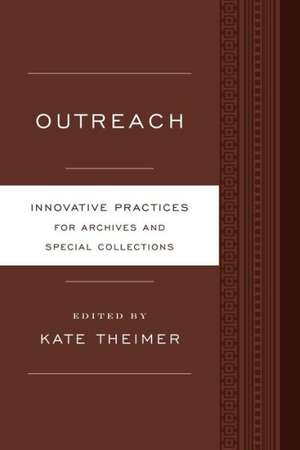
Outreach: Innovative Practices for Archives and Special Collections: Innovative Practices for Archives and Special Collections
Editat de Kate Theimeren Limba Engleză Paperback – 22 mai 2014
The case studies featured are
The Oregon Archives Crawl: Engaging New Users and AdvocatesMoved by the Spirit: Opportunistic Promotion of the Hamilton Family Séance CollectionWorking Within the Law: Public Programming and Continuing EducationStaying Connected: Engaging Alumni and Students to Digitize the Carl "Pappy" Fehr Choral Music Collection"Pin"pointing Success: Assessing the Value of Pinterest and Historypin for Special Collections OutreachCreating a New Learning Center: Designing a Space to Support Multiple Outreach Goals"Wikipedia is made of people!": Revelations from Collaborating with the World's Most Popular Encyclopedia 21 Revolutions: New Art from Old ObjectsHappy Accidents and Unintended Consequences: How We Named Our TribbleNavigating Nightingale: Creating an App Out of ArchivesDIY History: Redesigning a Platform for a Transcription Crowdsourcing Initiative Taking Preservation to the People: Educating the Public About Personal Digital Archiving
All twelve case studies look at outreach as identifying the organization's intended audience, building new ways of reaching them, and helping the organization achieve its mission. Each also reflects a philosophy of experimentation that is perhaps the most critical ingredient for any organization interested in developing its own "innovative" practices.
This volume will be useful to those working in archives and special collections as well as other cultural heritage organizations, and provides ideas ranging from those that require long-term planning and coordination to those that could be immediately implemented. It also provides students and educators in archives, library, and public history graduate programs a resource for understanding the variety of ways people conduct outreach in the field today and the kinds of strategies archivists are using to attract new users to collections.
Preț: 474.97 lei
Preț vechi: 685.98 lei
-31%
Puncte Express: 712
Carte tipărită la comandă
Livrare economică 02-16 decembrie
Livrare prin curier în România Termenul estimat este afișat lângă disponibilitate.
Transport gratuit pentru acest produs Plată online sau ramburs, în funcție de opțiunile comenzii.
Retur gratuit în 14 zile Comandă securizată și suport în română.
Specificații
ISBN-13: 9780810890978
ISBN-10: 0810890976
Pagini: 185
Ilustrații: black & white tables, figures
Dimensiuni: 148 x 226 x 14 mm
Greutate: 0.32 kg
Editura: Bloomsbury Publishing
Colecția Rowman & Littlefield
Seria Innovative Practices for Archives and Special Collections
Locul publicării:New York, United States
ISBN-10: 0810890976
Pagini: 185
Ilustrații: black & white tables, figures
Dimensiuni: 148 x 226 x 14 mm
Greutate: 0.32 kg
Editura: Bloomsbury Publishing
Colecția Rowman & Littlefield
Seria Innovative Practices for Archives and Special Collections
Locul publicării:New York, United States
Cuprins
Introduction
1. The Oregon Archives Crawl: Engaging New Users and Advocates
Diana Banning, Mary B. Hansen, Anne LeVant Prahl, Portland Area Archivists
2. Moved by the Spirit: Opportunistic Promotion of the Hamilton Family Séance Collection
Shelley Sweeney, University of Manitoba
3. Working Within the Law: Public Programming and Continuing Education
Leigh McWhite, University of Mississippi
4. Staying Connected: Engaging Alumni and Students to Digitize the Carl "Pappy" Fehr Choral Music Collection
Amy C. Schindler, College of William & Mary
5. "Pin"pointing Success: Assessing the Value of Pinterest and Historypin for Special Collections Outreach
Mark Baggett, Rabia Gibbs, Alesha Shumar, University of Tennessee
6. Creating a New Learning Center: Designing a Space to Support Multiple Outreach Goals
Dorothy Dougherty, National Archives at New York City
7. "Wikipedia is made of people!": Revelations from Collaborating with the World's Most Popular Encyclopedia
Sara Snyder, Archives of American Art
8. 21 Revolutions: New Art from Old Objects
Laura Stevens, Glasgow Women's Library
9. Happy Accidents and Unintended Consequences: How We Named Our Tribble
Rachael Dreyer, American Heritage Center
10. Navigating Nightingale: Creating an App Out of Archives
Geof Browell, King's College London
11. DIY History: Redesigning a Platform for a Transcription Crowdsourcing Initiative
Jen Wolfe and Nicole Saylor, University of Iowa
12. Taking Preservation to the People: Educating the Public About Personal Digital Archiving
William LeFurgy, Library of Congress
About the Editor
Index
1. The Oregon Archives Crawl: Engaging New Users and Advocates
Diana Banning, Mary B. Hansen, Anne LeVant Prahl, Portland Area Archivists
2. Moved by the Spirit: Opportunistic Promotion of the Hamilton Family Séance Collection
Shelley Sweeney, University of Manitoba
3. Working Within the Law: Public Programming and Continuing Education
Leigh McWhite, University of Mississippi
4. Staying Connected: Engaging Alumni and Students to Digitize the Carl "Pappy" Fehr Choral Music Collection
Amy C. Schindler, College of William & Mary
5. "Pin"pointing Success: Assessing the Value of Pinterest and Historypin for Special Collections Outreach
Mark Baggett, Rabia Gibbs, Alesha Shumar, University of Tennessee
6. Creating a New Learning Center: Designing a Space to Support Multiple Outreach Goals
Dorothy Dougherty, National Archives at New York City
7. "Wikipedia is made of people!": Revelations from Collaborating with the World's Most Popular Encyclopedia
Sara Snyder, Archives of American Art
8. 21 Revolutions: New Art from Old Objects
Laura Stevens, Glasgow Women's Library
9. Happy Accidents and Unintended Consequences: How We Named Our Tribble
Rachael Dreyer, American Heritage Center
10. Navigating Nightingale: Creating an App Out of Archives
Geof Browell, King's College London
11. DIY History: Redesigning a Platform for a Transcription Crowdsourcing Initiative
Jen Wolfe and Nicole Saylor, University of Iowa
12. Taking Preservation to the People: Educating the Public About Personal Digital Archiving
William LeFurgy, Library of Congress
About the Editor
Index
Recenzii
These case studies are a broad range of ideas that. . . .are applicable to a variety of situations, with approaches that include long-term planning or short-term implementation. Using both electronic media and face-to-face interactions, the intended goals of these projects include pre-determined learning outcomes, encouraged support for the special collection or long-term interaction with potential users. . . . Examples come from a range of situations, including a public continuing education law course using Mississippi law archives and an interactive 'archive crawl' in Oregon and should serve as a source for further ideas.
The [Innovate Practices for Archives and Special Collections] books are invaluable resources for everyone working in archives, special collections and other cultural heritage organisations. They also have a role in providing students and educators in archives, library and public administration with insights into the vast variety of reference and outreach resources available in the field and the diverse ways in which new users can be attracted to and use archival collections.
The diversity of case studies demonstrates the creativity and innovation of contemporary archives and offers a rich choice for any organization planning outreach activities.. . .Taken in isolation, each case study is worthy, successful to varying degrees and often intriguing, but their power is arguably in their collection as a whole (reflecting that of an archive itself ) - to demonstrate the rich and varied ways that different organizations can tackle outreach. Theimer's role as editor is to praise this creativity and to promote the outreach activities in a meta level of archival outreach. This is a book we will recommend to our students.
Kate Theimer has given us a very timely and very useful book. In an area such as outreach, which does not lend itself to "standard" methods, diverse case studies are the best way to share successful approaches that also meet Theimer's criteria for innovation and transferability. The mix of cases relying on online-only activities with others using face-to-face techniques offer rich possibilities for repositories varied in outreach experience, resources, objectives, and audiences.
Archivists are connectors, always trying to hook up the diverse resources in their collections with all sorts of people for uses both known and imagined. This new book, edited by Kate Theimer, describes a dozen ways in which archivists are using innovative strategies to expand the understanding and uses of archives, regardless of people's prior familiarity with them. Whether it's through crawling, crowdsourcing, social media, or even séances, the clear message in this book is that archives are for everyone and archivists can be creative in getting archives into as many new hands as possible.
The [Innovate Practices for Archives and Special Collections] books are invaluable resources for everyone working in archives, special collections and other cultural heritage organisations. They also have a role in providing students and educators in archives, library and public administration with insights into the vast variety of reference and outreach resources available in the field and the diverse ways in which new users can be attracted to and use archival collections.
The diversity of case studies demonstrates the creativity and innovation of contemporary archives and offers a rich choice for any organization planning outreach activities.. . .Taken in isolation, each case study is worthy, successful to varying degrees and often intriguing, but their power is arguably in their collection as a whole (reflecting that of an archive itself ) - to demonstrate the rich and varied ways that different organizations can tackle outreach. Theimer's role as editor is to praise this creativity and to promote the outreach activities in a meta level of archival outreach. This is a book we will recommend to our students.
Kate Theimer has given us a very timely and very useful book. In an area such as outreach, which does not lend itself to "standard" methods, diverse case studies are the best way to share successful approaches that also meet Theimer's criteria for innovation and transferability. The mix of cases relying on online-only activities with others using face-to-face techniques offer rich possibilities for repositories varied in outreach experience, resources, objectives, and audiences.
Archivists are connectors, always trying to hook up the diverse resources in their collections with all sorts of people for uses both known and imagined. This new book, edited by Kate Theimer, describes a dozen ways in which archivists are using innovative strategies to expand the understanding and uses of archives, regardless of people's prior familiarity with them. Whether it's through crawling, crowdsourcing, social media, or even séances, the clear message in this book is that archives are for everyone and archivists can be creative in getting archives into as many new hands as possible.