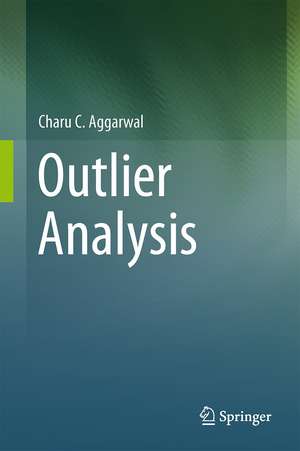
Outlier Analysis
Autor Charu C. Aggarwalen Limba Engleză Hardback – 11 ian 2013
Subliniem faptul că Outlier Analysis necesită un nivel de experiență solid în informatică, fiind conceput ca un text academic și tehnic ce presupune cunoștințe prealabile de algoritmi și structuri de date. Suntem de părere că această lucrare reprezintă un punct de referință datorită modului în care Charu C. Aggarwal reușește să unifice perspectivele din data mining, machine learning și statistică într-un cadru computațional coerent. Pe linia practică a volumului Outlier Detection: Techniques and Applications, dar cu un focus mult mai extins pe rigoarea teoretică a metodelor de înaltă dimensionalitate, această a doua ediție aduce completări esențiale prin includerea rețelelor neuronale și a metodelor de factorizare a matricelor.
Structura cărții este organizată progresiv, facilitând o înțelegere aprofundată a fenomenului. Primele șapte capitole pun bazele teoretice, explorând modelele probabilistice, liniare și cele bazate pe proximitate. Ulterior, cuprinsul indică o trecere către metode specifice domeniului, de la date de tip text și serii temporale, până la structuri complexe de tip graf sau rețea. Această abordare sistematică oglindește metodologia autorului întâlnită și în alte lucrări fundamentale ale sale, precum Data Clustering sau Neural Networks and Deep Learning, unde complexitatea este descompusă în componente gestionabile. Credem că integrarea capitolului final dedicat aplicațiilor practice și ghidajului pentru specialiști transformă acest volum dintr-un simplu manual într-un instrument de lucru indispensabil pentru cercetarea aplicată în securitate informatică sau analiza fluxurilor de date.
Preț: 947.41 lei
Preț vechi: 1184.26 lei
-20%
Carte disponibilă
Livrare economică 27 octombrie-10 noiembrie
Specificații
ISBN-10: 1461463955
Pagini: 464
Ilustrații: XV, 446 p.
Dimensiuni: 155 x 235 x 29 mm
Greutate: 0.82 kg
Ediția:2013
Editura: Springer
Colecția Springer
Locul publicării:New York, NY, United States
V-ar putea interesa
-
 Data Mining: Concepts and TechniquesJiawei Han-40%Preț: 423.98 lei711.99 lei
 -
 Generative AnalysisJim Arlow-20%Preț: 385.24 lei481.54 lei
 -
 The Elements of Statistical LearningJerome Friedman-20%Preț: 545.73 lei682.16 lei
 -
 -39%Preț: 391.86 lei645.65 lei
 -
 -20%Preț: 337.92 lei422.40 lei
 -
 Data Science and Big Data AnalyticsEmc Education Services-20%Preț: 395.12 lei493.89 lei
 -
 -9%Preț: 571.23 lei627.73 lei
 -
 -20%Preț: 134.29 lei167.85 lei
 -
 Data Science Essentials for DummiesLillian Pierson-20%Preț: 76.56 lei95.69 lei
 -
 The Data Hero PlaybookMalcolm HawkerPreț: 202.67 lei
 -
 Statistical Analysis with Python For DummiesJoseph SchmullerPreț: 197.06 lei
 -
 Machine Learning For DummiesLuca Massaron-20%Preț: 146.59 lei183.23 lei
 -
 Preț: 123.51 lei
 -
 Data Clustering: Algorithms and ApplicationsCharu C. Aggarwal-9%Preț: 1156.40 lei1270.77 lei
 -
 -35%Preț: 499.43 lei772.56 lei
 -
 Outlier Detection in PythonBrett Kennedy-20%Preț: 396.71 lei495.89 lei
 -
 Statistics for ScientistsUmberto Michelucci-20%Preț: 275.88 lei344.84 lei
 -
 The Data Science Design ManualSteven S. Skiena-20%Preț: 412.81 lei516.02 lei
 -
 Business Analytics with R and PythonDavid L. Olson-20%Preț: 405.64 lei507.05 lei
 -
 Multivariate Analysis and Machine Learning TechniquesSrikrishnan Sundararajan-20%Preț: 534.82 lei668.53 lei
Public țintă
ResearchDe ce să citești această carte
Recomandăm această carte cercetătorilor și practicienilor din domeniul analizei datelor care doresc o stăpânire completă a metodelor de detectare a anomaliilor. Cititorul câștigă o perspectivă integrată asupra algoritmilor de bază și a aplicațiilor lor în medii complexe, precum datele spațiale sau rețelele. Este un instrument esențial pentru oricine dorește să implementeze sisteme robuste de detectare a fraudelor sau a intruziunilor.
Despre autor
Charu C. Aggarwal este un cercetător de renume în cadrul diviziei de cercetare IBM, obținând doctoratul la MIT în 1996. Cu o carieră marcată de peste 90 de lucrări științifice publicate și peste 50 de brevete de invenție, Aggarwal a fost desemnat de două ori „Master Inventor” la IBM pentru valoarea comercială a inovațiilor sale. Expertiza sa vastă se reflectă în lucrări de referință precum Data Mining și Recommender Systems, fiind recunoscut în special pentru contribuțiile sale în detectarea amenințărilor bioteroriste în timp real în fluxurile de date.
Descriere scurtă
Cuprins
Recenzii
“Aggarwal has written a complete survey of the state of the art in anomaly detection. … His book provides a solid frame of reference for those interested in anomaly detection, both researchers and practitioners, no matter whether they are generalists or they are mostly focused on particular applications. All of them can benefit from the broad overview of the field, the nice introductions to many different techniques, and the annotated pointers for further reading that this book provides.” (Fernando Berzal, Computing Reviews, August, 2014)
“This book is an encyclopedia of how to handle outliers. The author introduces various methods to deal with outliers under various conditions, but in a systematic way so that one can easily find what one needs. The writing style is accessible to readers who do not have deep statistical training. … a good reference book for practitioners and researchers who are not experts in outlier analysis, but want to gain a basic understanding of how to do it.” (Hung Hung, Mathematical Reviews, March, 2014)
“This book aims at providing a missing formal view of recent advances in outlier analysis that have been carried out mostly independently in both the computer science and statistics communities. … the book contains a series of carefully created exercises, attempting to make the book useful as a textbook. … All in all, this is an excellent book. … the book seems to be oriented more towards the experienced researcher who will use this book as reference material … .” (Santiago Ontanon, zbMATH, Vol. 1291, 2014)
Caracteristici
Notă biografică
Textul de pe ultima copertă
- Basic algorithms: Chapters 1 through 7 discuss the fundamental algorithms for outlier analysis, including probabilistic and statistical methods, linear methods, proximity-based methods, high-dimensional (subspace) methods, ensemble methods, and supervised methods.
- Domain-specific methods: Chapters 8 through 12 discuss outlier detection algorithms for various domains of data, such as text, categorical data, time-series data, discrete sequence data, spatial data, and network data.
- Applications: Chapter 13 is devoted to various applications of outlier analysis. Some guidance is also provided for the practitioner.