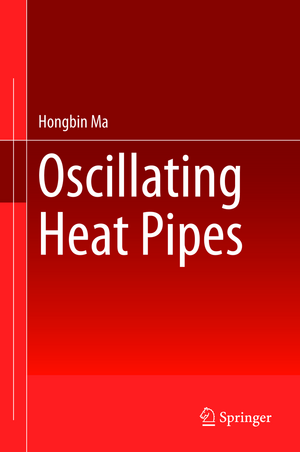
Oscillating Heat Pipes
Autor Hongbin Maen Limba Engleză Hardback – 24 mai 2015
This book also
· Includes detailed descriptions on how an oscillating heat pipe is fabricated, tested, and utilized
· Covers fundamentals of oscillating flow and heat transfer in an oscillating heat pipe
· Provides general presentation of conventional heat pipes
Preț: 1438.96 lei
Preț vechi: 1754.83 lei
-18%
Puncte Express: 2158
Carte tipărită la comandă
Livrare economică 07-21 decembrie
Livrare prin curier în România Termenul estimat este afișat lângă disponibilitate.
Transport gratuit pentru acest produs Plată online sau ramburs, în funcție de opțiunile comenzii.
Retur gratuit în 14 zile Comandă securizată și suport în română.
Specificații
ISBN-13: 9781493925032
ISBN-10: 1493925032
Pagini: 444
Ilustrații: XVI, 427 p. 252 illus., 36 illus. in color.
Dimensiuni: 160 x 241 x 30 mm
Greutate: 0.78 kg
Ediția:2015
Editura: Springer
Locul publicării:New York, NY, United States
ISBN-10: 1493925032
Pagini: 444
Ilustrații: XVI, 427 p. 252 illus., 36 illus. in color.
Dimensiuni: 160 x 241 x 30 mm
Greutate: 0.78 kg
Ediția:2015
Editura: Springer
Locul publicării:New York, NY, United States
V-ar putea interesa
-
 Latent Heat Transfer: An Introduction to FundamentalsG. S. H. Lock-21%Preț: 339.13 lei427.68 lei
 -
 Sustainable Energy Systems and ApplicationsIbrahim Dincer-15%Preț: 757.55 lei891.24 lei
 -
 Biological ThermodynamicsDonald T. Haynie-19%Preț: 557.28 lei687.99 lei
 -
 -19%Preț: 454.48 lei561.08 lei
 -
 Thermodynamics and Statistical MechanicsRobert J. Hardy-23%Preț: 523.98 lei680.49 lei
 -
 -23%Preț: 476.43 lei618.75 lei
 -
 Heat TransferPeter BöckhPreț: 507.26 lei
 -
 Transient Heat TransferDonatello AnnaratonePreț: 361.95 lei
 -
 Preț: 280.24 lei
Public țintă
ResearchCuprins
Introduction.- Fundamentals.- Oscillating Flow and Heat Transfer of Single Phase in Capillary Tubes.- Oscillating Motion and Heat Transfer Mechanics of Oscillating Heat Pipes.- Factors Affecting Oscillating Motion and Heat Transfer in an OHP.- Visualization of Oscillating Heat Pipes.- Nanofluid Oscillating Heat Pipe.- Experiment and Manufacturing Considerations.- Conventional Heat Pipes.
Textul de pe ultima copertă
This book presents the fundamental fluid flow and heat transfer principles occurring in oscillating heat pipes and also provides updated developments and recent innovations in research and applications of heat pipes. Starting with fundamental presentation of heat pipes, the focus is on oscillating motions and its heat transfer enhancement in a two-phase heat transfer system. The book covers thermodynamic analysis, interfacial phenomenon, thin film evaporation, theoretical models of oscillating motion and heat transfer of single phase and two-phase flows, primary factors affecting oscillating motions and heat transfer, neutron imaging study of oscillating motions in an oscillating heat pipes, and nanofluid’s effect on the heat transfer performance in oscillating heat pipes. The importance of thermally-excited oscillating motion combined with phase change heat transfer to a wide variety of applications is emphasized. This book is an essential resource and learning tool for senior undergraduate, graduate students, practicing engineers, researchers, and scientists working in the area of heat pipes.
This book also
· Includes detailed descriptions on how an oscillating heat pipe is fabricated, tested, and utilized
· Covers fundamentals of oscillating flow and heat transfer in an oscillating heat pipe
· Provides general presentation of conventional heat pipes
This book also
· Includes detailed descriptions on how an oscillating heat pipe is fabricated, tested, and utilized
· Covers fundamentals of oscillating flow and heat transfer in an oscillating heat pipe
· Provides general presentation of conventional heat pipes
Notă biografică
Dr Hongbin Ma is currently a Professor at the School of Automation, Beijing Institute of Technology. He received his bachelor degree from Zhengzhou University in 2001 and doctoral degree from the Academy of Mathematics and Systems Science, Chinese Academy of Sciences in 2006. He joined Bell Labs Research Center at Beijing in March of 2006 and later joined Temasek Laboratories, National University of Singapore in August 2006 as a Research Scientist. His research focuses on adaptation, learning and recognition, especially adaptive estimation and control, as well as their applications in robots, smart cars, and UAVs. He is also a member of IEEE, SIAM, CSIAM, ACM and Automation Society of China. He serves as (leading) guest editor or member of international/technical program committee of several academic conferences/journals such as Chinese Control Conference, Chinese Conference on Decision and Control, International Conference on Control & Automation, Journal of Robotics. Dr.Ma is the principle investigator of several scientific projects supported by National Natural Science Foundation (NSFC), Ministry of Education, and so on. In 2009, he was supported by the programme of New Century Excellent Talents in University, by Ministry of Education. In 2012, he obtained the 13th Huo Ying Dong Young Teacher Award for Higher Education and the 13th Excellent Education & Teaching Award of Beijing Institute of Technology. He was also supported by Beijing Outstanding Talents Project starting from 2012. In 2017, he obtained Wu Wenjun Artificial Intelligence Science and Technology Award, Big Data Academic Innovation Award, Outstanding Scientific Outcome Award and Second Prize in Innovation Contest for Oversea Talents. He received several awards, such as 2016 ICIRA Recognition Award, in international conferences. Dr. Ma has published more than 100 academic papers in reputable journals or conferences. And under his supervision, a dozen of students have performed well in scientific research, innovation contests, and establishing themselves.
Dr Liping Yan is currently an Associate Professor at the School of Automation, Beijing Institute of Technology. She received her bachelor degree and master degree from Henan University in 2000 and 2003, respectively. And she received her doctoral degree from Tsinghua University in 2007. She joined Institute of Communication since 2007 and then joined Beijing Institute of Technology since 2009. Her research focuses on multi-sensor information fusion, image registration, and integrated navigation and intelligent navigation. She has published two textbooks and more than 30 academic papers in reputable journals or conferences. And she obtained some original results in asynchronous information fusion. She has won several prized in scientific research and financially supported by several funding projects such as National Natural Science Foundation.
Dr. Yuanqing Xia was born in Anhui Province, China, in 1971 and graduated from the Department of Mathematics, Chuzhou University, Chuzhou, China, in 1991. Professor at the
School of Automation, Beijing Institution of Technology. He received his M.S. degree in Fundamental Mathematics from Anhui University, China, in 1998 and his Ph.D. degree in Control Theory and Control Engineering from Beijing University of Aeronautics and Astronautics, Beijing, China, in 2001. From 1991 to 1995, he was with Tongcheng MiddleSchool, Anhui, China, where he worked as a teacher. During January 2002 to November 2003, he was a postdoctoral research associate in the Institute of Systems Science, Academy of Mathematics and System Sciences, Chinese Academy of Sciences, Beijing, China, where he worked on navigation, guidance and control. From November 2003 to February 2004, he was with the National University of Singapore as a research fellow, where he worked on variable structure control. From February 2004 to