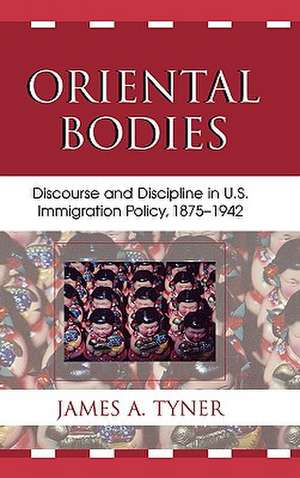
Oriental Bodies
Autor James A. Tyneren Limba Engleză Hardback – 7 mar 2006
| Toate formatele și edițiile | Preț | Express |
|---|---|---|
| Paperback (1) | 261.45 lei 6-8 săpt. | |
| Bloomsbury Publishing – 16 feb 2006 | 261.45 lei 6-8 săpt. | |
| Hardback (1) | 565.42 lei 6-8 săpt. | |
| Rowman & Littlefield – 7 mar 2006 | 565.42 lei 6-8 săpt. |
Preț: 565.42 lei
Preț vechi: 734.31 lei
-23%
Puncte Express: 848
Preț estimativ în valută:
99.96€ • 117.01$ • 87.29£
99.96€ • 117.01$ • 87.29£
Carte tipărită la comandă
Livrare economică 06-20 martie
Specificații
ISBN-13: 9780739112960
ISBN-10: 0739112961
Pagini: 117
Dimensiuni: 161 x 228 x 14 mm
Greutate: 0.31 kg
Editura: Rowman & Littlefield
ISBN-10: 0739112961
Pagini: 117
Dimensiuni: 161 x 228 x 14 mm
Greutate: 0.31 kg
Editura: Rowman & Littlefield
V-ar putea interesa
-
 The Ethics of ImmigrationJoseph H. Carens-23%Preț: 266.73 lei346.34 lei
 -
 Outsiders No More?: Models of Immigrant Political IncorporationJennifer Hochschild-11%Preț: 355.74 lei399.71 lei
 -
 Preț: 177.91 lei
 -
 Preț: 143.29 lei
 -
 The BeastOscar J. MartínezPreț: 81.33 lei
 -
 Fortress EuropeMatthew Carr-17%Preț: 85.67 lei103.59 lei
 -
 -26%Preț: 347.29 lei468.43 lei
 -
 Enterprising Migrants in BerlinBaris lker-19%Preț: 304.37 lei377.48 lei
 -
 -13%Preț: 155.19 lei178.27 lei
 -
 -17%Preț: 238.32 lei287.60 lei
Descriere scurtă
Cuprins
Chapter 1 Introduction
Chapter 2 "The Dark Speck Upon the Horizon"
Chapter 3 "They Never Cease Being Japanese"
Chapter 4 "That Place is the Orient"
Chapter 5 The Future of Immigration
Chapter 2 "The Dark Speck Upon the Horizon"
Chapter 3 "They Never Cease Being Japanese"
Chapter 4 "That Place is the Orient"
Chapter 5 The Future of Immigration
Recenzii
In a thorough examination of the intertwining of eugenics, geopolitics, and Orientalist discourse, James Tyner's Oriental Bodies analyzes the impacts of U.S. immigration and foreign policies and the exclusion of Asian immigrants, ranging from individual bodies and communities, to national and international scales. It connects the historical exclusion of Chinese, Japanese, and Filipino immigrants to the contemporary situation of Central America and Post-9/11 America. The book is an important addition to social science scholarship and geographical analysis on immigration, ethnicity, race, class, gender, and nation state building.
In this crisp narrative of the evolution of U.S. actions against Chinese, Japanese and Filipino immigrants, James Tyner confirms his reputation as a leading scholar in geography and gender, and provides a timely reminder of the perils and pitfalls of post-9/11 patriotism.
In this crisp narrative of the evolution of U.S. actions against Chinese, Japanese and Filipino immigrants, James Tyner confirms his reputation as a leading scholar in geography and gender, and provides a timely reminder of the perils and pitfalls of post-9/11 patriotism.