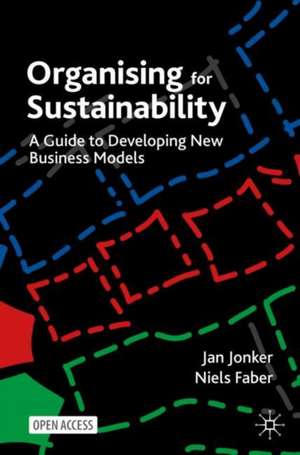
Organizing for Sustainability: A Guide to Developing New Business Models
Autor Jan Jonker, Niels Faberen Limba Engleză Paperback – 20 iul 2021
Problema centrală pe care o rezolvă Organizing for Sustainability este tranziția de la o viziune axată strict pe profit monetar la o structură organizațională capabilă să genereze impact pozitiv multiplu: social, ecologic și economic. Într-un peisaj global marcat de criza climatică, observăm că nu mai este suficient să vorbim despre sustenabilitate la nivel teoretic; avem nevoie de un instrumentar pragmatic pentru a redesena modul în care se creează valoarea. Pe linia practică a volumului Impact Business Design, dar cu un focus specific pe rigoarea academică și pe integrarea unor arhetipuri clare de business, această lucrare oferă un sistem coerent de transformare organizațională.
Ne-a atras atenția structura logică și progresivă a cărții, organizată în trei faze fundamentale: Definire, Proiectare și Rezultat. Autorii Jan Jonker și Niels Faber nu se limitează la concepte abstracte, ci ghidează cititorul prin zece „blocuri de construcție” esențiale, de la formularea „visului” și a propunerii de valoare, până la testarea externă și analiza impactului final. Apreciem în mod deosebit introducerea celor trei arhetipuri — platforma, comunitatea și economia circulară — care servesc drept modele de referință pentru orice startup sau corporație aflată în proces de pivotare.
În contextul operei lui Jan Jonker, acest titlu reprezintă o evoluție firească de la lucrări precum Management Models for Corporate Social Responsibility. Dacă în volumele anterioare accentul cădea pe managementul responsabilității sociale, aici observăm o trecere spre arhitectura propriu-zisă a afacerii. Cartea funcționează ca un manual de laborator, oferind studii de caz, sarcini de lucru și resurse multimedia, fiind ideală pentru transformarea unei idei brute într-un prototip funcțional de business sustenabil.
Preț: 377.42 lei
Carte indisponibilă temporar
Specificații
ISBN-10: 3030781569
Pagini: 242
Ilustrații: XXXV, 242 p. 1 illus.
Dimensiuni: 155 x 235 x 22 mm
Greutate: 0.4 kg
Ediția:1st ed. 2021
Editura: Springer International Publishing
Colecția Palgrave Macmillan
Locul publicării:Cham, Switzerland
V-ar putea interesa
-
 Business Model GenerationAlexander OsterwalderPreț: 207.05 lei
 -
 Preț: 354.79 lei
 -
 Preț: 320.04 lei
 -
 Business Model ShiftsPatrick van der PijlPreț: 208.44 lei
 -
 Business Model YouTimothy ClarkPreț: 154.08 lei
 -
 Waste to WealthJakob RutqvistPreț: 391.14 lei
 -
 Brilliant Business ModelsAdam J. BockPreț: 103.67 lei
 -
 Preț: 240.41 lei
 -
 The Business Model NavigatorOliver GassmannPreț: 206.58 lei
 -
 New Venture CreationPaul Burns-26%Preț: 372.32 lei502.25 lei
 -
 Preț: 214.73 lei
 -
 From Values to ActionHarry M Jansen KraemerPreț: 180.15 lei
 -
 The New Nature of BusinessAndre HoffmannPreț: 110.69 lei
 -
 Mastering the Circular EconomyEd WeenkPreț: 226.73 lei
 -
 -45%Preț: 124.34 lei225.23 lei
 -
 The Business of Building a Better WorldDavid CooperriderPreț: 215.26 lei
 -
 Do BuildAlan Moore-20%Preț: 54.38 lei68.33 lei
 -
 The Six-Minute EntrepreneurSara DaviesPreț: 137.25 lei
 -
 Business Model Innovation: Game Changers and Contemporary IssuesAnnabeth AagaardPreț: 283.28 lei
 -
 -28%Preț: 169.90 lei234.82 lei
De ce să citești această carte
Această carte este esențială pentru antreprenorii și managerii care vor să depășească stadiul de „greenwashing” și să implementeze structuri economice viabile. Veți câștiga acces la Business Model Template (BMT), un instrument aplicat care vă permite să alegeți și să adaptați un model de afaceri circular sau bazat pe comunitate, asigurând o relevanță pe termen lung într-o economie în schimbare.
Despre autor
Jan Jonker este profesor asociat și cercetător la Nijmegen School of Management, în cadrul Universității Radboud din Olanda, fiind o autoritate recunoscută în domeniul managementului sustenabil. Expertiza sa se concentrează pe dezvoltarea modelelor de afaceri care integrează valorile sociale și ecologice. A coordonat numeroase volume colective despre responsabilitatea socială corporativă în Europa, precum Corporate Social Responsibility Across Europe, și a publicat lucrări fundamentale despre metodologia cercetării și designul organizațional, adaptându-și constant teoriile la realitățile economiei circulare.
Descriere scurtă
The book offers students and entrepreneurs a structured approach based through the Business Model Template (BMT). It consists of three stages and ten building blocks to facilitate the development of a business model. Users, be they students or practitioners, need to choose from one of the three offered business model archetypes, namely the platform, community, or circular business models. Each archetype offers a dedicated logic for vale creation. The book can be used to develop a business model from scratch (turning an idea into a working prototype) or to transform an existing business model into one of the three archetypes. Throughout the book extra sources, links to relevant online video clips, assignments and literature are offered to facilitate the development process.
This book will be of interest to students studying the development of business models, sustainable management, innovation, and value creation. It will also be of interest executives, and professionals such as consultants or social entrepreneurs seeking further education.
Cuprins
Notă biografică
Niels Faber is assistant professor of Circular Entrepreneurship at the Campus Fryslân Faculty of the University of Groningen in Leeuwarden (the Netherlands) and lecturer-researcher at the International Business School and Knowledge Centre Bio-based Economy of the Hanze University of Applied Sciences in Groningen (the Netherlands).His research focuses on the organisational aspects of, and business models for, sustainability and the circular economy.