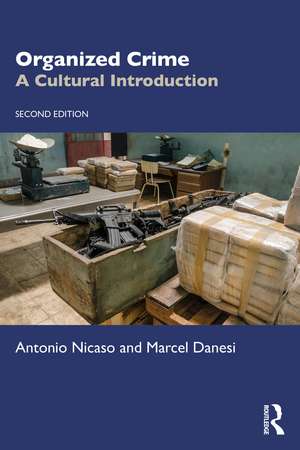
Organized Crime: A Cultural Introduction
Autor Antonio Nicaso, Marcel Danesien Limba Engleză Paperback – 14 aug 2025
- An historic overview of organized crime, including the social, economic, and cultural conditions that favor its development
- A description and character analysis of the type of people who make up organized criminal groups and the activities in which they engage
- The symbols, rituals, codes, and languages that characterize criminal institutions
- The relationship between traditional organized crime, cybercrime, and evolving forms of crime on the Dark Web and in the Metaverse
- The traditional and changing roles of women in organized crime
- The transnational operations of criminal groups
- Media portrayals of organized crime
- Policing responses to organized crime
- The use of technologies by the organized criminal groups
Preț: 390.62 lei
Puncte Express: 586
Carte disponibilă
Livrare economică 12-26 noiembrie
Livrare express 28 octombrie-03 noiembrie pentru 45.25 lei
Livrare prin curier în România Termenul estimat este afișat lângă disponibilitate.
Transport gratuit de la 400.00 lei Plată online sau ramburs, în funcție de opțiunile comenzii.
Retur gratuit în 14 zile Comandă securizată și suport în română.
Specificații
ISBN-13: 9781041002185
ISBN-10: 1041002181
Pagini: 370
Ilustrații: 38
Dimensiuni: 156 x 234 x 24 mm
Greutate: 0.68 kg
Ediția:2. Auflage
Editura: Taylor & Francis
Colecția Routledge
Locul publicării:Oxford, United Kingdom
ISBN-10: 1041002181
Pagini: 370
Ilustrații: 38
Dimensiuni: 156 x 234 x 24 mm
Greutate: 0.68 kg
Ediția:2. Auflage
Editura: Taylor & Francis
Colecția Routledge
Locul publicării:Oxford, United Kingdom
V-ar putea interesa
-
 -23%Preț: 521.43 lei677.19 lei
 -
 X-Rated!Marcel DanesiPreț: 401.88 lei
 -
 Increase Your Puzzle IQMarcel DanesiPreț: 99.78 lei
 -
 Using Italian VocabularyMarcel Danesi-19%Preț: 538.05 lei664.26 lei
 -
 Preț: 74.85 lei
 -
 The Dark Mafia: Organized Crime in the Age of the InternetAntonio NicasoPreț: 354.50 lei
 -
 Publications of the Scottish History SocietyScottish History SocietyPreț: 206.46 lei
 -
 Preț: 169.71 lei
 -
 The SaxonsRobert Sass-8%Preț: 457.29 lei497.05 lei
 -
 A History of England, Julius Caesar to Richard IIIH. O. Arnold-ForsterPreț: 103.39 lei
 -
 The WinnerDario LisieroPreț: 95.23 lei
 -
 Popular CultureMarcel Danesi-23%Preț: 680.02 lei883.14 lei
 -
 POPULAR CULTURE INTRODUCTORY PPBMarcel Danesi-17%Preț: 307.64 lei370.35 lei
 -
 Alabama and the Civil War: A History & GuideRobert C. JonesPreț: 179.52 lei
 -
 Doomed DestroyerRon CopePreț: 141.85 lei
 -
 Adventures in the far West;Catherine Van Valkenburg WaitePreț: 242.96 lei
 -
 The History and Debates of the Convention of the People of AlabamaWilliam Russell SmithPreț: 325.76 lei
 -
 Preț: 114.81 lei
 -
 Blood and thunders or, Dime novels of the 80's and 90'sFloyd L BeaglePreț: 91.29 lei
 -
 History of Trinidad (First Period) from 1781 to 1813 (Volume I)Lionel Mordaunt FraserPreț: 197.22 lei
 -
 Preț: 158.93 lei
 -
 Memorandum upon recent disturbances in CeylonEdward Walter PereraPreț: 100.37 lei
 -
 Preț: 179.55 lei
Public țintă
Postgraduate and Undergraduate AdvancedNotă biografică
Antonio Nicaso teaches courses on the social history of organized crime and Mafia culture at Queen's University, Canada. He is a leading expert on Mafia and Mafia-like criminal organizations in the world. He has published extensively on organized crime, including many bestsellers.
Marcel Danesi is Professor Emeritus of Anthropology at the University of Toronto, where he taught courses on forensic semiotics. He has published extensively in the fields of linguistics, semiotics, and forensic semiotics.
Marcel Danesi is Professor Emeritus of Anthropology at the University of Toronto, where he taught courses on forensic semiotics. He has published extensively in the fields of linguistics, semiotics, and forensic semiotics.
Cuprins
1. What is organized crime? 2. Theories 3. The Italian Mafias 4. Other criminal organizations 5. Organization 6. The players 7. Codes 8. The made man 9. The women 10. Resources 11. The business agenda 12. Strategic violence 13. Symbols, myths, traditions 14. Communications 15. Hybrid criminality 16. The age of AI 17. A gang instinct 18. Popular culture 19. Policing 20. Epilogue
Descriere
This book aims to describe and demystify what makes organized criminal groups so culturally powerful. This new edition examines their codes of conduct, initiation rites, secret communication methods, origin myths, symbols, and lifestyles, and serves as an introduction to organized crime from the angle of cultural analysis.
Recenzii
Organized Crime is a social bad, that harms people and the economy. Yet it is also a phenomenon that goes beyond the profit motive, involving rituals, norms of behaviour, and codes of conduct. This book by Danesi and Nicaso is an excellent general introduction to the topic, that also sheds light on several neglected aspects of this phenomenon. A text well worth reading.
Federico Varese, Author of Mafia Life, Professor of Criminology, Oxford University
At long last, a book that combines the rigour of an academic text with the accessibility and page-turning qualities of some of the best works of literary non-fiction covering the Mafia. In Nicaso and Danesi's latest offering, we once again see their non-traditional and multidisciplinary approach to exploring the cultural underpinnings and rituals of organised crime and their place both within not only larger and complex social and legal structures but also within the popular imagination. The format of this book also allows for quick reference as needed, making it ideal as a course text for those criminology courses out there focusing on not only the Mafia per se, but also any groups recognized as being adherents to the "traditional" organised crime model.
Dr. Michael Arntfield, Criminologist & Homicide Scholar, Western University, Canada
Like many people, I am, I must confess, both drawn to and repelled by certain types of organised crime, at least in terms of what I see in the movies and elsewhere. The family bonds in The Godfather draw me in, I never wanted Sonny to die like that, the slaughter in Al Pacino’s Scarface repels me. The news most nights tell me that organised crime is behind most of society’s ills. But what’s behind the emotional (and sometimes glamorous) images and the headlines. Organised Crime: A Cultural Introduction by Antonio Nicaso and Marcel Danesi explains fully. This interdisciplinary approach to the subject of organised crime is a truly fascinating read which will be an eye-opener for scholars and students across a range of disciplines including criminology, sociology, anthropology and psychology. Academic authority, cultural and semiotic sensitivity, and a deep understanding of the subject matter shines through this important book.
Professor Geoffrey Beattie, Edge Hill University, UK
Federico Varese, Author of Mafia Life, Professor of Criminology, Oxford University
At long last, a book that combines the rigour of an academic text with the accessibility and page-turning qualities of some of the best works of literary non-fiction covering the Mafia. In Nicaso and Danesi's latest offering, we once again see their non-traditional and multidisciplinary approach to exploring the cultural underpinnings and rituals of organised crime and their place both within not only larger and complex social and legal structures but also within the popular imagination. The format of this book also allows for quick reference as needed, making it ideal as a course text for those criminology courses out there focusing on not only the Mafia per se, but also any groups recognized as being adherents to the "traditional" organised crime model.
Dr. Michael Arntfield, Criminologist & Homicide Scholar, Western University, Canada
Like many people, I am, I must confess, both drawn to and repelled by certain types of organised crime, at least in terms of what I see in the movies and elsewhere. The family bonds in The Godfather draw me in, I never wanted Sonny to die like that, the slaughter in Al Pacino’s Scarface repels me. The news most nights tell me that organised crime is behind most of society’s ills. But what’s behind the emotional (and sometimes glamorous) images and the headlines. Organised Crime: A Cultural Introduction by Antonio Nicaso and Marcel Danesi explains fully. This interdisciplinary approach to the subject of organised crime is a truly fascinating read which will be an eye-opener for scholars and students across a range of disciplines including criminology, sociology, anthropology and psychology. Academic authority, cultural and semiotic sensitivity, and a deep understanding of the subject matter shines through this important book.
Professor Geoffrey Beattie, Edge Hill University, UK