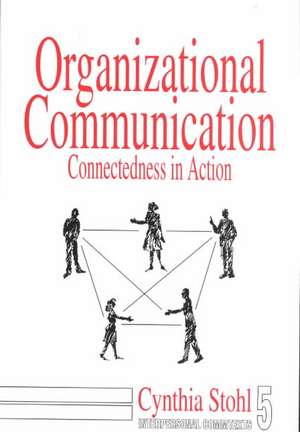
Organizational Communication
Autor Cynthia Stohlen Limba Engleză Hardback – apr 1995
Preț: 943.36 lei
Preț vechi: 1292.27 lei
-27%
Puncte Express: 1415
Carte tipărită la comandă
Livrare economică 20 noiembrie-04 decembrie
Livrare prin curier în România Termenul estimat este afișat lângă disponibilitate.
Transport gratuit pentru acest produs Plată online sau ramburs, în funcție de opțiunile comenzii.
Retur gratuit în 14 zile Comandă securizată și suport în română.
Specificații
ISBN-13: 9780803934252
ISBN-10: 0803934254
Pagini: 224
Dimensiuni: 157 x 235 x 18 mm
Greutate: 0.37 kg
Ediția:New.
Editura: Sage Publications, Inc
Locul publicării:Thousand Oaks, United States
ISBN-10: 0803934254
Pagini: 224
Dimensiuni: 157 x 235 x 18 mm
Greutate: 0.37 kg
Ediția:New.
Editura: Sage Publications, Inc
Locul publicării:Thousand Oaks, United States
V-ar putea interesa
-
 -19%Preț: 352.85 lei434.25 lei
 -
 FriendshipA. C. GraylingPreț: 112.57 lei
 -
 The Routledge Handbook of Strategic CommunicationDerina Holtzhausen-18%Preț: 1876.78 lei2288.75 lei
 -
 Managing Conflict in a Negotiated WorldPeter M. Kellett-18%Preț: 948.84 lei1157.12 lei
 -
 Understanding AudiencesAndy Ruddock-18%Preț: 682.47 lei832.28 lei
 -
 -23%Preț: 630.08 lei818.29 lei
 -
 Preț: 248.91 lei
 -
 News and SexualityLaura Castañeda-18%Preț: 819.69 lei999.62 lei
 -
 Political Communication and DeliberationJohn Gastil-23%Preț: 636.78 lei826.99 lei
 -
 Preț: 304.98 lei
Cuprins
PART ONE: ORGANIZATIONS AS NETWORKS
Connectedness-in-Action
A Network Perspective
PART TWO: THE COMPLEX MATRIX
Messages
Relationships
PART THREE: LINKING COMMUNICATION AND ORGANIZATION
Hierarchy
Participation
Conclusion
Connectedness-in-Action
A Network Perspective
PART TWO: THE COMPLEX MATRIX
Messages
Relationships
PART THREE: LINKING COMMUNICATION AND ORGANIZATION
Hierarchy
Participation
Conclusion
Descriere
In addition to the connections between home life, social life and professional activities, Cynthia Stohl says we must pay attention to the linkages that individuals develop and maintain within their organizational contexts. Organizational Communication illustrates the ways in which today's changing social patterns, the increasing diversity of the workforce, the introduction of new communication technologies, and the challenges of global integration and competition, create organizational and interpersonal networks that are intricately interwoven. By reframing the network metaphor, the author challenges readers to examine the ways in which organizational communication is always embedded in, and influenced by, overlappi