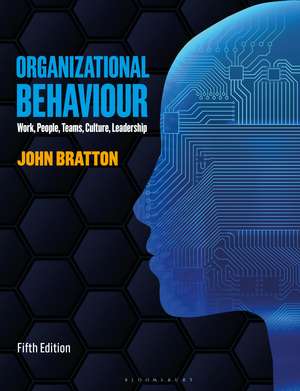
Organizational Behaviour: Work, People, Teams, Culture, Leadership
Autor John Brattonen Limba Engleză Paperback – 11 dec 2026
Balancing critical and management perspectives with the sociological and psychological aspects of organizational behaviour, this textbook provides a comprehensive introduction to the subject and helps you think critically about the effects of human action on people at work.
This edition has reworked chapters and a strong focus on sustainability and diversity, equity and inclusion (DEI) in the workplace. It includes new coverage of the impact of artificial intelligence, work-life balance, hybrid and remote working, DEI initiatives and changes to organizations post-Covid. There are a variety of features to help you connect theory to practice, including The Reality of Work and Globalization and Organizational Behaviour. Globally-oriented, this 5th edition includes new cases and examples from around the world, and includes new chapter case studies that are aligned to the United Nations Sustainable Development Goals.
It assumes no prior knowledge of the subject or previous work experience, and the content fits to the typical structure of Organizational Behaviour modules at undergraduate, postgraduate and MBA level.
This edition is supported by extensive online teaching and learning resources, freely available at bloomsbury.pub/organizational_behaviour_5e
Preț: 427.09 lei
Preț vechi: 497.99 lei
-14% Precomandă
Puncte Express: 641
Carte nepublicată încă
Livrare prin curier în România Precomanda se expediază când titlul devine disponibil.
Transport gratuit pentru acest produs Plată online sau ramburs, în funcție de opțiunile comenzii.
Retur gratuit în 14 zile Comandă securizată și suport în română.
Doresc să fiu notificat când acest titlu va fi disponibil:
Se trimite...
Specificații
ISBN-13: 9781350526501
ISBN-10: 1350526509
Pagini: 596
Ilustrații: 72 figures; 40 tables
Dimensiuni: 190 x 244 x 26 mm
Greutate: 1.16 kg
Ediția:5th edition
Editura: Bloomsbury Publishing
Colecția Bloomsbury Academic
Locul publicării:London, United Kingdom
ISBN-10: 1350526509
Pagini: 596
Ilustrații: 72 figures; 40 tables
Dimensiuni: 190 x 244 x 26 mm
Greutate: 1.16 kg
Ediția:5th edition
Editura: Bloomsbury Publishing
Colecția Bloomsbury Academic
Locul publicării:London, United Kingdom
Cuprins
Part I: Work and Organizational Behaviour
1. Organizational Behaviour in the age of AI
2. Charting the Changing Nature of Work
3. Technology and Artificial Intelligence
4. Culture
5. Studying Work and Organizations
Part II: People in Organizations
6. Class, Gender, Race, and Equality
7. Personality and Self-Identity
8. Perception and Emotions
9. Motivation
Part III: Groups and Teams in the Organization
10. Group and Team Dynamics
11. Learning at Work
12. Communication
Part IV: Structure and Managing Diversity
13. Rethinking Organizational Design
14. Managing Diversity
Part V: Leadership and Leading Change
15. Leadership in the Age of AI
16. Power, Politics, and Resistance
17. Decision Making, Ethics, and Social Responsibility
18. Sustainable Futures and Leading Change
NB: Feature Contributors:
Sarah Albugami, Prince Sattam bin Abdulaziz University, Saudi Arabia contributed some case studies
Bahareh Ansari, Queen's University Belfast, UK contributed some case studies
George Boak, York St John's University, UK contributed some of the Globalization and Organizational Behaviour features
David Denham, formerly Wolverhampton University, UK contributed some of The Realities of Work features
Meghan Van Portfliet, University of Colorado Boulder, US contributed to the Globalization and Organizational Behaviour features
Laura Steele, Queen's University Belfast, UK contributed some case studies
1. Organizational Behaviour in the age of AI
2. Charting the Changing Nature of Work
3. Technology and Artificial Intelligence
4. Culture
5. Studying Work and Organizations
Part II: People in Organizations
6. Class, Gender, Race, and Equality
7. Personality and Self-Identity
8. Perception and Emotions
9. Motivation
Part III: Groups and Teams in the Organization
10. Group and Team Dynamics
11. Learning at Work
12. Communication
Part IV: Structure and Managing Diversity
13. Rethinking Organizational Design
14. Managing Diversity
Part V: Leadership and Leading Change
15. Leadership in the Age of AI
16. Power, Politics, and Resistance
17. Decision Making, Ethics, and Social Responsibility
18. Sustainable Futures and Leading Change
NB: Feature Contributors:
Sarah Albugami, Prince Sattam bin Abdulaziz University, Saudi Arabia contributed some case studies
Bahareh Ansari, Queen's University Belfast, UK contributed some case studies
George Boak, York St John's University, UK contributed some of the Globalization and Organizational Behaviour features
David Denham, formerly Wolverhampton University, UK contributed some of The Realities of Work features
Meghan Van Portfliet, University of Colorado Boulder, US contributed to the Globalization and Organizational Behaviour features
Laura Steele, Queen's University Belfast, UK contributed some case studies
Recenzii
Bratton has delivered another cutting-edge resource for scholars and students of organization and work. The distinctive critical approach is retained, giving students and educators a chance to engage with organizational life as it really is. Rich in examples and with contributions by other leading researchers, this book provides both detail and scope in a readable yet thought-provoking way.
Bratton's fifth edition places enduring organizational questions in the context of urgent contemporary change - e.g. AI, wars, democratic erosion, and climate breakdown. An excellent and timely resource for those seeking to understand organizational behaviour in the present era. Its strengths include intellectual depth, real-world relevance and diversity of ideas. By balancing critical and mainstream perspectives on organizations, leadership, and work, this textbook continues its strong appeal to my international students.
This updated and extended version of an already outstanding textbook provides an in-depth interrogation of behaviour in our organisations. New and developed content around new challenges including AI, the changing geo-political environment, the new-normal workplace and the extension of dispersed and hybrid working. This is a definitive text, and a must use for students and scholars of Organisational Behaviour.
This timely textbook offers a much-needed critical update to organizational behaviour for a world shaped by disruption and technological change. It combines intellectual rigour with a clear pedagogical commitment to helping students question taken-for-granted assumptions about power, efficiency, and organization. Its engagement with AI is especially valuable, inviting readers to ask how this socio-technical system shapes organizational behaviour and whose interests it serves.
Bratton's fifth edition places enduring organizational questions in the context of urgent contemporary change - e.g. AI, wars, democratic erosion, and climate breakdown. An excellent and timely resource for those seeking to understand organizational behaviour in the present era. Its strengths include intellectual depth, real-world relevance and diversity of ideas. By balancing critical and mainstream perspectives on organizations, leadership, and work, this textbook continues its strong appeal to my international students.
This updated and extended version of an already outstanding textbook provides an in-depth interrogation of behaviour in our organisations. New and developed content around new challenges including AI, the changing geo-political environment, the new-normal workplace and the extension of dispersed and hybrid working. This is a definitive text, and a must use for students and scholars of Organisational Behaviour.
This timely textbook offers a much-needed critical update to organizational behaviour for a world shaped by disruption and technological change. It combines intellectual rigour with a clear pedagogical commitment to helping students question taken-for-granted assumptions about power, efficiency, and organization. Its engagement with AI is especially valuable, inviting readers to ask how this socio-technical system shapes organizational behaviour and whose interests it serves.