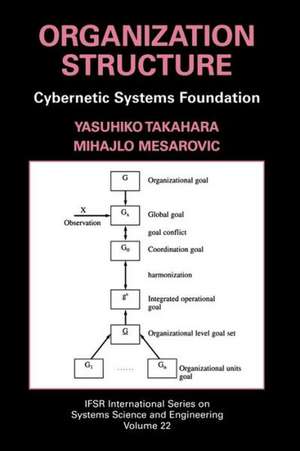
Organization Structure: Cybernetic Systems Foundation: IFSR International Series in Systems Science and Systems Engineering, cartea 22
Autor Yasuhiko Takahara, Mihajlo Mesarovicen Limba Engleză Paperback – 27 aug 2012
Din seria IFSR International Series in Systems Science and Systems Engineering
- 18%
 Preț: 997.36 lei
 - 18%
 Preț: 986.18 lei
 - 18%
 Preț: 1435.49 lei
 - 18%
 Preț: 990.35 lei
 -
 Preț: 372.87 lei
 - 20%
 Preț: 1025.44 lei
 - 18%
 Preț: 1168.82 lei
 - 15%
 Preț: 613.00 lei
 - 15%
 Preț: 659.23 lei
 - 20%
 Preț: 994.22 lei
 - 18%
 Preț: 952.06 lei
 - 18%
 Preț: 916.03 lei
 - 15%
 Preț: 647.44 lei
 - 20%
 Preț: 573.74 lei
 - 18%
 Preț: 1152.83 lei
 -
 Preț: 415.65 lei
 - 20%
 Preț: 610.90 lei
 -
 Preț: 376.55 lei
 - 15%
 Preț: 619.81 lei
 -
 Preț: 409.30 lei
 -
 Preț: 401.21 lei
 - 18%
 Preț: 820.70 lei
 - 15%
 Preț: 671.56 lei
 - 18%
 Preț: 821.34 lei
 - 18%
 Preț: 788.77 lei
 -
 Preț: 467.13 lei
 - 20%
 Preț: 670.94 lei
 - 15%
 Preț: 666.40 lei
Preț: 389.44 lei
Puncte Express: 584
Carte tipărită la comandă
Livrare economică 08-22 decembrie
Livrare prin curier în România Termenul estimat este afișat lângă disponibilitate.
Transport gratuit de la 400.00 lei Plată online sau ramburs, în funcție de opțiunile comenzii.
Retur gratuit în 14 zile Comandă securizată și suport în română.
Specificații
ISBN-13: 9781461379447
ISBN-10: 146137944X
Pagini: 284
Ilustrații: 288 p.
Dimensiuni: 152 x 229 x 16 mm
Greutate: 0.42 kg
Ediția:2003
Editura: Springer
Colecția IFSR International Series in Systems Science and Systems Engineering
Seria IFSR International Series in Systems Science and Systems Engineering
Locul publicării:New York, NY, United States
ISBN-10: 146137944X
Pagini: 284
Ilustrații: 288 p.
Dimensiuni: 152 x 229 x 16 mm
Greutate: 0.42 kg
Ediția:2003
Editura: Springer
Colecția IFSR International Series in Systems Science and Systems Engineering
Seria IFSR International Series in Systems Science and Systems Engineering
Locul publicării:New York, NY, United States
V-ar putea interesa
-
 Evolution of Networks: From Biological Nets to the Internet and WWWS. N. Dorogovtsev-23%Preț: 432.72 lei558.75 lei
 -
 The Computer and the BrainJohn Von NeumannPreț: 113.01 lei
 -
 Introduction to Systems TheoryNiklas LuhmannPreț: 169.40 lei
 -
 Introduction ModelicaFritzson-8%Preț: 452.76 lei492.13 lei
 -
 Optimal Estimation of Dynamic SystemsJohn L. Crassidis-18%Preț: 1494.88 lei1823.02 lei
 -
 -15%Preț: 572.75 lei673.83 lei
 -
 Switching in Systems and ControlDaniel Liberzon-15%Preț: 584.73 lei687.91 lei
 -
 Perturbation Analysis of Optimization ProblemsJ.Frederic Bonnans-18%Preț: 1341.26 lei1635.67 lei
 -
 Stochastic Networked Control SystemsSerdar Yüksel-18%Preț: 995.63 lei1214.17 lei
 -
 Stochastic Networked Control SystemsSerdar Yüksel-18%Preț: 909.87 lei1109.60 lei
 -
 -18%Preț: 918.59 lei1120.23 lei
 -
 Modeling and Control of Discrete-Event Dynamic SystemsBranislav Hrúz-15%Preț: 471.15 lei554.30 lei
 -
 Introducing ChaosIwona AbramsPreț: 64.56 lei
 -
 Model-Based Control of Networked SystemsEloy Garcia-15%Preț: 675.30 lei794.47 lei
 -
 Introduction to Time-Delay Systems: Analysis and ControlEmilia Fridman-46%Preț: 513.77 lei945.44 lei
Public țintă
ResearchCuprins
1 Organizational Cybernetics.- 1.1 Traditional Systems View of Organization.- 1.2 Management Cybernetics: A Viable System Model.- 1.3 General Systems Theoretic View of Complex System: Multi-layer Model.- 1.4 Model of Organizational Cybernetics.- 2 Goal Seeking System.- 2.1O rganization Member as Goal Seeking System.- 2.2 Decision Problem.- 2.3 Decision Principle and Formal Representation of Goal Seeking System.- 2.4 Input Output Model Associated With Goal Seeking System: Standard Operating Procedure.- 3 Goal Compatibility.- 3.1 Goal Compatibility in Decision Principle.- 3.2 Goal Compatibility Example: Political Desirability of Decision Principle.- 3.3 Required Properties for Decision Principle.- 4 Organization Skeleton.- 4.1 Hierarchical Skeleton of Organization.- 4.2 Taxonomy of Organization.- 4.3 Properties of Organization Chart.- 5 Operational Level Management.- 5.1 Regulation of Operational Level.- 5.2 Stability of Operational Level.- 5.3 Departmentalized Operational Units.- 5.4 Optimization Activity of Operational Level.- 6 Organizational Level Management.- 6.1 Total Scheme of Organizational Level Management.- 6.2 Formulation of Organizational Level Management.- 6.3 Example of Formulation.- 6.4 Coordination Principle and Design of Organizational Level Management.- 7 Goal Assignment Coordination.- 7.1 Organizational Level Management Structure on IBP (Interaction Balance Principle).- 7.2 Intra-level Function for IBP Coordination.- 7.3 Validity Theorem of Operational Goal Assignment Coordination.- 7.4 Operational Level Goal Design for IBP.- 8 Task Assignment Coordination.- 8.1 Organizational Level Management Structure in Coordination by IPP.- 8.2 Example of Organizational Level Management Structure on IPP.- 8.3 Validity Theorem of Operational Task Assignment.- 9 Normative Behavior Model Of Operational Level.- 9.1 Normative Operational Level Model.- 9.2 Formulation of Normative Operational Unit and Optimal Directive.- 9.3 Management Structure of Normative Model.- 9.5 Feasibility of Normative Management.- 10 Institutional Level Management.- 10.1 External Input Structure and Institutional Level Management.- 10.2 Structure.- 10.3 Internal Model Principle.- 10.4 Environmental Variety and Internal Variety.- 10.5 Variety Matching.- 11 Computational Approach To Organization.- 11.1 Computational Approach to Organization Theory.- 11.2 Garbage Can Model.- 11.3 Formulation of Garbage Can Model.- 11.4 Implementation of Garbage Can Model.- Appendix I General Sytems Approach and General Systems Models.- AI.1 Introduction.- AI.2 Development Methodology and General Systems Model.- AI.3 Characterization.- AI.4 Categorization.- AI.5 Universality.- Appendix II Min-Max Theorem.- AII.1 Introduction.- AII.2 Preliminary Concepts.- All.3 Optimization and Min-max Theorem.- AII.4 Min-max Theorem for Differentiable Function.- AII.5 Min-max Theorem.- Appendix III Maximum Principle.- AIII.1 Introduction.- AIH.2 Maximum Principle.- References.