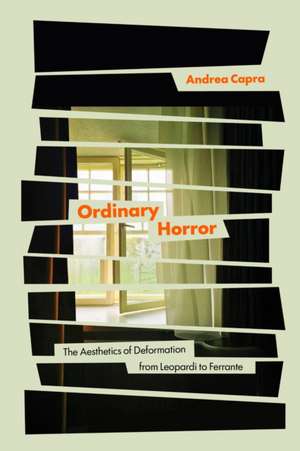
Ordinary Horror
Autor Andrea Capraen Limba Engleză Paperback – sep 2026
Centering on modern Italian literature, Ordinary Horror shows a tradition not typically associated with horror to be rife with it. To this end, Capra emphasizes the centrality of the experience in canonical authors, as seen, for instance, in Giacomo Leopardi's pages on existential suffering, Primo Levi's writings on Auschwitz, and Elena Ferrante's descriptions of sexual violence. Literature, Capra argues, can convey horror's experiential magnitude through what he calls the "aesthetics of deformation"—scenes when otherwise realistic texts depart from verisimilitude and embrace a more disquieting style. Weaving together aesthetics and phenomenology, Capra shows that just as horror may rupture the fabric of everyday life, so too may it rupture the fabric of a literary text.
Preț: 190.45 lei
Nou
Puncte Express: 286
Carte disponibilă
Livrare economică 02-16 noiembrie
Livrare express 16-22 octombrie pentru 31.07 lei
Livrare prin curier în România Termenul estimat este afișat lângă disponibilitate.
Transport gratuit de la 400.00 lei Plată online sau ramburs, în funcție de opțiunile comenzii.
Retur gratuit în 14 zile Comandă securizată și suport în română.
Specificații
ISBN-13: 9781503648142
ISBN-10: 1503648141
Pagini: 312
Dimensiuni: 229 x 150 x 19 mm
Greutate: 0.42 kg
Editura: Stanford University Press
ISBN-10: 1503648141
Pagini: 312
Dimensiuni: 229 x 150 x 19 mm
Greutate: 0.42 kg
Editura: Stanford University Press
Notă biografică
Andrea Capra is Assistant Professor of Italian Studies at NYU.
Cuprins
Acknowledgments
Introduction: Horror beyond Horror
1. The Sublime Roots of Horror: Giacomo Leopardi
2. Not in Control: Carlo Michelstaedter and Luigi Pirandello
3. Structural Horror: Curzio Malaparte and Primo Levi
4. The Banality of Horror: Anna Maria Ortese and Giuseppe Berto
5. To Make Horror Concrete: Elena Ferrante
Coda: Are Horror Stories Real
Notes
Bibliography
Index
Introduction: Horror beyond Horror
1. The Sublime Roots of Horror: Giacomo Leopardi
2. Not in Control: Carlo Michelstaedter and Luigi Pirandello
3. Structural Horror: Curzio Malaparte and Primo Levi
4. The Banality of Horror: Anna Maria Ortese and Giuseppe Berto
5. To Make Horror Concrete: Elena Ferrante
Coda: Are Horror Stories Real
Notes
Bibliography
Index