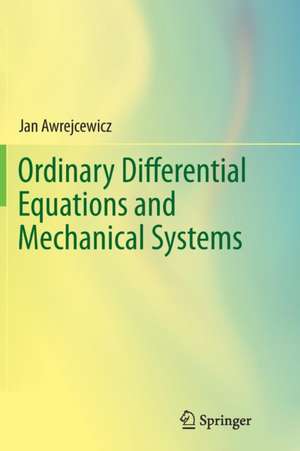
Ordinary Differential Equations and Mechanical Systems
Autor Jan Awrejcewiczen Limba Engleză Paperback – 22 sep 2016
Presenting both an overview of the theory of the introductory differential equations in the context of applicability and a systematic treatment of modeling of numerous engineering and physical problems through linear and non-linear ODEs, the volume is self-contained, yet serves both scientific and engineering interests. The presentation relies on a general treatment, analytical and numerical methods, concrete examples and engineering intuition.
The scientific background used is well balanced between elementary and advanced level, making it as a unique self-contained source for both theoretically and application oriented graduate and doctoral students, university teachers, researchers and engineers of mechanical, civil and mechatronic engineering.
Preț: 631.40 lei
Preț vechi: 742.82 lei
-15%
Puncte Express: 947
Carte tipărită la comandă
Livrare economică 28 decembrie 26 - 11 ianuarie 27
Livrare prin curier în România Termenul estimat este afișat lângă disponibilitate.
Transport gratuit pentru acest produs Plată online sau ramburs, în funcție de opțiunile comenzii.
Retur gratuit în 14 zile Comandă securizată și suport în română.
Specificații
ISBN-13: 9783319352893
ISBN-10: 331935289X
Pagini: 629
Ilustrații: XV, 614 p. 213 illus., 52 illus. in color.
Dimensiuni: 155 x 235 x 32 mm
Greutate: 0.87 kg
Ediția:Softcover reprint of the original 1st ed. 2014
Editura: Springer International Publishing
Colecția Springer
Locul publicării:Cham, Switzerland
ISBN-10: 331935289X
Pagini: 629
Ilustrații: XV, 614 p. 213 illus., 52 illus. in color.
Dimensiuni: 155 x 235 x 32 mm
Greutate: 0.87 kg
Ediția:Softcover reprint of the original 1st ed. 2014
Editura: Springer International Publishing
Colecția Springer
Locul publicării:Cham, Switzerland
V-ar putea interesa
-
 -29%Preț: 379.19 lei530.91 lei
-
 Statistical and Computational Inverse ProblemsJari Kaipio-20%Preț: 857.54 lei1071.93 lei
-
 An Introduction to Difference EquationsSaber Elaydi-15%Preț: 541.35 lei636.87 lei
-
 A First Course in Discrete Dynamical SystemsRichard A. Holmgren-15%Preț: 453.29 lei533.29 lei
-
 A First Course in Finite ElementsJacob Fish-19%Preț: 427.24 lei527.46 lei
-
 Extremes and Recurrence in Dynamical SystemsValerio Lucarini-9%Preț: 726.18 lei798.00 lei
-
 Sparse and Redundant RepresentationsMichael EladPreț: 442.07 lei
-
 Ordinary Differential EquationsWilliam A. AdkinsPreț: 523.20 lei
-
 Spectral and Dynamical Stability of Nonlinear WavesTodd Kapitula-15%Preț: 584.13 lei687.20 lei
-
 Foundations of Iso-Differential Calculus: Volume IISvetlin Georgiev-27%Preț: 1330.31 lei1812.80 lei
-
 Nonlinear Partial Differential Equations with ApplicationsTomá¿ Roubí¿ek-15%Preț: 541.00 lei636.47 lei
-
 Solving Ordinary Differential Equations IIErnst Hairer-18%Preț: 1447.04 lei1764.69 lei
-
 Nonlinear Differential Equations and Dynamical SystemsFerdinand VerhulstPreț: 459.23 lei
Cuprins
1. Introduction.- 2. First order ODEs.- 3. Second order ODEs.- 4. Linear ODEs.- 5. Higher-order ODEs polynomial form.- 6. Systems.- 7. Theory and criteria of similarity.- 8. Model and modeling.- 9. Phase plane and phase space.- 10. Stability.- 11. Modeling via perturbation methods.- 12. Continualization and discretization.- 13. Bifurcations.- 14. Optimization of systems.- 15. Chaos and synchronization.
Recenzii
“The book is a welcome addition to the vast collection of ODE books – particularly for graduate students and researchers needing to obtain more insight than is available through routine numerical solutions. … the book should be well-received by researchers and by libraries where it is likely to be a sought after reference for years to come.” (Ronald L. Huston, zbMATH 1308.34001, 2015)
Textul de pe ultima copertă
This book applies a step-by-step treatment of the current state-of-the-art of ordinary differential equations used in modeling of engineering systems/processes and beyond. It covers systematically ordered problems, beginning with first and second order ODEs, linear and higher-order ODEs of polynomial form, theory and criteria of similarity, modeling approaches, phase plane and phase space concepts, stability optimization, and ending on chaos and synchronization.
Presenting both an overview of the theory of the introductory differential equations in the context of applicability and a systematic treatment of modeling of numerous engineering and physical problems through linear and non-linear ODEs, the volume is self-contained, yet serves both scientific and engineering interests. The presentation relies on a general treatment, analytical and numerical methods, concrete examples, and engineering intuition.
The scientific background used is well balanced between elementary and advanced level, making it as a unique self-contained source for both theoretically and application oriented graduate and doctoral students, university teachers, researchers and engineers of mechanical, civil and mechatronic engineering.
Caracteristici
Contains a diverse selection of chapters, ranging from the first and the second order ODEs to bifurcation to modeling Richly illustrates each chapter with a number of examples that don't depend on a particular choice of computer-based methods Emphasizes the importance and benefits of mathematical modeling of physical and engineering objects through ordinary differential equations
Notă biografică
Anton Krysko (A.V. Krysko) obtained his Ph.D. degree in Mechanics of Solids from the Department of Strength of Materials, Saratov State Technical University in 1995, D.Sci. degree in Mechanics of Solids 2003 and a habilitation from Saratov State Technical University in 2008. He has worked as a professor at the Department of Applied Mathematics and Theory Navigation Device as well as Head of the Department of Higher Mathematics and Mechanics. Currently he is a professor at the Department of Applied Mathematics and System Analysis. His research interests cover advanced numerical methods for MEMS / NEMS sensors, EEG signal processing, nonlinear dynamics and chaotic vibrations continues mechanical systems as well as nano-structures, thermoelasticity and thermoplasticity, the theory of optimization of mechanical systems. For his scientific merits, he received prestigious national awards and distinctions, among them the Diploma of the Ministry of Education and Science of the Russian Federation for the great and fruitful work on the preparation of the teaching staff; development of scientific research on topical issues of fundamental and applied science, 2011, Moscow, Russia
Vadim Krysko (V. A. Krysko) obtained his Ph.D. degree in Mechanics of Solids from the Department of Structural mechanics Saratov State Technical University, USSR in 1967, and D.Sci. degree in Mechanics of Solids from Moscow State University of Civil Engineering in 1978. In 1982 he became a full professor, the academic rank of professor obtained from the Department of Higher Mathematics, Saratov State Technical University. In 2008 he founded the Department of Mathematics and Modeling, that he still manages. His research interest are on thermoelasticity and thermoplasticity, the theory of optimization of mechanical systems, the theory of propagation of elastic waves upon impact, the theory of coupled problems of thermoelasticity and the interaction of flexible elastic shellswith a transonic gas flow, numerical methods for solving nonlinear problems of shells theory, nonlinear dynamics and chaos in MEMS / NEMS resonators, nonlinear dynamics of nano structures as well as signal processing for brain-computer interfaces (BCI) and EEG signal processing. For his scientific achievements, he received prestigious awards and distinctions, including the title of Honored Personality of science and technology of the Russian Federation for special merits in the field of science and technology (1987), and titles of Doctor Honoris Causa of the Lodz University of Technology, Poland (2012). Vadim Krysko opened and developed novel scientific directions for research in the construction, justification and numerical implementation of new classes of equations of mathematical physics of hyperbolic-parabolic types and proposed effective methods for their numerical solution.
Jan Awrejcewicz obtained his PhD in technical sciences and a postdoctoral degree (habilitation) at the Mechanical Faculty of the Lodz University of Technology. In 1994, he received the title of Professor from the President of Poland. In 1998 he founded the Department of Automation, Biomechanics and Mechatronics, that he is still managing. Since 2013 he has been a member of the Polish Central Commission for Degrees and Titles, and since 2019 also of the Council for Scientific Excellence. His scientific achievements cover asymptotic methods for continuous and discrete mechanical systems considering thermoelasticity and tribology, and computer implementations using symbolic calculus, nonlinear dynamics of mechanical systems with friction and impacts, as well as engineering biomechanics. For his scientific merits he received numerous prestigious awards and distinctions, among them the Humboldt Award (twice) and titles of the Honorary Doctor of Cz¿stochowa University of Technology (2013), University of Technology and Humanities in Bielsko-Biäa (2013),Kielce