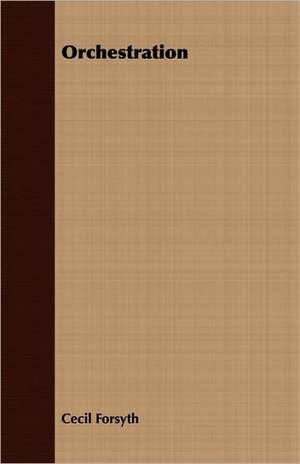
Orchestration
Autor Cecil Forsythen Limba Engleză Paperback – 18 mai 2008
Preț: 311.48 lei
Puncte Express: 467
Carte tipărită la comandă
Livrare economică 21 decembrie 26 - 04 ianuarie 27
Livrare prin curier în România Termenul estimat este afișat lângă disponibilitate.
Transport gratuit de la 400.00 lei Plată online sau ramburs, în funcție de opțiunile comenzii.
Retur gratuit în 14 zile Comandă securizată și suport în română.
Specificații
ISBN-13: 9781409726890
ISBN-10: 1409726894
Pagini: 568
Dimensiuni: 140 x 216 x 33 mm
Greutate: 0.71 kg
Editura: Williams Press
ISBN-10: 1409726894
Pagini: 568
Dimensiuni: 140 x 216 x 33 mm
Greutate: 0.71 kg
Editura: Williams Press
V-ar putea interesa
-
 -15%Preț: 458.14 lei538.99 lei
-
 Vocal Chamber Music: A Performer's GuideBarbara Winchester-18%Preț: 1163.49 lei1418.89 lei
-
 Con BrioNat BrandtPreț: 110.74 lei
-
 The ConcertoRalph Hill-28%Preț: 494.05 lei687.60 lei
-
 A Johnny Reb Band from SalemHarry H HallPreț: 110.69 lei
-
 -15%Preț: 478.47 lei562.90 lei
-
 -15%Preț: 467.25 lei549.71 lei
-
 Teaching and Learning Materials and the InternetIan Forsyth-18%Preț: 1467.42 lei1789.53 lei
-
 Symphony No. 2Sergei RachmaninoffPreț: 121.45 lei
-
 Preț: 117.01 lei
-
 Preț: 125.20 lei
-
 Mozart's Clarinet ConcertoDavid EtheridgePreț: 200.32 lei
-
 Preț: 285.34 lei
-
 Preț: 63.26 lei
-
 Keep Calm and Listen to Alicia Keys: Composition Note Book JournalNotesgo NotesflowPreț: 66.90 lei
-
 Verdi in Victorian LondonMassimo ZicariPreț: 319.50 lei
-
 Three-Octave Scales for the Cello, Book OneCassia HarveyPreț: 86.99 lei
Textul de pe ultima copertă
"For its time the most comprehensive treatment of the subject."--"New Grove Dictionary of Music and Musicians
"Before the 17th century, composers seldom indicated in their music whether the composition was to be performed by a particular combination of voices or instruments. Then in 1607 Monteverdi made a well-known suggestion for the orchestration of his opera "Orfeo." And as the Baroque era unfolded, the concept of orchestrations began to evolve, achieving a notable clarity and the acceptance of a keyboard instrument as an integral part of the ensemble.
Toward the middle of the 18th century, stylistic changes in instrumental music, e.g. styles that emphasized a single melodic line, directly affected methods of orchestration; while in the 19th century, orchestrations became an ever more vital factor in the composer's technique, a stylistic determinant that places a wealth of possibilities at his disposal. Finally, in the early 18th century, increasing awareness of the importance of internal balance, certain ideals of blended sound, and firmly established instrumental characteristics enabled orchestration to take its place as an academic discipline beside harmony and counterpoint.
In this classic manual, a noted English composer describes 57 orchestral instruments (ca. 1914) tracing their origins, development, and status at the beginning of World War I. Not only are the history and evolution of each instrument fully discussed, the author also explores the techniques of each instrument, as well as players' impressions about what they must play. The result is an unparalleled insight into the inner working of an orchestra--a vivid impression of what it is like to be a violinist, clarinetist, trombonist, or other orchestral player.
While there have been numerous developments in instrumental technique on an individual basis since the book's first publication, most of what Forsyth says is still valid. Writing with wit, grace, and good sense, Forsyth created a formidably thorough, comprehensive, and informative text that has instructed and influenced generations of composers, conductors, musicians, and musicologists.
Descriere
Descriere de la o altă ediție sau format:
Probably best general book on the subject. Thorough discussion of 57 instruments, technical aspects of writing for each, much else.