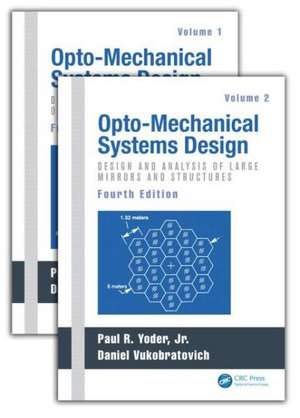
Opto-Mechanical Systems Design, Two Volume Set
Autor Paul Yoder, Daniel Vukobratovichen Limba Engleză Hardback – 14 apr 2015
The first volume, Design and Analysis of Opto-Mechanical Assemblies, addresses topics pertaining primarily to optics smaller than 50 cm aperture. It summarizes the opto-mechanical design process, considers pertinent environmental influences, lists and updates key parameters for materials, illustrates numerous ways for mounting individual and multiple lenses, shows typical ways to design and mount windows and similar components, details designs for many types of prisms and techniques for mounting them, suggests designs and mounting techniques for small mirrors, explains the benefits of kinematic design and uses of flexures, describes how to analyze various types of opto-mechanical interfaces, demonstrates how the strength of glass can be determined and how to estimate stress generated in optics, and explains how changing temperature affects opto-mechanical assemblies.
The second volume, Design and Analysis of Large Mirrors and Structures, concentrates on the design and mounting of significantly larger optics and their structures, including a new and important topic: detailed consideration of factors affecting large mirror performance. The book details how to design and fabricate very large single-substrate, segmented, and lightweight mirrors; describes mountings for large mirrors with their optical axes in vertical, horizontal, and variable orientations; indicates how metal and composite mirrors differ from ones made of glass; explains key design aspects of optical instrument structural design; and takes a look at an emerging technology—the evolution and applications of silicon and silicon carbide in mirrors and other types of components for optical applications.
Preț: 2267.01 lei
Preț vechi: 2636.06 lei
-14%
Puncte Express: 3401
Carte disponibilă
Livrare economică 09-23 noiembrie
Livrare prin curier în România Termenul estimat este afișat lângă disponibilitate.
Transport gratuit pentru acest produs Plată online sau ramburs, în funcție de opțiunile comenzii.
Retur gratuit în 14 zile Comandă securizată și suport în română.
Specificații
ISBN-13: 9781439839775
ISBN-10: 1439839778
Pagini: 1672
Ilustrații: 917 black & white illustrations, 149 black & white tables
Dimensiuni: 178 x 254 x 78 mm
Greutate: 2.7 kg
Ediția:4th edition
Editura: CRC Press
Colecția CRC Press
ISBN-10: 1439839778
Pagini: 1672
Ilustrații: 917 black & white illustrations, 149 black & white tables
Dimensiuni: 178 x 254 x 78 mm
Greutate: 2.7 kg
Ediția:4th edition
Editura: CRC Press
Colecția CRC Press
V-ar putea interesa
-
 Gravity: A Very Short IntroductionTimothy Clifton-19%Preț: 57.65 lei71.42 lei
 -
 -27%Preț: 1394.84 lei1910.74 lei
 -
 The Variational Principles of MechanicsCornelius Lanczos-24%Preț: 147.24 lei192.49 lei
 -
 Fluid Dynamics for PhysicistsT. E. Faber-19%Preț: 678.49 lei837.64 lei
 -
 Introduction to Classical MechanicsDavid Morin-8%Preț: 535.69 lei582.26 lei
 -
 -9%Preț: 679.73 lei746.95 lei
 -
 Fundamentals and Applications of Ultrasonic WavesJ. David N. Cheeke-18%Preț: 1725.56 lei2104.34 lei
 -
 -9%Preț: 1030.54 lei1132.46 lei
 -
 Classical MechanicsJohn R. Taylor-18%Preț: 901.43 lei1099.30 lei
 -
 WJEC Physics for A2 Level: Student BookGareth Kelly-21%Preț: 284.93 lei358.42 lei
 -
 LAGRANGIAN & HAMILTONIAN MECHANICSCalkin M GPreț: 379.94 lei
Public țintă
ProfessionalCuprins
Opto-Mechanical Design Process. Environmental Influences. Opto-Mechanical Characteristics of Materials. Mounting Individual Lenses. Mounting Multiple Lens Assemblies. Design and Mounting of Windows, Domes, and Filters. Prism Design and Applications. Techniques for Mounting Prisms. Design and Mounting of Small Mirrors. Kinematic Design and Applications of Flexures. Analysis of the Opto-Mechanical Design. Factors Affecting Mirror Performance. Large Mirror Design. Mounting Large, Horizontal-Axis Mirrors. Mounting Large, Vertical-Axis Mirrors. Mounting Large, Variable-Orientation Mirrors. Design and Mounting of Metallic Mirrors. Optical Instrument Structural Design. Emerging Mirror Technologies.
Recenzii
"This is a great starting point and reference tool for engineers coming into this field. …it gives a concise review of metal mirrors identifying the key design and manufacturing practices that have been developed across the industry through the past two decades. The extensive list of references provides original source data for further reading on any topic."
—Dr. Alan R. Hedges, II-VI Incorporated
"… [the previous edition] is my go-to reference for all things optomechanics, so I anticipate the new edition will get just as much use. … The large number of illustrations, real-world examples, material property data, and additional references make this an excellent resource for any practicing optomechanical engineer."
—Katie Schwertz, Edmund Optics
"… main strength of this book is very comprehensive coverage of the key optomechanical design concepts and analytical methods that can be applied directly in the design and development of simple to very complex optical system. The information is easy to understand and therefore easy to customize and apply to new optical systems or instruments being developed. It is rare to find such a wealth of knowledge about many related topics in a single book."
—Anees Ahmad, Raytheon Missile Systems & College of Optical Sciences, University of Arizona, Tucson, USA
"… an industry standard in the field of Opto-mechanical design for many years. A must for mechanical engineers involved in mounting and design of high acuity optical systems."
—John Pepi, L-3 Communications SSG
"… a great reference book which covers many interesting topics and technologies which are practical and applicable to high precision optical systems."
—Myung Cho, National Optical Astronomy Observatory (NOAO)
"… probably the most comprehensive, detailed, and up-to-date text on opto-mechanics."
Professor Nathan Kopeika
—Dr. Alan R. Hedges, II-VI Incorporated
"… [the previous edition] is my go-to reference for all things optomechanics, so I anticipate the new edition will get just as much use. … The large number of illustrations, real-world examples, material property data, and additional references make this an excellent resource for any practicing optomechanical engineer."
—Katie Schwertz, Edmund Optics
"… main strength of this book is very comprehensive coverage of the key optomechanical design concepts and analytical methods that can be applied directly in the design and development of simple to very complex optical system. The information is easy to understand and therefore easy to customize and apply to new optical systems or instruments being developed. It is rare to find such a wealth of knowledge about many related topics in a single book."
—Anees Ahmad, Raytheon Missile Systems & College of Optical Sciences, University of Arizona, Tucson, USA
"… an industry standard in the field of Opto-mechanical design for many years. A must for mechanical engineers involved in mounting and design of high acuity optical systems."
—John Pepi, L-3 Communications SSG
"… a great reference book which covers many interesting topics and technologies which are practical and applicable to high precision optical systems."
—Myung Cho, National Optical Astronomy Observatory (NOAO)
"… probably the most comprehensive, detailed, and up-to-date text on opto-mechanics."
Professor Nathan Kopeika
Notă biografică
Paul Yoder (BS physics, Juniata College, Huntingdon, Pennsylvania, 1947, and MS physics, Penn State University, University Park, Pennsylvania, 1950) learned optical design and opto-mechanical engineering at the U.S. Army’s Frankford Arsenal (1951–1961). He then applied those skills at Perkin-Elmer Corporation (1961–1986) and served the optical community as a consultant in optical and opto-mechanical engineering (1986–2006). A fellow of the OSA and SPIE, Yoder has authored numerous chapters on opto-mechanics, published more than 60 papers, been awarded 14 U.S. and several foreign patents, and taught more than 75 short courses for SPIE, U.S. government agencies, and industry.
Daniel Vukobratovich is senior principal multidisciplinary engineer at Raytheon Systems, Tucson, Arizona, and adjunct professor at the University of Arizona. He has authored more than 50 papers, taught short courses in opto-mechanics in 12 different countries, and consulted for more than 40 companies. A SPIE fellow, he is a founding member of the opto-mechanics working group. He holds international patents and received an IR-100 award for work on metal matrix composite optical materials. He led development on a series of ultra-lightweight telescopes using new materials, and worked on space telescope systems for STS-95, Mars Observer, Mars Global Surveyor, and FUSE.
Daniel Vukobratovich is senior principal multidisciplinary engineer at Raytheon Systems, Tucson, Arizona, and adjunct professor at the University of Arizona. He has authored more than 50 papers, taught short courses in opto-mechanics in 12 different countries, and consulted for more than 40 companies. A SPIE fellow, he is a founding member of the opto-mechanics working group. He holds international patents and received an IR-100 award for work on metal matrix composite optical materials. He led development on a series of ultra-lightweight telescopes using new materials, and worked on space telescope systems for STS-95, Mars Observer, Mars Global Surveyor, and FUSE.
Descriere
In this Fourth Edition, coauthor Daniel Vukobratovich has brought his broad expertise in materials, opto-mechanical design, analysis of optical instruments, large mirrors, and structures; Jan Nijenhuis has provided a comprehensive new chapter on kinematics and applications of flexures; and several other experts have contributed. A total of 110 worked-out design examples, extended text, new illustrations, new tables of data, and new references have warranted publication of two volumes.