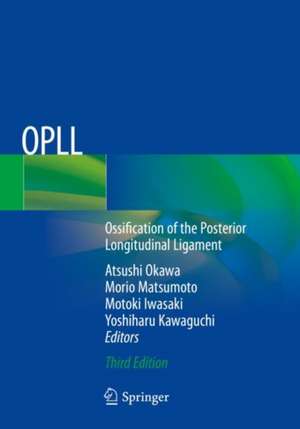
OPLL: Ossification of the Posterior Longitudinal Ligament
Editat de Atsushi Okawa, Morio Matsumoto, Motoki Iwasaki, Yoshiharu Kawaguchien Limba Engleză Paperback – 16 mai 2021
Gestionarea deficitelor neurologice severe cauzate de compresia măduvei spinării reprezintă una dintre cele mai mari provocări în chirurgia spinală, mai ales când etiologia implică transformarea ligamentelor în țesut osos. În volumul OPLL, coordonat de Atsushi Okawa și echipa sa, găsim o analiză clinică și științifică de o profunzime rară asupra osificării ligamentului longitudinal posterior. Această a treia ediție survine într-un moment critic, integrând progresele tehnologice și clinice majore apărute din 2006 până în prezent.
Considerăm că forța acestui tratat rezidă în capacitatea de a uni cercetarea fundamentală cu practica chirurgicală. Structura este riguros organizată în secțiuni care pornesc de la istoric și epidemiologie, trec prin genetica moleculară — unde sunt explorate celulele stem mezenchimale și tehnologia iPS — și culminează cu protocoalele de diagnostic. Cartea nu se limitează doar la OPLL, ci extinde spectrul către osificarea ligamentului galben (OLF), oferind o perspectivă holistică asupra condițiilor hiperostotice ale coloanei.
Credem că acest manual completează esențial lucrarea Cervical Spondylotic Myelopathy and Ossification of Posterior Longitudinal Ligament de Mehmet Zileli. În timp ce volumul lui Zileli se concentrează pe consensul comitetului WFNS și tehnici chirurgicale, ediția de față aduce în plus detalii despre patogeneza moleculară și analize de metabolomică, oferind contextul biologic necesar pentru înțelegerea progresiei bolii. Ritmul expunerii este unul academic, cu o densitate informațională care reflectă experiența vastă a școlii japoneze de ortopedie în acest domeniu specific. Este o resursă indispensabilă pentru înțelegerea mecanismelor de „ossification of the ligamentum flavum”, facilitând decizii terapeutice bazate pe dovezi actualizate.
Preț: 816.03 lei
Preț vechi: 858.97 lei
-5%
Carte disponibilă
Livrare economică 29 aprilie-13 mai
Specificații
ISBN-10: 9811538573
Pagini: 278
Ilustrații: X, 278 p. 138 illus., 61 illus. in color.
Dimensiuni: 178 x 254 mm
Greutate: 0.59 kg
Ediția:3rd ed. 2020
Editura: Springer Nature Singapore
Colecția Springer
Locul publicării:Singapore, Singapore
V-ar putea interesa
-
 Revision Lumbar Spine SurgeryRobert F. Heary-30%Preț: 889.20 lei1264.20 lei
 -
 Comparative Management of Spine PathologyKaisorn Chaichana-29%Preț: 1041.02 lei1474.42 lei
 -
 -5%Preț: 701.06 lei737.96 lei
 -
 Complications in Orthopaedics: Spine SurgeryVikas Patel-25%Preț: 1233.29 lei1640.55 lei
 -
 Obstetric Imaging: Fetal Diagnosis and CareJoshua A. Copel-29%Preț: 1637.96 lei2303.62 leiRecomandat
 -
 Operative Techniques: Spine SurgeryAlexander R. Vaccaro-30%Preț: 1290.44 lei1830.67 lei
 -
 ExpertDDx: Brain and SpineKaren L. Salzman-24%Preț: 1613.13 lei2117.37 lei
 -
 Atlas of Orthoses and Assistive DevicesDouglas P. Murphy-29%Preț: 1093.52 lei1542.40 leiRecomandat
 -
 Diagnostic Imaging: Pediatric NeuroradiologyKevin R. Moore-31%Preț: 1800.11 lei2609.98 lei
 -
 Diagnostic Imaging: SpineJeffrey S. Ross-29%Preț: 1865.81 lei2616.49 lei
 -
 A System of Orthopaedic MedicineLudwig Ombregt-29%Preț: 1160.69 lei1631.81 lei
 -
 The Biomechanics of Back PainMichael A. Adams-5%Preț: 463.11 lei487.49 lei
 -
 -23%Preț: 1042.53 lei1362.36 lei
 -
 Minimally Invasive Spine SurgeryBurak Ozgur-5%Preț: 361.49 lei380.52 lei
 -
 Biomechanics of Spine StabilizationEdward C Benzel-5%Preț: 1543.32 lei1624.55 lei
 -
 Pocket Atlas of Spine SurgeryKern Singh-5%Preț: 480.41 lei505.69 lei
 -
 -30%Preț: 1634.83 lei2330.88 lei
 -
 Operative Techniques in Spine SurgeryJohn Rhee-23%Preț: 1643.33 lei2125.29 lei
 -
 Essentials of Spine SurgeryAlpaslan ¿Enköylü-5%Preț: 572.90 lei603.05 lei
 -
 Ear, Nose, and Throat DiseasesHans Behrbohm-5%Preț: 848.54 lei893.19 lei
De ce să citești această carte
Recomandăm această ediție a treia chirurgilor ortopezi și neurochirurgilor care tratează mielopatii complexe. Cititorul câștigă acces la cele mai noi date despre genetica și istoria naturală a OPLL, fiind singura resursă care integrează tehnologia celulelor stem și metabolomica în diagnosticul spinal. Este un instrument de referință pentru a diferenția precis între diversele forme de hiperostoză vertebrală și pentru a anticipa evoluția neurologică a pacienților.
Despre autor
Atsushi Okawa, Morio Matsumoto, Motoki Iwasaki și Yoshiharu Kawaguchi sunt autorități de renume mondial în chirurgia coloanei vertebrale, activând în instituții academice de elită din Japonia. Expertiza lor colectivă acoperă întreg spectrul patologiilor spinale, de la cercetarea de laborator asupra celulelor stem până la tehnici chirurgicale de avangardă. Aceștia au contribuit decisiv la literatura medicală internațională prin studii pe termen lung privind istoria naturală a osificării ligamentelor, transformând acest domeniu dintr-o nișă regională într-o prioritate globală a ortopediei moderne.
Descriere scurtă
Cuprins
Notă biografică
Morio Matsumoto, MD and PhD, is a Professor and Chairman of Orthopedic Surgery at Keio University. He also serves as President of the Japanese Orthopaedic Association. His research interests include genetic studies on ossification of the posterior longitudinal ligament and idiopathic and congenital scoliosis, as well as clinical studies on various spinal disorders. He has published over 400peer-reviewed articles in the field of orthopedics.
Motoki Iwasaki is Vice-President of Osaka Rosai Hospital and a Clinical Professor at Osaka University’s Graduate School of Medicine. He has previously served as a visiting assistant professor at the Department of Orthopaedic Surgery, UCSF (1995-1997). His main research interests are in OPLL and spinal deformities. He has published over 250 papers and over 60 books. He also serves as an editor for Spine Surgery and Related Research, and for Journal of Orthopaedic Science. He has been honored e.g. with an Academic Encouragement Award (JOA, 1994), New Investigators Recognition Award (ORS, 1997), and Clinical Research Award (CSRS, 2001 & 2003).
Yoshiharu Kawaguchi is a Professor and Chairman of the Department of Orthopaedic Surgery, University of Toyama. He also serves as Educational Chair of Orthopaedic Surgery, AOSpine Asia Pacific region and has previously chaired the International Committee of the Japanese Orthopaedic Association (JOA). His research interests include spinal surgery and the pathology of spinal diseases, including ossification of the spinal ligaments. He has published over 100 papers and eight books. He is a chief editor of the Journal of Spine Research, the official journal of the Japanese Society of Spine Research (JSSR); a deputy editor of Spine Surgery Related Research, the official English-language journal of the JSSR; and a deputy editor of Global Spine Journal, the official journal of AOSpine. He has been honored with various awards, including a JOA basic research award (1996) and JOA clinical research award (2004).