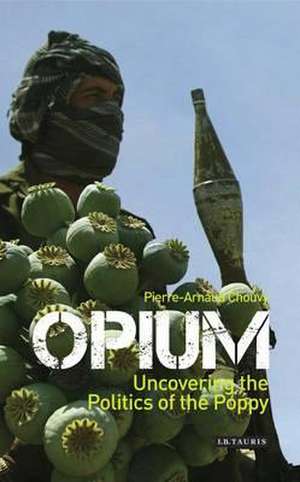
Opium: Uncovering the Politics of the Poppy
Autor Pierre-Arnaud Chouvyen Limba Engleză Hardback – 18 sep 2009
The result is a compelling account of our continuing fascination with a narcotic as old as humanity itself and a powerful insight into the complexities and difficulties of the politics and economics of the poppy in Asia and the world today.
Preț: 334.47 lei
Preț vechi: 388.48 lei
-14%
Puncte Express: 502
Carte disponibilă
Livrare economică 10-24 noiembrie
Livrare prin curier în România Termenul estimat este afișat lângă disponibilitate.
Transport gratuit de la 400.00 lei Plată online sau ramburs, în funcție de opțiunile comenzii.
Retur gratuit în 14 zile Comandă securizată și suport în română.
Specificații
ISBN-13: 9781845119737
ISBN-10: 1845119738
Pagini: 256
Ilustrații: 9 b/w integrated + 10 maps
Dimensiuni: 164 x 236 x 26 mm
Greutate: 0.58 kg
Editura: Bloomsbury Publishing
Colecția I.B.Tauris
Locul publicării:London, United Kingdom
ISBN-10: 1845119738
Pagini: 256
Ilustrații: 9 b/w integrated + 10 maps
Dimensiuni: 164 x 236 x 26 mm
Greutate: 0.58 kg
Editura: Bloomsbury Publishing
Colecția I.B.Tauris
Locul publicării:London, United Kingdom
V-ar putea interesa
-
 Intuitions of Justice and the Utility of DesertPaul H. Robinson-31%Preț: 1128.45 lei1637.28 lei
 -
 Whitey BulgerKevin CullenPreț: 173.02 lei
 -
 -15%Preț: 622.79 lei732.69 lei
 -
 Using AnalyticsMantone-8%Preț: 564.15 lei613.21 lei
 -
 Criminological PerspectivesEugene Mclaughlin-22%Preț: 508.96 lei652.51 lei
 -
 Media and CrimeYvonne JewkesPreț: 421.13 lei
 -
 Satan's ChoiceLorne Campbell-25%Preț: 98.11 lei130.15 lei
 -
 The CartelGraham Johnson-26%Preț: 62.54 lei84.69 lei
 -
 Understanding Crime and Social PolicyEmma WincupPreț: 252.60 lei
 -
 -30%Preț: 49.46 lei71.13 lei
Notă biografică
Pierre-Arnaud Chouvy is currently a Research Fellow at the Centre National de la Recherche Scientifique (CNRS). He presented the opening speech at the G-8 special meeting in Paris on drug routes in Central Asia. He is also the creator of the website geopium.org.
Recenzii
Timely and provocative...Chouvy meticulously recounts the poppy's very political history, concluding that while illicit production tends to flourish in areas where violence restricts state control, most "Asian opium farmers grow poppies in order to combat poverty."...Exhaustively researched and cogently argued, Chouvy's analysis of the geopolitics of narcotics should be required reading for policymakers, stakeholders, and concerned citizens. Publishers Weekly 20100118 Pierre-Arnaud Chouvy...is an expert on the politics of illicit drugs in Asia. This detailed, well-researched...account is uncompromising in its conclusions: the American war on drugs has been an expensive failure; and crop eradication hasn't worked. Opium growing is a concomitant of weak or non-existent government, combined with civil war, poverty and food insecurity. -- Robert Carver The Tablet 20100204 This book traces the use of opium back to prehistoric times and sketches its complex and interesting history in Europe and especially in Asia, from ancient China and ancient Persia to modern times. It contends that opium production is intimately related to poverty and food insecurity, that eradication programs have inevitably failed to suppress opium production, and that the only way to reduce opium production is to address its economic and social sources by providing livelihoods superior to poppy production. Contrary to conventional wisdom, the labor-intensive production of opium is not highly lucrative to the poppy farmers; it does, however, compare favorably to alternative crops in the states where it is produced. -- Richard N. Cooper Foreign Affairs 20100501 As a site of both the war on terror and the war on drugs, Afghanistan serves Chouvy as a test case for investigating the chicken-or-egg questions that riddle anti-drug policy. What comes first, poverty or poppy growth? Do local warlords spur opium production, or do the conditions that first allowed warlords to take power also give way to a drug trade? Is narcoterrorism--the notion that terrorists use drugs to fund insurgencies--actually behind violence in Afghanistan? ...Opium's insight lies in its reframing of such questions: despite what some politicians would like you to believe, Chouvy argues, these phenomena--violence, poverty, and drugs--can never be understood independently of each other. -- Jessica Loudis New Republic online 20100427 In laying out the economics and politics that tend to accompany opium farming, Chouvy encourages us to reevaluate our drug policy to focus less on the trade itself and more on its root causes, arguing that not until Afghanistan enjoys economic growth and a stable government will it be possible to curtail the drug trade. -- Sarah Halzack Washington Post 20100502