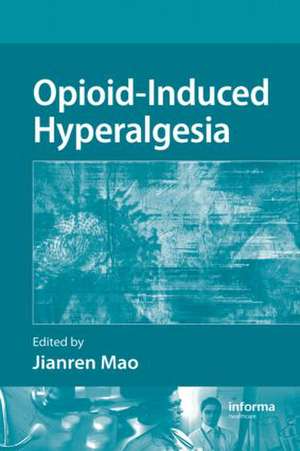
Opioid-Induced Hyperalgesia
Editat de Jianren Maoen Limba Engleză Hardback – 26 oct 2009
Organized to provide the information quickly and easily, the book includes dosage recommendations to help minimize the likelihood and/or delay onset of hyperglasia and covers management approaches such as opioid rotation and tapering, provide clinicians with alternative methods for treating OIH's difficult, persistent, and varied problems.
Preț: 1793.14 lei
Preț vechi: 1887.51 lei
-5%
Puncte Express: 2690
Carte tipărită la comandă
Livrare economică 09-23 decembrie
Livrare prin curier în România Termenul estimat este afișat lângă disponibilitate.
Transport gratuit pentru acest produs Plată online sau ramburs, în funcție de opțiunile comenzii.
Retur gratuit în 14 zile Comandă securizată și suport în română.
Specificații
ISBN-13: 9781420088991
ISBN-10: 1420088998
Pagini: 208
Ilustrații: 50 b/w images
Dimensiuni: 152 x 229 x 18 mm
Greutate: 0.41 kg
Ediția:1
Editura: CRC Press
Colecția CRC Press
Locul publicării:Boca Raton, United States
ISBN-10: 1420088998
Pagini: 208
Ilustrații: 50 b/w images
Dimensiuni: 152 x 229 x 18 mm
Greutate: 0.41 kg
Ediția:1
Editura: CRC Press
Colecția CRC Press
Locul publicării:Boca Raton, United States
V-ar putea interesa
-
 -24%Preț: 832.49 lei1102.20 lei
 -
 HeadacheOlivia Begasse de Dhaem-21%Preț: 346.75 lei438.71 lei
 -
 Opioids in Cancer PainMellar P. Davis-20%Preț: 619.46 lei775.05 lei
 -
 Monitoring in Anesthesia and Perioperative CareDavid L. Reich-5%Preț: 766.88 lei807.24 lei
 -
 The Caffeine Advantage: How to Sharpen Your Mind, Improve Your Physical Performance and Schieve Your GoalsPh.D. Bennett Alan Weinberg Ph.D.-5%Preț: 97.80 lei102.95 lei
 -
 Handbook of Acute Pain ManagementJennifer A. Elliott-5%Preț: 757.36 lei797.22 lei
 -
 The Other Side of the Desk: An IntroductionStuart Donaldson-5%Preț: 163.98 lei172.62 lei
 -
 Practical Guide to Chronic Pain SyndromesGary W. Jay-5%Preț: 1809.63 lei1904.87 lei
 -
 -5%Preț: 780.40 lei821.47 lei
 -
 -5%Preț: 1804.14 lei1899.09 lei
 -
 Chest Pain with Normal Coronary ArteriesJuan Carlos Kaski-5%Preț: 1351.90 lei1423.05 lei
 -
 The Pharmacologic Basis of PsychotherapeuticsLouis A. Pagliaro-5%Preț: 1439.10 lei1514.85 lei
 -
 Pharmacological Intervention in Management of Neck Pain Disorders: A ReviewMarwan S M Al-Nimer-23%Preț: 409.02 lei532.25 lei
 -
 Unlearn PainJutta Richter-5%Preț: 195.17 lei205.44 lei
 -
 -5%Preț: 251.77 lei265.02 lei
 -
 -5%Preț: 271.14 lei285.41 lei
Public țintă
ProfessionalCuprins
Overview on Opioid-Induced Hyperalgesia. Cellular Mechanisms Underlying Morphine Analgesic Tolerance and Hyperalgesia. Overview on Clinical Features of Opioid-Induced Hyperalgesia. Clinical Assessment Tools: Quantitative Sensory Testing. Opioid Tolerance, Dependence, and Hyperalgesia. Challenging Clinical Issues on the Interaction Between Addiction and Hyperalgesia. Practical Management of Opioid-Induced Hyperalgesia in the Primary Care Setting. Managing Opioid-Induced Hyperalgesia in the Perioperative Period. Role of Ketamine in Managing Opioid-InducedHyperalgesia. Role of Opioid Rotation and Tapering in Managing Opioid-Induced Hyperalgesia. Clinical Implications of Opioid-Induced Hyperalgesia.
Descriere
The first clinically focused text dedicated to the newly emerging area of pain medicine known as opioid-induced hyperalgesia (OIH), Opioid-Induced Hyperalgesia provides pain specialists, anesthesiologists, and neurologists with the most current, cutting-edge research and therapeutic options for treating OIH patients. It supplies best practice guidelines for the effective assessment, diagnosis, and management of OIH—need-to-know information clinicians trust and can use in their practice.