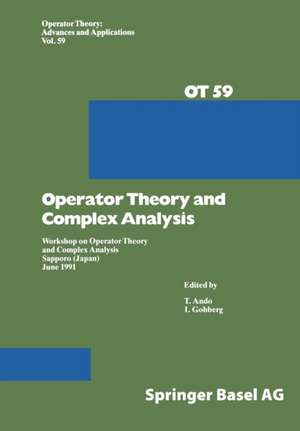
Operator Theory and Complex Analysis: Workshop on Operator Theory and Complex Analysis Sapporo (Japan) June 1991: Operator Theory: Advances and Applications, cartea 59
Autor T. Ando, I. Gohbergen Limba Engleză Paperback – 30 oct 2012
Din seria Operator Theory: Advances and Applications
- 18%
 Preț: 944.38 lei
 - 18%
 Preț: 894.63 lei
 - 18%
 Preț: 730.36 lei
 - 15%
 Preț: 643.71 lei
 - 24%
 Preț: 1001.42 lei
 - 18%
 Preț: 1015.73 lei
 - 18%
 Preț: 1130.95 lei
 - 18%
 Preț: 1080.74 lei
 - 15%
 Preț: 623.05 lei
 - 15%
 Preț: 622.11 lei
 - 15%
 Preț: 635.31 lei
 - 18%
 Preț: 1148.54 lei
 - 18%
 Preț: 1011.13 lei
 - 18%
 Preț: 920.57 lei
 - 18%
 Preț: 914.35 lei
 - 15%
 Preț: 624.95 lei
 -
 Preț: 379.51 lei
 - 15%
 Preț: 641.07 lei
 - 24%
 Preț: 1287.53 lei
 - 15%
 Preț: 569.44 lei
 -
 Preț: 372.84 lei
 -
 Preț: 390.43 lei
 - 15%
 Preț: 589.08 lei
 - 18%
 Preț: 762.11 lei
 - 15%
 Preț: 622.29 lei
 -
 Preț: 369.74 lei
 -
 Preț: 371.37 lei
 - 15%
 Preț: 572.28 lei
 - 15%
 Preț: 617.72 lei
 - 15%
 Preț: 627.31 lei
 - 15%
 Preț: 621.80 lei
 -
 Preț: 375.81 lei
 - 15%
 Preț: 620.18 lei
 - 15%
 Preț: 560.96 lei
Preț: 383.59 lei
Puncte Express: 575
Carte tipărită la comandă
Livrare economică 19 august-02 septembrie
Livrare prin curier în România Termenul estimat este afișat lângă disponibilitate.
Transport gratuit de la 400.00 lei Plată online sau ramburs, în funcție de opțiunile comenzii.
Retur gratuit în 14 zile Comandă securizată și suport în română.
Specificații
ISBN-13: 9783034896993
ISBN-10: 3034896999
Pagini: 420
Ilustrații: X, 406 p.
Greutate: 0.67 kg
Ediția:Softcover reprint of the original 1st ed. 1992
Editura: Birkhäuser Basel
Colecția Birkhäuser
Seria Operator Theory: Advances and Applications
Locul publicării:Basel, Switzerland
ISBN-10: 3034896999
Pagini: 420
Ilustrații: X, 406 p.
Greutate: 0.67 kg
Ediția:Softcover reprint of the original 1st ed. 1992
Editura: Birkhäuser Basel
Colecția Birkhäuser
Seria Operator Theory: Advances and Applications
Locul publicării:Basel, Switzerland
V-ar putea interesa
-
 OCR Gateway GCSE Biology 9-1 Student BookAnne PillingPreț: 206.22 lei
 -
 AQA GCSE Physics for Combined Science: Trilogy 9-1 Student BookCharles GolabekPreț: 157.72 lei
 -
 -28%Preț: 35.54 lei49.04 lei
 -
 All About EvolutionRobert Winston-17%Preț: 58.64 lei71.02 lei
 -
 All About BiologyRobert Winston-18%Preț: 58.49 lei70.94 lei
 -
 Ways Into Science: All About PlantsPeter Riley-38%Preț: 45.32 lei72.93 lei
 -
 -36%Preț: 66.63 lei103.95 lei
 -
 Preț: 58.86 lei
 -
 Preț: 55.73 lei
 -
 Preț: 103.69 lei
 -
 Preț: 193.73 lei
Public țintă
ResearchCuprins
Scattering matrices for microschemes.- 1. General expressions for the scattering matrix.- 2. Continuity condition.- References.- Holomorphic operators between Krein spaces and the number of squares of associated kernels.- 0. Introduction.- 1. Realizations of a class of Schur functions.- 2. Positive squares and injectivity.- 3. Application of the Potapov-Ginzburg transform.- References.- On reproducing kernel spaces, the Schur algorithm, and interpolation in a general class of domains.- 1. Introduction.- 2. Preliminaries.- 3. B(X) spaces.- 4. Recursive extractions and the Schur algorithm.- 5. H?(S) spaces.- 6. Linear fractional transformations.- 7. One sided interpolation.- 8. References.- The central method for positive semi-definite, contractive and strong Parrott type completion problems.- 1. Introduction.- 2. Positive semi-definite completions.- 3. Contractive completions.- 4. Linearly constrained contractive completions.- References.- Interpolation by rational matrix functions and stability of feedback systems: The 4-block case.- 1. Preliminaries.- 2. A homogeneous interpolation problem.- 3. Interpolation problem.- 4. Parametrization of solutions.- 5. Interpolation and internally stable feedback systems.- References.- Matricial coupling and equivalence after extension.- 1. Introduction.- 2. Coupling versus equivalence.- 3. Examples.- 4. Special classes of operators.- References.- Operator means and the relative operator entropy.- 1. Introduction.- 2. Origins of operator means.- 3. Operator means and operator monotone functions.- 4. Operator concave functions and Jensen’s inequality.- 5. Relative operator entropy.- References.- An application of Furuta’s inequality to Ando’s theorem.- 1. Introduction.- 2. Operator functions.- 3. Furuta’s type inequalities.-4. An application to Ando’s theorem.- References.- Applications of order preserving operator inequalities.- 0. Introduction.- 1. Application to the relative operator entropy.- 2. Application to some extended result of Ando’s one.- References.- The band extension of the real line as a limit of discrete band extensions, I. The main limit theorem.- 0. Introduction.- I. Preliminaries and preparations.- II. Band extensions.- III. Continuous versus discrete.- References.- Interpolating sequences in the maximal ideal space of H? II.- 1. Introduction.- 2. Condition (A2).- 3. Condition (A3).- 4. Condition (A1).- References.- Operator matrices with chordal inverse patterns.- 1. Introduction.- 2. Entry formulae.- 3. Inertia formula.- References.- Models and unitary equivalence of cyclic selfadjoint operators in Pontrjagin spaces.- 1. The class F of linear functionals.- 2. The Pontrjagin space associated with ? ? F.- 3. Models for cyclic selfadjoint operators in Pontrjagin spaces.- 4. Unitary equivalence of cyclic selfadjoint operators in Pontrjagin spaces.- References.- The von Neumann inequality and dilation theorems for contractions.- 1. The von Neumann inequality and strong unitary dilation.- 2. Canonical representation of completely contractive maps.- 3. An effect of generation of nuclear algebras.- References.- Interpolation problems, inverse spectral problems and nonlinear equations.- References.- Extended interpolation problem in finitely connected domains.- I. Matrices and transformation formulas.- II. Disc Cases.- III. Domains of finite connectivity.- References.- Accretive extensions and problems on the Stieltjes operator-valued functions relations.- 1. Accretive and sectorial extensions of the positive operators, operators of the class C(?) and theirparametric representation.- 2. Stieltjes operator-valued functions and their realization.- 3. M.S. Livsic triangular model of the M-accretive extensions (with real spectrum) of the positive operators.- 4. Canonical and generalized resolvents of QSC-extensions of Hermitian contractions.- References.- Commuting nonselfadjoint operators and algebraic curves.- 1. Commuting nonselfadjoint operators and the discriminant curve.- 2. Determinantal representations of real plane curves.- 3. Commutative operator colligations.- 4. Construction of triangular models: Finite-dimensional case.- 5. Construction of triangular models: General case.- 6. Characteristic functions and the factorization theorem.- References.- All (?) about quasinormal operators.- 1. Introduction.- 2. Representations.- 3. Spectrum and multiplicity.- 4. Special classes.- 5. Invariant subspaces.- 6. Commutant.- 7. Similarity.- 8. Quasisimilarity.- 9. Compact perturbation.- 10. Open problems.- References.- Workshop Program.- List of Participants.