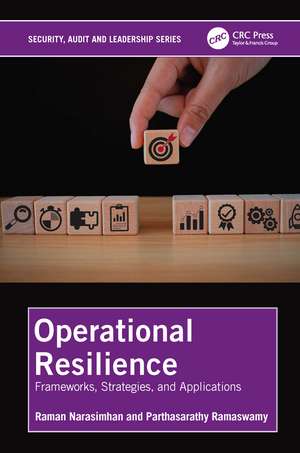
Operational Resilience: Frameworks, Strategies, and Applications: Security, Audit and Leadership Series
Autor Raman Narasimhan, Parthasarathy Ramaswamyen Limba Engleză Paperback – 19 feb 2027
This book presents operational resilience as a practical governance, fraud-risk and risk-assessment discipline for boards, senior executives, risk professionals, internal auditors, compliance teams, technology leaders and regulators. It explains why resilience must move beyond documentation and become a tested organisational capability: the ability to continue delivering important services through disruption, fraud, cyber compromise, third-party failure and operational stress.
The book examines the core building blocks of a resilient organisation, including governance and accountability, critical operations, impact tolerances, dependency mapping, scenario testing, technology resilience, cyber resilience, data integrity, crisis communication, recovery planning, assurance, KRIs and continuous monitoring. It also focuses on the risks often hidden inside business continuity and resilience frameworks: vendor concentration, outsourcing dependency, supply-chain compromise, insider threat, collusion, weak data quality, poor escalation and the failure to prioritise key resilience requirements until after an incident occurs.
A particular emphasis is placed on third-party and vendor resilience. Modern organisations depend on cloud providers, SaaS platforms, processors, logistics partners, consultants and specialised service vendors. These relationships create efficiency, but also hidden exposure. A vendor may have strong documentation but weak execution. A control may exist on paper but fail during stress. Sub-vendors may remain outside effective oversight. A trusted insider or collusive external party may exploit gaps that traditional continuity planning never considered.
Too often, boards are assured that “strong agreements are in place” while the real questions remain unanswered: Have supply-chain controls been tested? Can critical vendors perform under stress? Will the organisation receive priority during a crisis? Are KRIs strong enough to detect emerging failure, fraud or integrity risk before impact? Does assurance test operational reality, or only contractual comfort?
Drawing on regulatory developments and practical examples across financial services, technology, aviation, healthcare, supply chains and outsourced operations, this book challenges organisations to look beyond policies and agreements. Operational resilience is not merely about surviving disruption. It is about protecting trust when systems, people, vendors and controls are tested.
Din seria Security, Audit and Leadership Series
-
 Preț: 418.53 lei
 - 8%
 Preț: 445.18 lei
 - 11%
 Preț: 635.66 lei
 -
 Preț: 414.87 lei
 -
 Preț: 430.76 lei
 - 8%
 Preț: 445.74 lei
 - 20%
 Preț: 405.06 lei
 - 20%
 Preț: 1197.18 lei
 -
 Preț: 326.44 lei
 -
 Preț: 415.48 lei
 - 20%
 Preț: 379.78 lei
 - 20%
 Preț: 685.25 lei
 - 20%
 Preț: 418.05 lei
 - 15%
 Preț: 472.42 lei
 - 20%
 Preț: 506.49 lei
 - 20%
 Preț: 535.60 lei
 - 20%
 Preț: 299.76 lei
 - 20%
 Preț: 1629.80 lei
 -
 Preț: 345.94 lei
 - 20%
 Preț: 526.36 lei
 -
 Preț: 384.37 lei
 -
 Preț: 219.16 lei
 - 20%
 Preț: 492.86 lei
 - 20%
 Preț: 527.83 lei
 - 20%
 Preț: 1308.63 lei
 - 20%
 Preț: 354.29 lei
 - 20%
 Preț: 374.75 lei
 - 20%
 Preț: 1030.95 lei
 - 20%
 Preț: 530.01 lei
 - 20%
 Preț: 573.71 lei
 - 20%
 Preț: 349.28 lei
 -
 Preț: 350.55 lei
 - 20%
 Preț: 311.00 lei
 - 20%
 Preț: 715.46 lei
 - 20%
 Preț: 488.00 lei
 -
 Preț: 297.38 lei
 -
 Preț: 391.02 lei
 - 20%
 Preț: 316.61 lei
 -
 Preț: 424.04 lei
 -
 Preț: 346.21 lei
 - 20%
 Preț: 327.92 lei
 - 20%
 Preț: 1112.87 lei
 - 20%
 Preț: 520.36 lei
Preț: 349.81 lei
Preț vechi: 394.14 lei
-11% Precomandă
Puncte Express: 525
Carte nepublicată încă
Livrare prin curier în România Precomanda se expediază când titlul devine disponibil.
Transport gratuit de la 400.00 lei Plată online sau ramburs, în funcție de opțiunile comenzii.
Retur gratuit în 14 zile Comandă securizată și suport în română.
Doresc să fiu notificat când acest titlu va fi disponibil:
Se trimite...
Specificații
ISBN-13: 9781041095491
ISBN-10: 104109549X
Pagini: 176
Ilustrații: 38
Dimensiuni: 156 x 234 mm
Ediția:1
Editura: CRC Press
Colecția CRC Press
Seria Security, Audit and Leadership Series
ISBN-10: 104109549X
Pagini: 176
Ilustrații: 38
Dimensiuni: 156 x 234 mm
Ediția:1
Editura: CRC Press
Colecția CRC Press
Seria Security, Audit and Leadership Series
Public țintă
Professional Practice & Development, Professional Reference, and Professional TrainingNotă biografică
Raman Narasimhan is a multidisciplinary risk, forensic, internal audit, technology risk and governance professional with more than 30 years of experience across consulting, financial services and global technology organisations. He is currently Managing Principal at Mekiki Partners, a consulting firm focused on risk, governance, forensic, resilience and regulatory advisory. His career spans Big Four advisory, forensic consulting, global technology organisations and a very large Non-Banking Financial Company (NBFC) group in India, where he served as Head of Internal Audit and later as Chief Risk Officer.
His work has covered internal audit, enterprise risk management, operational risk, fraud risk management, investigations, forensic reviews, process and control improvement, cyber and technology risk, business continuity, third-party risk, regulatory governance and board-level risk oversight. At the NBFC group, he worked across a diversified financial services environment covering vehicle finance, housing finance, mutual funds and general insurance, with responsibilities spanning risk governance, assurance, fraud prevention, early-warning signals, AML/CFT, resilience, technology risk and management reporting.
He has also worked with governance and management system frameworks including ISO 31000 on risk management, ISO 22301 on business continuity, ISO/IEC 27001 and ISO/IEC 27701 on information security and privacy, and ISO 37001, ISO 37002 and ISO 37003 on anti-bribery, whistleblowing and fraud control management systems.
He has contributed to professional and regulatory thinking in areas such as fraud detection, technology risk and resilience. He was a member of the Reserve Bank of India study group on large-fraud detection, whose work informed directions on Early Warning Signals and Fraud Risk Management Systems. He has also authored and co-authored professional books and reference material on fraud analytics, artificial intelligence in financial services, risk management and operational resilience.
Raman is a Fellow Member of the Institute of Company Secretaries of India, a law graduate, an IICA Certified Independent Director, and holds professional credentials including CISA, CISM, CRISC, CDPSE and Certified Fraud Examiner. He is also associated with professional bodies including ISACA and ACFE, and is the Founding President of the ACFE Chennai Chapter.
His work brings together finance, law, technology, fraud, audit, operational risk and governance, with a focus on helping boards and management teams understand not only where risk has occurred, but where exposure may be building- from a forward looking perspective.
Parthasarathy Ramaswamy is a Chartered Accountant and management consultant with around 30 years of experience advising boards and management teams on business, operational and risk problems. He is currently a Senior Partner with a firm of Chartered Accountants in Chennai, leading the advisory practice for the firm. His career spans Big Four consulting, along with having performed statutory and internal audit of large corporates and advisory engagements for multinational companies, listed entities and public sector undertakings, frequently working with cross-cultural teams on global clients.
His consulting work has centred on translating business problems into workable solutions: performance improvement and cost reduction, activity-based costing, balanced scorecard and performance management frameworks including the evaluation of technical and behavioural competencies, offshoring strategy, IT strategy and ERP implementation advisory, and due diligence support for transactions. Alongside this, he has advised extensively on enterprise risk management, corporate governance, internal financial controls, Sarbanes-Oxley compliance for US-listed entities, IT general computer controls, third-party control reviews for outsourced processes, technology reviews, investigations, forensic reviews, operational reviews and Foreign Corrupt Practices Act framework advisory and compliance.
He has contributed to professional literature and practice guidance in audit, data analytics and fraud detection. He co-authored GTAG-7, an audit guide on Information Technology Outsourcing published by the Institute of Internal Auditors, Florida, in 2007, and has co-authored, with the same team, "The Risk Story", "Leveraging Data Analytics for Internal Audit and Fraud Detection" and "AI for Fraud Detection", published by the Institute of Internal Auditors, India. He was President of the Institute of Internal Auditors, Madras Chapter, and continues as an active board member of IIA Madras and Association of Certified Fraud Examiners, Chennai Chapter.
Parthasarathy is a Fellow Member of the Institute of Chartered Accountants of India and of the Institute of Cost Accountants of India, and an Associate Member of the Institute of Company Secretaries of India and of the Institute of Chartered Accountants of England and Wales. He holds a Master's degree in Economics and is a member of the Chartered Institute of Management Accountants (UK). His professional credentials include Certified Information Systems Auditor (CISA), Certified Internal Auditor (CIA) and Certified Fraud Examiner (CFE).
His work brings together finance, cost, technology, governance and forensic disciplines, with a consultant's orientation towards practical outcomes: helping organisations improve how they perform, not merely how they report.
His work has covered internal audit, enterprise risk management, operational risk, fraud risk management, investigations, forensic reviews, process and control improvement, cyber and technology risk, business continuity, third-party risk, regulatory governance and board-level risk oversight. At the NBFC group, he worked across a diversified financial services environment covering vehicle finance, housing finance, mutual funds and general insurance, with responsibilities spanning risk governance, assurance, fraud prevention, early-warning signals, AML/CFT, resilience, technology risk and management reporting.
He has also worked with governance and management system frameworks including ISO 31000 on risk management, ISO 22301 on business continuity, ISO/IEC 27001 and ISO/IEC 27701 on information security and privacy, and ISO 37001, ISO 37002 and ISO 37003 on anti-bribery, whistleblowing and fraud control management systems.
He has contributed to professional and regulatory thinking in areas such as fraud detection, technology risk and resilience. He was a member of the Reserve Bank of India study group on large-fraud detection, whose work informed directions on Early Warning Signals and Fraud Risk Management Systems. He has also authored and co-authored professional books and reference material on fraud analytics, artificial intelligence in financial services, risk management and operational resilience.
Raman is a Fellow Member of the Institute of Company Secretaries of India, a law graduate, an IICA Certified Independent Director, and holds professional credentials including CISA, CISM, CRISC, CDPSE and Certified Fraud Examiner. He is also associated with professional bodies including ISACA and ACFE, and is the Founding President of the ACFE Chennai Chapter.
His work brings together finance, law, technology, fraud, audit, operational risk and governance, with a focus on helping boards and management teams understand not only where risk has occurred, but where exposure may be building- from a forward looking perspective.
Parthasarathy Ramaswamy is a Chartered Accountant and management consultant with around 30 years of experience advising boards and management teams on business, operational and risk problems. He is currently a Senior Partner with a firm of Chartered Accountants in Chennai, leading the advisory practice for the firm. His career spans Big Four consulting, along with having performed statutory and internal audit of large corporates and advisory engagements for multinational companies, listed entities and public sector undertakings, frequently working with cross-cultural teams on global clients.
His consulting work has centred on translating business problems into workable solutions: performance improvement and cost reduction, activity-based costing, balanced scorecard and performance management frameworks including the evaluation of technical and behavioural competencies, offshoring strategy, IT strategy and ERP implementation advisory, and due diligence support for transactions. Alongside this, he has advised extensively on enterprise risk management, corporate governance, internal financial controls, Sarbanes-Oxley compliance for US-listed entities, IT general computer controls, third-party control reviews for outsourced processes, technology reviews, investigations, forensic reviews, operational reviews and Foreign Corrupt Practices Act framework advisory and compliance.
He has contributed to professional literature and practice guidance in audit, data analytics and fraud detection. He co-authored GTAG-7, an audit guide on Information Technology Outsourcing published by the Institute of Internal Auditors, Florida, in 2007, and has co-authored, with the same team, "The Risk Story", "Leveraging Data Analytics for Internal Audit and Fraud Detection" and "AI for Fraud Detection", published by the Institute of Internal Auditors, India. He was President of the Institute of Internal Auditors, Madras Chapter, and continues as an active board member of IIA Madras and Association of Certified Fraud Examiners, Chennai Chapter.
Parthasarathy is a Fellow Member of the Institute of Chartered Accountants of India and of the Institute of Cost Accountants of India, and an Associate Member of the Institute of Company Secretaries of India and of the Institute of Chartered Accountants of England and Wales. He holds a Master's degree in Economics and is a member of the Chartered Institute of Management Accountants (UK). His professional credentials include Certified Information Systems Auditor (CISA), Certified Internal Auditor (CIA) and Certified Fraud Examiner (CFE).
His work brings together finance, cost, technology, governance and forensic disciplines, with a consultant's orientation towards practical outcomes: helping organisations improve how they perform, not merely how they report.
Cuprins
PART I — Foundations. Chapter 1: Introduction to Operational Resilience. Chapter 2: Historical Perspective: The Evolution of Operational Resilience. Chapter 3: Key Pillars of Operational Resilience. Chapter 4: Building a Resilient Culture. PART II — Governance & Structure. Chapter 5: Governance & Regulatory Landscape. Chapter 6: Regulatory & Industry Collaboration. Chapter 7: Risk Governance: Key Requirements. Chapter 8: Risk Identification & Assessment Methodologies. PART III — Building Resilience Capability. Chapter 9: Risk Quantification, Prioritisation & Risk-Based Decision Making. Chapter 10: Risk Mitigation & Control Design. Chapter 11: Building Resilient Technology Architecture. Chapter 12: Cyber Resilience & Digital Trust. Chapter 13: Data Resilience & Integrity Protection. Chapter 14: Vendor & Third-Party Resilience. Chapter 15: Operational Scenario Testing & Validation. PART IV — Leadership & Strategic Integration. Chapter 16: Crisis Communication & Stakeholder Confidence. Chapter 17: Leadership, Culture & Human Resilience. Chapter 18: Governance, Oversight & Board Accountability. Chapter 19: Metrics, KRIs & Continuous Monitoring. Chapter 20: Building a Sustainable Operational Resilience Programme. Epilogue: Resilience Is Not a Framework. It Is a Choice. PART V — Patterns of Failure & Governance Lessons. Applied Signals from the Field. Chapter 1: The 94-Minute Outage. Chapter 2: The ₹800 Chip. Chapter 3: The Single Engineer Risk. Chapter 4: The Silent Analyst. Chapter 5: The Six-Hour Clock. Chapter 6: The Shared Crisis. Chapter 7: Committee Paralysis. Chapter 8: The Obvious Heatwave. Chapter 9: The Deferred Investment. Chapter 10: The Failover Illusion. Chapter 11: The Vendor's Vendor. Chapter 12: The Partial Recovery. Chapter 13: The Privacy Blindspot. Chapter 14: The Cloud Concentration. Chapter 15: The Overconfident Test. Chapter 16: The Exhausted Team. Chapter 17: The Blame Culture. Chapter 18: The Passive Board. Chapter 19: The Green Dashboard. Chapter 20: The Fading Programme. Contemporary Disruptions & Emerging Risk Signals. PART VI — References by Chapter. PART VII — Research Methodology & Source Framework. Supplementary Deep Dives. Advanced Control Design Principles. Technology Resilience Validation. Cyber Resilience Governance. Data Governance and Resilience Integration. Vendor Relationship Management. Simulation Design and Learning.
Descriere
Operational resilience is no longer only about business continuity plans, disaster recovery sites or crisis manuals. Organisations fail when critical services are interrupted, technology dependencies break, data integrity is compromised, vendors underperform, insiders exploit control gaps.