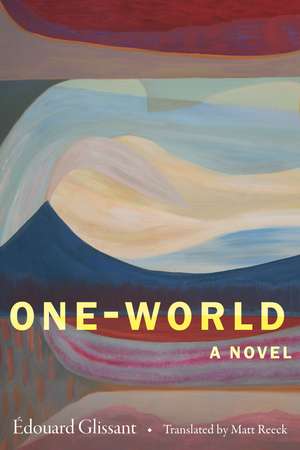
One-World: A Novel: Georgia Review Books
Autor Édouard Glissant Traducere de Matthew Stefan Reecken Limba Engleză Paperback – mar 2027



Preț: 214.49 lei
Precomandă
Puncte Express: 322
Carte nepublicată încă
Livrare prin curier în România Precomanda se expediază când titlul devine disponibil.
Transport gratuit de la 400.00 lei Plată online sau ramburs, în funcție de opțiunile comenzii.
Retur gratuit în 14 zile Comandă securizată și suport în română.
Doresc să fiu notificat când acest titlu va fi disponibil:
Se trimite...
Specificații
ISBN-13: 9781496238801
ISBN-10: 149623880X
Pagini: 394
Dimensiuni: 152 x 229 mm
Editura: Nebraska
Colecția University of Nebraska Press
Seria Georgia Review Books
Locul publicării:United States
ISBN-10: 149623880X
Pagini: 394
Dimensiuni: 152 x 229 mm
Editura: Nebraska
Colecția University of Nebraska Press
Seria Georgia Review Books
Locul publicării:United States
Notă biografică
Édouard Glissant (1928–2011) has been recognized as one of the most important writers and thinkers in the French and Francophone world. Along with other writers from the French West Indies, Glissant inaugurated a radical interrogation of the French literary canon from the margins of the traditionally Paris-centered literary world. Several of his novels and essays have been published in English, including Mahagony (Nebraska, 2021), The Overseer’s Cabin (Bison Books, 2011), and The Fourth Century (Bison Books, 2001). Matt Reeck has translated eighteen works from French, Hindi, and Urdu. His translations from French focus on Francophone fiction, poetry, and prose. A Guggenheim Fellow in translation, he won the 2020 Albertine Prize for his translation of Zahia Rahmani’s “Muslim”: A Novel.
Extras
I
The Rising Moon
Postcards fondly repeat the familiar phrase “The Island of Coming Back,”
and perhaps there’s some truth in it. But then is it because you, sir, and
you, madame, happy wanderers that you are, are sure to return at least
once, having stayed here for, what was it, a day or two? Or because we,
its residents, discover on its shores that we’re like ghosts returning from
some unknown eternity?
Let’s not say ghosts of some unknown history because, as for history,
our history, it’s still for us to excavate or resuscitate, within us and among
us. Which gives us, for the moment, the ambiguous pleasure of attending
to this illusory eternity.
Our history is a headless body, just like the statue of the Empress Josephine
(empress of the French, but, it’s worth noting, not from France)
that was decapitated by vigilantes, looking for history and, at the same
time, pissed at History, in one of these lanes in the Savane in Fort-de-
France (which we used to call Foyal, a contraction of the city’s original
colonial name, Fort-Royal). And it was a part of their relentless desire
to declaim their history, which for them is still eternity, I mean, as it is
for us all, an absence. And since they suspected, these rough body-shop
mechanics, that the decapitated head of Josephine would in no way produce
for them a historian able to tell them about themselves, not even
through antithesis, they buried it somewhere, this head in a hole, or in
the mud. The authorities are still looking for it.
“Having been once, you’re sure to come back . . .”
Ah, that’s a good phrase, I tell you, to explain a country where sudden
changes of direction reroute thinking in unexpected ways while the
body luxuriates in pleasure and happiness, and yet where a detour only
makes sense for you,—motionlessly
entertaining these trifles in your non-decapitated
head,—at that moment when your inevitable return
drops you there (in that country, that is) as a liana, a liana, and there
you’re flush again against the open sea.
It’s a country where the locals connect with the land through the
rhythm of leaving then coming back, which is like indomitable dust
motes swirling in the four winds. The detour is our science, the coming
and going. It’s an open country, but one that never strayed from its course,
and where, if thoughts come and go, they aren’t lost for good in smoky
obscurity. It’s a country desperate in its flat calmness, but one that has
never lost its way.
It’s from these sorts of countries that we can clearly see and imagine
the world.
First, you hurtle down different types of time-volcanoes, volcanoes of
every era that you have ever known. You cry out, that’s what you do best,
when you fall from one time to another time, that’s to say, not from one
moment to another but, in madness, and literally, from century to century,
if you’re able to grasp what a century means, a Negro is a century,
in this maelstrom. And so you fall on these upward slopes, ah,—which
can’t even imagine what a downward slope would be—and you roll from morne to morne, from man-fouti to man-fouté,
from carnival to carnival. And you rub in the mastless night against all of the corners of the boundary
wall, with the odors of old fricassees that make your stomach rumble,
and you stare melancholically at a can or a bottle of bière lorraine, so Martinican
despite its name, that’s miraculously balanced on a boulder that’s
just as old, and the trash of Ash Wednesday’s big vidé, which intoxicates
you much more than the parade itself. And then, well, there you are, suddenly
rowing without a paddle, and without an ocean, in the highlands
of the La Favorite plantation, in mad pursuit of a pig as unnatural as the
one owned by our Monsieur Lomé,—it took them an entire day to chase
it down. But, ah no! you slip again, and now it’s the future, where you see
yourself gazing melancholically at something—there’s no end to this—it’s
an old beer bottle suspended in a version of the past now blocked to you,
not at all within your control, which is actually your present.
And what do you see in this cacophony into which you are falling
headlong like a lost soul? You imagine the world beyond, gaping as wide
as the mouths of all these Negros that we are, when we enjoy the performances
of a troupe of street musicians, who have nothing, and among
whom not even one tells us that the world is there.
These untethered times that have swept you up, you’re used to them,
but aren’t they the force that throws you into this tumultuous country
so far away, where you see so many Martiniques everywhere?
Now, setting aside this music of laughing-so- we-don’t-cry, now all you
have to do is follow the wind through the quickstick and casuarina trees,
and you rush over the thatched roofs, the tiles, the corrugated tin, burning
like a pot over a campfire, and so you unravel the thread and unroll the
history to its full length, and you organize the events going on across the
country, you pile the day into the night, the sounds of words on top of
words, and once again you pour out stories all the way to their very ends
like this endless thread, but then!—suddenly, you fall through a twist in
the world, suddenly you start babbling, dizzy, you try to maintain your
balance, you tremble! Then, once again you hear the languages of the world that meet on
top of the wave, the mountain, all the languages that crash and dissolve
into one another like the crests of furious waves, and, to each and every
person’s delight, you try to leap from one language to another, and this
makes for large, unpredictable changes of direction. Then you rush along
with this mystery of words, leaving behind the turmoil, and you run
like a dry river guarding the secret of its watershed, well, no one takes
any delight in this—you’re the only one to descend from the highlands,
you try to avoid what might be called a style more secretive than a bête-longue
sloughing its snakeskin in the heart of a blackwood forest, and
what they mean by style is just the way you speak about the river rocks,
and the wind speed on top of misery and unhappiness, and the smoke
rising from the woods on top of all possible sorts of happiness.
And then, finally, you change how you tell your story, no longer like
a thread but a whirlwind, and with all of this wind and all of this smoke
you invoke the tempest, a hurricane that demolishes without uprooting,
and, in that, more than anything else, you imagine the world beyond.
Cuprins
Recalling the Trips That Have Preceded This
I. The Rising Moon
Banyans
The Volcano’s Water
A Terebinth Root
The Colombie
Bezaudin
It’s Me, Mycéa
II. The Setting Sun
Atala
Senegal Ticks
28 September
Stepan Stepanovitch or the Madness of Marie Celat
We Won’t All Die
III. Land Ahoy! Land Ahoy!
The Tragedy of Askia
Air-Plane
Country Cab
About the Names
About the Words
Acknowledgments
Recenzii
“One-World (Tout-Monde) is a Faulknerian epic in which Édouard Glissant weaves together the story of his extraordinary life and encounters. Told through a multiplicity of voices, the narrative integrates the core reflections that form the heart of his treatise on the one-world and philosophy of relation. Ultimately, the work fulfills its own maxim: ‘Open the field of your identity to the world.’ Facing this monumental text, Matthew Reeck’s translation is a true tour de force.”—Jean Khalfa, translator, scholar, and emeritus professor in French studies at Trinity College, Cambridge
“With One-World, Matt Reeck accomplishes what seemed utterly impossible—to translate into English the poetic silt, the semantic lava, and the philosophical matter that constitute Édouard Glissant’s Tout-Monde. Thanks to Reeck’s acute sensitivity to language and vast knowledge, Anglophone readers have now access to this sumptuous edifice Glissant built by revisiting his own previous works and aggregating chunks of them into a new astonishing whole. Creatively faithful to the original that challenges conventional notions of temporality, One-World is a complex yet limpid read and a major reference for transversal humanism.”—Sylvie Kandé, award-winning French poet and historian
“Matt Reeck’s intrinsic translation of Édouard Glissant’s Tout-Monde is one of uprooted pheromones historically attuned to ill-intended mirages haunted by ravenous hunting dogs—the latter being Glissant’s ironic haunting metaphor for slavers consumed by their own damnation.”—Will Alexander, author of Refractive Africa: Ballet of the Forgotten
“Édouard Glissant’s masterpiece of interconnectedness, One-World is structured in waves meant to overwhelm any notion that history moves in a straight line. Matt Reeck has admirably solved the problem that this poses to its translator by approaching descriptions of place with the eyes of a poet and then reverting to a more formal expression for analysis. Using informal language that dallies over everyday events or conversations, Reeck honors the place of orality in Glissant’s work by retaining the spirit of creole words that connect Glissant, who came and went from Martinique throughout his life, to the land where he began his wanderings, creating history from a spreading field of small, seemingly random tales. This fine translation will serve well anyone grappling with the puzzles presented by Glissant’s theory of relation.”—Betsy Wing, translator of Édouard Glissant’s Mahagony and The Fourth Century
Descriere
A postmodern novel following narrator Mathieu Béluse, the literary avatar of Édouard Glissant, through time and space as he comments on the history, present, and future of Caribbean America, in which the world’s peoples have been interwoven since the beginning of time.