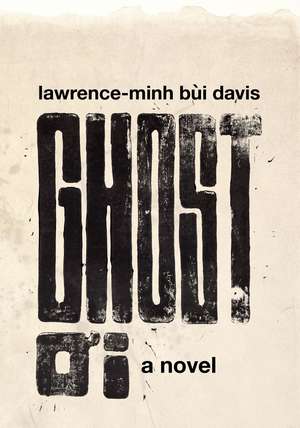
GHOST OI: a novel: Georgia Review Books
Autor lawrence-minh bùi davisen Limba Engleză Paperback – mar 2027
It’s a book of hidden histories and the lonely work of recovering queer ancestry forgotten since precolonial times. It’s also a book of ceding control, accepting limits of knowing for narrator and reader alike: All the ghosts of the novel are “channeled” not by the author but by other viet diasporic writers and artists—Ocean Vuong, Cathy Linh Che, Monique Truong, Mimi Khúc, among others—then incorporated into the book without questions or edits. The ghosts simply appear, and we have to figure out how to make sense of them or live with the possibility of never being able to. The result is a reimagining of refugee life and death and of what it means to commune, in broken language, with our ghosts.




Preț: 196.29 lei
Precomandă
Puncte Express: 294
Carte nepublicată încă
Livrare prin curier în România Precomanda se expediază când titlul devine disponibil.
Transport gratuit de la 400.00 lei Plată online sau ramburs, în funcție de opțiunile comenzii.
Retur gratuit în 14 zile Comandă securizată și suport în română.
Doresc să fiu notificat când acest titlu va fi disponibil:
Se trimite...
Specificații
ISBN-13: 9781496250650
ISBN-10: 1496250656
Pagini: 520
Ilustrații: 98 illustrations
Dimensiuni: 178 x 254 mm
Editura: Nebraska
Colecția University of Nebraska Press
Seria Georgia Review Books
Locul publicării:United States
Notă biografică
lawrence-minh bùi davis is a refugee diaspore, curator, editor, writer, and troublemaker who lives as a guest on the ancestral lands of the Piscataway Nation. He cofounded (with Gerald Maa) the arts antiprofit Asian American Literary Review and serves as editor in chief. He is cofounder of the Asian American Literature Festival, the AALF Collective, and the Center for Refugee Poetics. GHOST ƠI is his debut novel.
Extras
JOURNAL 1
Không trông mong giúp thì sẽ không thất-vọng
—Painted on a rooftop in Village de L’est, Ninth Ward, New Orleans.
Roughly translated: “Don’t expect help, you won’t be disappointed”
There are three kinds of reporters in this world: The ones who work at medium-sized
papers and think they’re a big fucking deal, the ones who work at major newspapers
and know they’re a bfd, and the ones who work at a paper where the editor-in-
chief, advice columnist, and janitor are all a dude named Hùng.
That’s the breakdown on the current junket at least. I’m in the third category. It’s
November 2005, and I’m on assignment, reporting on the aftermath of Hurricane
Katrina for the Vietnamese American Gazette. There’s a huge viet population down in
nola, so we’re all here, all the viet papers. I’m traveling with the big fish—reporters
from the Orange County papers, one each from Houston, Northern Virginia, and
Bay Area papers, and a Viet One Channel tv correspondent. We even have a helicopter,
or rather the gentleman from the Viet One Channel has one, and he’s kindly
let the rest of us tag along.
Not one of us—probably not one member of the viet diaspora anywhere—misses
the connection between this disaster and the exodus of boat people out of postwar
Vietnam between the 1970s and 1990s. That’s why we’re here, really—why this is news
news. Water to water, tragedy to tragedy, and again, in death, find life.
To say the devastation is indescribable is to accept the age-old maxim about the
incommensurability of language and experience. It’s the path most taken by a good
many reporters and the majority of emergency responders and politicians. “Too
much to take in.” “Incomprehensible.” “Beggars description.” It’s also the easy way out.
Our helicopter is a Bell 206l3 Long Ranger, sleek black with massive horsepower
and state-of-the-art flir video equipment. My colleagues are Mr. Bảo, fifty-four,
heavyset, raspy, cranky; Mr. Đê, sixty-six, lanky and dressed like a dandy; Mr. Giang,
forty-nine, elegant, smooth, and, not so secretly, a very angry person; and three other
guys whose names I haven’t gotten yet. I’m the only woman of the group. My name
is Karen Nguyễn. Reformed smoker, no kids, unmarried, twenty-nine this month.
According to our pilot, the black water once stretched as far as the eye can see,
eventually draining to leave pretty much the tableau we find now: abandoned cars
and toppled trees framing an unending procession of broken buildings. Ahead on
the left is a destroyed townhouse complex. On the right is a destroyed elementary
school. Behind the school is a field of shanties made of tarpaulins held up by what
look like soccer goals and uprooted signposts. I’m not a quarter of the way through
the landscape below us, let alone what lies out of view . . . Maybe the devastation is
indescribable.
An hour later, we touch down on a helipad on the north side of downtown. My
colleagues are clamoring over what restaurant to visit tonight. It’ll be dark in less
than five minutes, and I’d like to throw up discreetly in a trash can somewhere. I walk
to the edge of the roof and look down. I can see into an alley, and after a moment,
I realize I’m looking at a leg walking back and forth.
Two days later, Mr. Đinh, a reporter from Houston, will tell me that his son is here
somewhere, his adopted son, and I’ll think back to the severed leg.
“Not really adopted, you know? Just so we could bring him over, legally, we sign
some paper. He living down here, cut hair for a job. He have two step-kid.
He been missing since the first day. He is why I take the assignment.”
The leg is just a lower leg, ending at the knee. It walks slowly from one side of the
alley to the other, never pausing, and its persistence is Mr. Đinh’s sorrow. I listen to
him talk about his adopted son without knowing quite what to say. There are ghosts
everywhere here. I’m not imagining the leg, though it’d be simpler if I were.
Recenzii
“A scintillating and daring debut of enormous heart and power, the novel looks at the entanglement of historic hauntings and forges new ghosts from which we might know ourselves, our pasts, and reckon with each other through tender, undeniable grace.”—Ocean Vuong, author of On Earth We’re Briefly Gorgeous and The Emperor of Gladness
“This is queer auto-ghost-busting-fiction. I love the hauntingness of the work. For better or worse, our ghosts stay with us.”—Karen Tei Yamashita, Lifetime Achievement Awardee from the National Book Foundation
“lawrence-minh bùi davis has written a tender, generous novel teeming with ghosts. Reporter Karen Nguyễn covers Hurricane Katrina for her father’s community newspaper but has to move on when she realizes there’s so much more to see, say, and feel than a newspaper can cover. She begins practicing a martial art called khí công and finds out that Vietnamese shamanism lives on in the queer diaspora. She befriends an eccentric auntie who cares for her community through an empire built on drycleaning. She tracks the vicious activities of the Ku Klux Klan against Vietnamese fishers in Galveston, Texas. Through letters to her newfound lover and messy yet passionate activist work with other displaced people on Indigenous lands, she struggles to figure out who she really is and what really matters. GHOST ƠI is an expansive and perceptive novel committed to the lives, loves, and losses of Vietnamese Americans, imagined and voiced with ears and eyes wide open to both the living and the dead.”—Larissa Lai, author of The Lost Century and Iron Goddess of Mercy
“A cross-genre ghost story told around the decolonizing encampment fire, lawrence-minh bùi davis’s revelatory debut demonstrates the ghost work at the heart of queer, settler colonial, and refugee critique—how any uprising and raising of consciousness requires us to listen vigilantly to our already risen and always vociferous dead.”—Brandon Som, author of Tripas, winner of the Pulitzer Prize for Poetry
“With Ghost ƠI, lawrence-minh bùi davis has un/crafted a text so spectral, so responsibly in touch with the dead, it becomes a living thing, a breath beyond the ‘blurred tension between could be/never was,’ an assemblage of potential genre-becomings. And what is a genre if not a brief body we pass through to become more capable of loving, of seeing, our people? Never since the likes of Elias Khoury (allah yerhamo) have I read a work that loves, and commits its whole self to loving, so capaciously, rhizomatically, and world-endingly. It takes a truly exceptional comrade to write a text like this, as visually stunning as it is musically engaging, as selfless and life affirming as it is collaborative and visionary, as historically rooted as it is concerned with the spectral dailiness of living.”—George Abraham, author of When the Arab Apocalypse Comes to America: Poems
Descriere
GHOST ƠI is a book of recovering hidden histories and possibilities, including those of queer ancestors and shamans forgotten since precolonial times.