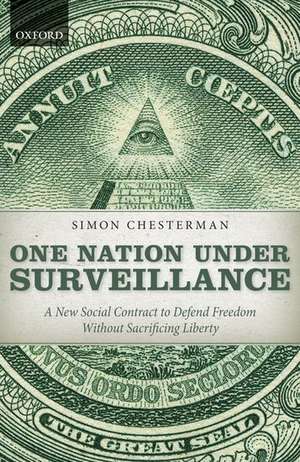
One Nation Under Surveillance: A New Social Contract to Defend Freedom Without Sacrificing Liberty
Autor Simon Chestermanen Limba Engleză Hardback – 24 feb 2011
Structura și metodologia volumului One Nation Under Surveillance sunt fundamentate pe o premisă realistă, adesea ignorată în dezbaterile contemporane: inevitabilitatea transparenței electronice. Simon Chesterman organizează materialul pornind de la eșecul vechilor regimuri juridice care separau strict supravegherea externă de cea internă, demonstrând cum tehnologia modernă a dizolvat aceste granițe. Apreciem modul în care autorul refuză să se limiteze la critica supravegherii, concentrându-se în schimb pe crearea unui cadru normativ care să protejeze libertatea într-o eră în care intimitatea, în sensul ei clasic, este în declin.
Remarcăm că lucrarea nu se concentrează pe întrebarea dacă guvernele ar trebui să colecteze informații, ci pe modul în care cetățenii, ca participanți activi, pot media acest proces. Această abordare reprezintă o alternativă necesară la Surveillance, Privacy and Security de Michael Friedewald pentru cursurile de [Politici Publice și Securitate Națională](category), având avantajul că oferă o soluție pragmatică sub forma unui nou contract social, depășind simpla analiză a perspectivei cetățeanului.
În contextul operei sale, One Nation Under Surveillance rafinează temele explorate în Law and Practice of the United Nations, unde autorul analiza limitele instituțiilor multilaterale. Aici, el aplică aceeași rigoare juridică asupra aparatelor de informații, poziționând cartea ca un pilon central în bibliografia sa academică despre autoritatea publică și protecția datelor. Stilul este analitic și lipsit de alarmism, oferind o perspectivă lucidă asupra viitorului identificării biometrice și al minării de date.
Preț: 356.94 lei
Preț vechi: 475.69 lei
-25%
Carte tipărită la comandă
Livrare economică 04-09 decembrie
Specificații
ISBN-10: 0199580375
Pagini: 312
Dimensiuni: 160 x 240 x 21 mm
Greutate: 0.61 kg
Editura: OUP OXFORD
Colecția OUP Oxford
Locul publicării:Oxford, United Kingdom
V-ar putea interesa
-
 The Tools of Government: A Guide to New GovernanceLester M. Salamon-26%Preț: 395.47 lei531.33 lei
 -
 Law & Practice of the United Nations: Documents and CommentaryThe Late Thomas Franck-31%Preț: 876.71 lei1267.41 lei
 -
 -28%Preț: 380.79 lei529.88 lei
 -
 Political Participation and Government RegulationSam PeltzmanPreț: 310.02 lei
 -
 BioregionalismMichael Vincent McGinnis-15%Preț: 616.01 lei724.71 lei
 -
 -18%Preț: 1258.30 lei1534.51 lei
 -
 The Spirit of Public AdministrationH. George FredericksonPreț: 430.97 lei
 -
 Handbook of Public Law and AdministrationPhillip J Cooper-8%Preț: 569.51 lei619.04 lei
 -
 Transforming GovernmentPatricia W IngrahamPreț: 278.17 lei
 -
 Creating High-Performance Government OrganizationsMark G PopovichPreț: 373.91 lei
 -
 Globalization and DecentralizationJong S JunPreț: 340.25 lei
 -
 Studying Law at University: Everything you need to knowSimon ChestermanPreț: 366.68 lei
De ce să citești această carte
Această lucrare este esențială pentru studenții la științe politice și drept, dar și pentru oricine este interesat de viitorul democrației în era digitală. Cititorul câștigă o înțelegere profundă a modului în care securitatea națională reconfigurează drepturile individuale. Este o recomandare fermă pentru cei care doresc să înțeleagă de ce metodele tradiționale de protecție a intimității nu mai sunt suficiente și ce mecanisme noi de control pot fi implementate.
Despre autor
Simon Chesterman este un academician australian de prestigiu, profesor de drept și decan al Facultății de Drept de la Universitatea Națională din Singapore (NUS Law). Recunoscut la nivel internațional pentru expertiza sa în drept internațional și reglementarea inteligenței artificiale, Chesterman ocupă și funcția de Senior Director pentru Guvernanța AI în cadrul AI Singapore. Cu o carieră ce include poziții de cercetare la New York University și calitatea de membru în consiliul Universității Națiunilor Unite, autorul a publicat peste douăzeci de volume academice, fiind o voce critică și avizată asupra rolului în expansiune al agențiilor de informații în societatea modernă.
Descriere
Recenzii
One Nation Under Surveillance is rich in theory and crafted with a scholarly eye. Chesterman concisely surveys the political history and jurisprudential treatment of intelligence activities, before providing an engaging comparative perspective on the flawed approaches pursued by the United States, United Kingdom and United Nations in recent times.
This is a unique work that will make for a thought-provoking addition to the reading list of any student doing political theory or international relations theory. It will be of particular interest to those students looking for a new theoretical perspective on civil rights and the Big Brother state in the post 9/11 era.
a timely examination of the theory and practice of governmental surveillance, with particular focus on the Anglophone democracies and the United Nations. One Nation Under Surveillance is a cogent contribution to the growing body of post-9/11 literature examining contemporary political developments in tension with the fundamental values of political liberalism, in this case particularly the right to privacy and due process of lawit is a welcome addition to any library and will prove to be a valuable resource for students and researchers in the area. And, it is to be hoped, for our policymakers and 'deciders'
I recommend this book to everybody interested in private civil libertiess
Chesterman's book provides a selective field guide to some of the best that has been said about intelligence and national security strained through the author's experience and legal knowledge ... a fine teaching device and is, as book blurbs say, "highly recommended".
In One Nation Under Surveillance, Simon Chesterman, a law professor at the National University of Singapore and New York University, maintains that privacy is already a dead letter, and proposes that we concentrate instead on regulating the governments use of the information it gathers, rather than futilely seeking to control surveillance itself. He argues convincingly that the specter of catastrophic terrorist attacks creates extraordinary pressure for intrusive monitoring; that technological advances have made the collection and analysis of vast amounts of previously private information entirely feasible; and that in a culture transformed by social media, in which citizens are increasingly willing to broadcast their innermost thoughts and acts, privacy may already be as outmoded as chivalry.
This book squarely faces the taboo subject of domestic privacy in an era of Islamist terrorism. Our enemies are not nation-states, so the targets of the intelligence services seeking to pre-empt terrorist attacks must be individuals. The casualty will be individual privacy. People will struggle against heightened surveillance, Chesterman notes, but the war will be lost. A must-read for anyone interested in staying current about the privacy implications of the war on terror.
This is an important book, breaking new ground in the sweep of its analysis, its analytical insights, and the policy implications it draws out. It shows just how often foreign and domestic intelligence gathering in the major democracies has been insensitive to public accountability, legality, and its consequences for individuals, to the detriment of both liberty and security and how this can and must change. Simon Chesterman writes, as always, with compelling clarity and authority.
Simon Chesterman offers a clear, thoughtful, and incisive analysis of the long-standing tension between civil liberties, on the one hand, and security against threats to the polity, on the other hand. He takes a new tact on this old dilemma by probing into the question of what governments actually do with all the information they gather on their citizens. This is an interesting and provocative book.
Simon Chesterman moves the debate on privacy beyond the question of whether the government and its intelligence services should have access to personal information to the realistic recognition that electronic transparency is here to stay. In a series of carefully articulated arguments, Chesterman outlines mechanisms that can hold governments accountable for the uses of that information. In so doing, he points the way to a twenty-first century rethinking of notions of privacy, security, and the laws that regulate them.