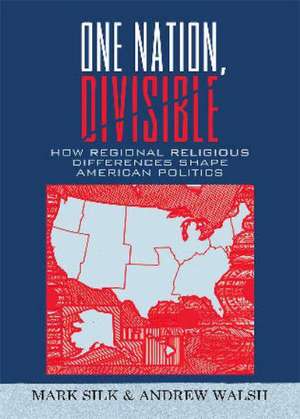
One Nation, Divisible: How Regional Religious Differences Shape American Politics: Religion by Region
Autor Mark Silk, Andrew Walshen Limba Engleză Paperback – 16 dec 2011
Preț: 277.28 lei
Preț vechi: 361.50 lei
-23%
Puncte Express: 416
Carte tipărită la comandă
Livrare economică 28 noiembrie-12 decembrie
Livrare prin curier în România Termenul estimat este afișat lângă disponibilitate.
Transport gratuit de la 400.00 lei Plată online sau ramburs, în funcție de opțiunile comenzii.
Retur gratuit în 14 zile Comandă securizată și suport în română.
Specificații
ISBN-13: 9780742558465
ISBN-10: 0742558460
Pagini: 288
Dimensiuni: 148 x 226 x 20 mm
Greutate: 0.32 kg
Editura: Bloomsbury Publishing
Colecția Rowman & Littlefield
Seria Religion by Region
Locul publicării:New York, United States
ISBN-10: 0742558460
Pagini: 288
Dimensiuni: 148 x 226 x 20 mm
Greutate: 0.32 kg
Editura: Bloomsbury Publishing
Colecția Rowman & Littlefield
Seria Religion by Region
Locul publicării:New York, United States
Descriere
From the evangelical South to Catholic New England to the 'unchurched' Pacific Northwest, regional religious differences have a dramatic impact on public life not only in the regions themselves but also in the United States as a whole. As the interplay between religion and politics continues to dominate public discussion, understanding regional similarities and differences is key to understanding the debate around such national issues as health care, immigration, and the environment. For the first time, One Nation, Divisible shows how geographical religious diversity has shaped public culture in eight distinctive regions of the country and how regional differences influence national politics.
Examining each region in turn, Mark Silk and Andrew Walsh provide historical context, stories that reveal the current cultural dynamics, and analyses of current politics to create rounded portraits of each region. They then present a compelling new account of the evolution of national religious politics since World War II. In doing so, they suggest that the regional religious forces that have fueled recent culture wars may be giving way to a less confrontational style rooted in different regional realities.
Examining each region in turn, Mark Silk and Andrew Walsh provide historical context, stories that reveal the current cultural dynamics, and analyses of current politics to create rounded portraits of each region. They then present a compelling new account of the evolution of national religious politics since World War II. In doing so, they suggest that the regional religious forces that have fueled recent culture wars may be giving way to a less confrontational style rooted in different regional realities.
Cuprins
Chapter 1: Preface
Chapter 2: Religion by Region
Chapter 3: The Middle Atlantic: Fount of Diversity
Chapter 4: New England: Steady Habits, Changing Slowly
Chapter 5: The South: In the Evangelical Mode
Chapter 6: The Southern Crossroads: Showdown States
Chapter 7: The Pacific: Fluid Identities
Chapter 8: The Pacific Northwest: The "None" Zone
Chapter 9: The Mountain West: Sacred Landscapes in Tension
Chapter 10: The Midwest: The Common Denominator?
Chapter 11: Retelling the National Story
Chapter 2: Religion by Region
Chapter 3: The Middle Atlantic: Fount of Diversity
Chapter 4: New England: Steady Habits, Changing Slowly
Chapter 5: The South: In the Evangelical Mode
Chapter 6: The Southern Crossroads: Showdown States
Chapter 7: The Pacific: Fluid Identities
Chapter 8: The Pacific Northwest: The "None" Zone
Chapter 9: The Mountain West: Sacred Landscapes in Tension
Chapter 10: The Midwest: The Common Denominator?
Chapter 11: Retelling the National Story
Recenzii
For the past several years, Mark Silk and Andrew Walsh have presided over an ambitious, richly textured study of religion and regional variations in the United States. Their findings, which are nicely distilled in this summary volume, point out the importance of geography and regional cultures in decoding both the nation's religious life and its political behavior. I commend this book to anyone seeking to understand the complex mosaic of religious life in America.
This book not only confirms what we already suspect, but goes much further in detailing regional religious differences and how they influence American politics. For general readers, the message is clear: Beware broad generalizations about religion and politics in the United States. For politicians, preachers, and pundits seeking to mobilize the populace one way or another, the message is crucial: Overlook regional views of religion and of its relation to politics at your peril.
With the clarity of its analyses and its demonstration of how important the nation's diverse religious regions are-for social mores, for politics, for religion itself-One Nation, Divisible is a splendid and much-welcomed study.
The authors create a most compelling mosaic of this phenomenon through their use of history and personal stories. Excellent notes, bibliography, index. Recommended.
Includes a fascinating final chapter that revisits American history through the prism of regional religious affiliation. This scholarly work will appeal mostly to historians and political scientists, but it will also inform citizens and officials who want to gain insight into the often ignored role of religion in American society.
One Nation, Divisible is a masterful account of the potent nexus of religion and region in the United States. Silk and Walsh offer an insightful retelling of the American national story through the lenses of piety and place.
It doesn't happen very often but on occasion books surprise and even delight you for their perspicuity, and the persuasive nature of their argument. Mark Silk and Andrew Walsh's One Nation, Divisible: How Regional Religious Differences Shape American Politics does just that. Regional differences in religion and politics matter in America, but showing it and doing it with data, interpretation and occasional pithiness is welcome. I found Silk and Walsh's analysis fresh, unique, and determinative for the case that they make: regional differences matter, both in terms of religious majorities in each region and the unique regional and cultural ecologies.
Mark Silk and Andrew Walsh's excellent One Nation, Divisible presents a valuable corrective should any of us forget the reality and importance of regionalism in American religion or regionalism's consequences for religion and politics and politicians. The authors' regionalist perspective is fascinating, and it is a pleasure to read how fully and skillfully these articulate authors develop this theme in their book.
This book not only confirms what we already suspect, but goes much further in detailing regional religious differences and how they influence American politics. For general readers, the message is clear: Beware broad generalizations about religion and politics in the United States. For politicians, preachers, and pundits seeking to mobilize the populace one way or another, the message is crucial: Overlook regional views of religion and of its relation to politics at your peril.
With the clarity of its analyses and its demonstration of how important the nation's diverse religious regions are-for social mores, for politics, for religion itself-One Nation, Divisible is a splendid and much-welcomed study.
The authors create a most compelling mosaic of this phenomenon through their use of history and personal stories. Excellent notes, bibliography, index. Recommended.
Includes a fascinating final chapter that revisits American history through the prism of regional religious affiliation. This scholarly work will appeal mostly to historians and political scientists, but it will also inform citizens and officials who want to gain insight into the often ignored role of religion in American society.
One Nation, Divisible is a masterful account of the potent nexus of religion and region in the United States. Silk and Walsh offer an insightful retelling of the American national story through the lenses of piety and place.
It doesn't happen very often but on occasion books surprise and even delight you for their perspicuity, and the persuasive nature of their argument. Mark Silk and Andrew Walsh's One Nation, Divisible: How Regional Religious Differences Shape American Politics does just that. Regional differences in religion and politics matter in America, but showing it and doing it with data, interpretation and occasional pithiness is welcome. I found Silk and Walsh's analysis fresh, unique, and determinative for the case that they make: regional differences matter, both in terms of religious majorities in each region and the unique regional and cultural ecologies.
Mark Silk and Andrew Walsh's excellent One Nation, Divisible presents a valuable corrective should any of us forget the reality and importance of regionalism in American religion or regionalism's consequences for religion and politics and politicians. The authors' regionalist perspective is fascinating, and it is a pleasure to read how fully and skillfully these articulate authors develop this theme in their book.